At nine months, sunscreen is squarely appropriate for your baby. The NHS advises a sunscreen of at least SPF 30 with at least 4-star UVA protection, reapplied every two hours and straight after water or towel drying even if the bottle says water resistant — and the AAP says that from six months you apply it to all exposed areas, being careful around the eyes.
The bottle, though, is the last line of defence, not the first. On an Indian beach, timing, shade and clothing do most of the work.
Not medical advice — consult your pediatrician for guidance specific to your baby.
The "not under six months" rule, and why people will repeat it to you
You will hear this at least twice before you reach the coast, so it helps to know what it actually says. Under six months, the AAP's position is to use sunscreen only on small areas of the body, such as the face, when protective clothing and shade are not available. It was never "sunscreen is poisonous for babies" — it was "shade and cloth first, and a dab of cream where you genuinely cannot cover".
The reasoning is about skin, not chemistry. Infant skin has a thinner, less compact outer layer with more water in it, which makes it more permeable and a weaker barrier than adult skin through the first year. A review of UV filters adds that young children also have a higher skin-surface-area to body-weight ratio, which puts them at risk of absorbing more of what goes on, so the best practice under six months is shade plus lightweight sun-protective clothing.
Your baby is nine months old. That guidance has already handed the decision back to you.
What the sun is actually doing at an Indian beach
This is the part that changes the plan. Measurements over India's four biggest metros put the UV Index between 9 and 13 — the very high to extreme band for damage from uncovered sun exposure. For context, WHO's UV Index guidance says the risk of skin damage is already increased, and protective measures already recommended, from the middle of the scale upward.
Three things make a beach worse than your balcony:
- Sand reflects about 15 per cent of the UV falling on it and sea foam about 25 per cent, against under 10 per cent for grass or soil — so a baby under a beach umbrella still catches UV bouncing up off the sand.
- UV levels rise with how high the sun sits in the sky, and stay high even under cloud cover — an overcast Goa afternoon is not a safe afternoon.
- WHO's advice is to keep babies under 12 months in the shade, and it is explicit that sunscreen must not be used to extend time in the sun, because it delays sunburn without blocking UV.
The practical version: plan beach time for early morning and late afternoon. The FDA's advice is to limit time in the sun especially between 10 a.m. and 2 p.m., when the sun's rays are most intense — in September on the Konkan or Kerala coast, treat that whole block as room, lunch or shaded-pool time. That single decision protects your baby more than any upgrade in SPF.
Choosing a bottle: criteria, not brands
Every sunscreen sold in India will tell you it is "for babies". These are the things actually worth checking on the back label, and they apply to any bottle at any price.
| What to look for | Why it matters |
|---|---|
| SPF 30 or higher | The NHS floor for meaningful UVB protection |
| UVA protection stated (star rating, "UVA" in a circle, or "broad spectrum") | SPF alone only describes UVB |
| Zinc oxide or titanium dioxide as the active filters | The two filters regulators have the most safety data on |
| A stated water-resistance time (40 or 80 minutes) | Tells you when to reapply, honestly |
| Fragrance-free, and a small patch test at home first | Cheaper than discovering a reaction on holiday |
Two labels deserve a straight explanation.
"Water resistant" does not mean waterproof. The FDA requires a water-resistant sunscreen to state whether it stays effective for 40 or 80 minutes of swimming or sweating, says plainly that there is no such thing as waterproof sunscreen, and advises reapplying at least every two hours and more often when swimming or sweating. Forty minutes is one splash-about, not an afternoon.
"Broad spectrum" is the phrase to hunt for. SPF is a UVB number. If the label does not separately promise UVA cover, you have bought half a sunscreen.
Mineral or chemical: what the evidence does and does not say
Mineral filters (zinc oxide, titanium dioxide) sit on the skin and scatter light. Organic — commonly called chemical — filters absorb it. Most paediatric sources lean mineral for babies, and there is a defensible reason for that, but it is not the horror story the internet sells.
| Mineral (zinc oxide, titanium dioxide) | Organic / "chemical" filters | |
|---|---|---|
| How it works | Sits on the surface, scatters and absorbs UV | Absorbs UV within the skin |
| Regulatory position | Enough safety data to be proposed as generally recognised as safe and effective | Several filters flagged as needing more data |
| Feel | Thicker, can leave a white cast | Lighter, rubs in clear |
| Best for | Babies, toddlers, reactive skin | Older children and adults who will actually reapply |
Here is the honest read. The FDA's proposed sunscreen order found sufficient safety data on zinc oxide and titanium dioxide at up to 25 per cent to propose them as generally recognised as safe and effective, while several organic filters were flagged as needing more data — and the FDA states that this is not a conclusion that those ingredients are unsafe. "We need more data" and "this is harmful" are different sentences.
A 2019 randomised trial in JAMA did find that four common organic filters reached blood levels above the 0.5 ng/mL threshold that triggers further safety testing — and the authors wrote, in the same paper, that the results do not indicate people should refrain from using sunscreen. What was shown is absorption. What was not shown is harm. Given that gap, and given a baby's thinner skin and higher surface-area-to-weight ratio, choosing mineral for a nine-month-old is a reasonable, low-cost hedge — not a rejection of the alternative.
How much, and how often
Under-application is the single biggest reason sunscreen disappoints, and almost nobody is told the number. SPF is measured in the lab at 2 mg of product per square centimetre of skin, but studies of real-world use put actual application between 0.2 and 1.27 mg/cm2. Apply a quarter of the tested dose and you are not wearing the SPF on the bottle.
What that means at the beach:
- Put on far more than looks necessary. Two passes — a layer, then a second layer over it — gets closer to the tested dose than one careful smear.
- Do it in the room, on a dry, still baby — MedlinePlus advises applying about 30 minutes before going outdoors for best results. Sand and a wriggling nine-month-old make thorough coverage impossible.
- Cover the spots everyone misses: ears, the tops of the feet, the back of the neck, the hairline and the backs of the knees.
- Reapply every two hours, and straight after water or towel drying even if the bottle says water resistant — towelling physically wipes it off.
Hats, clothing and shade do the heavy lifting
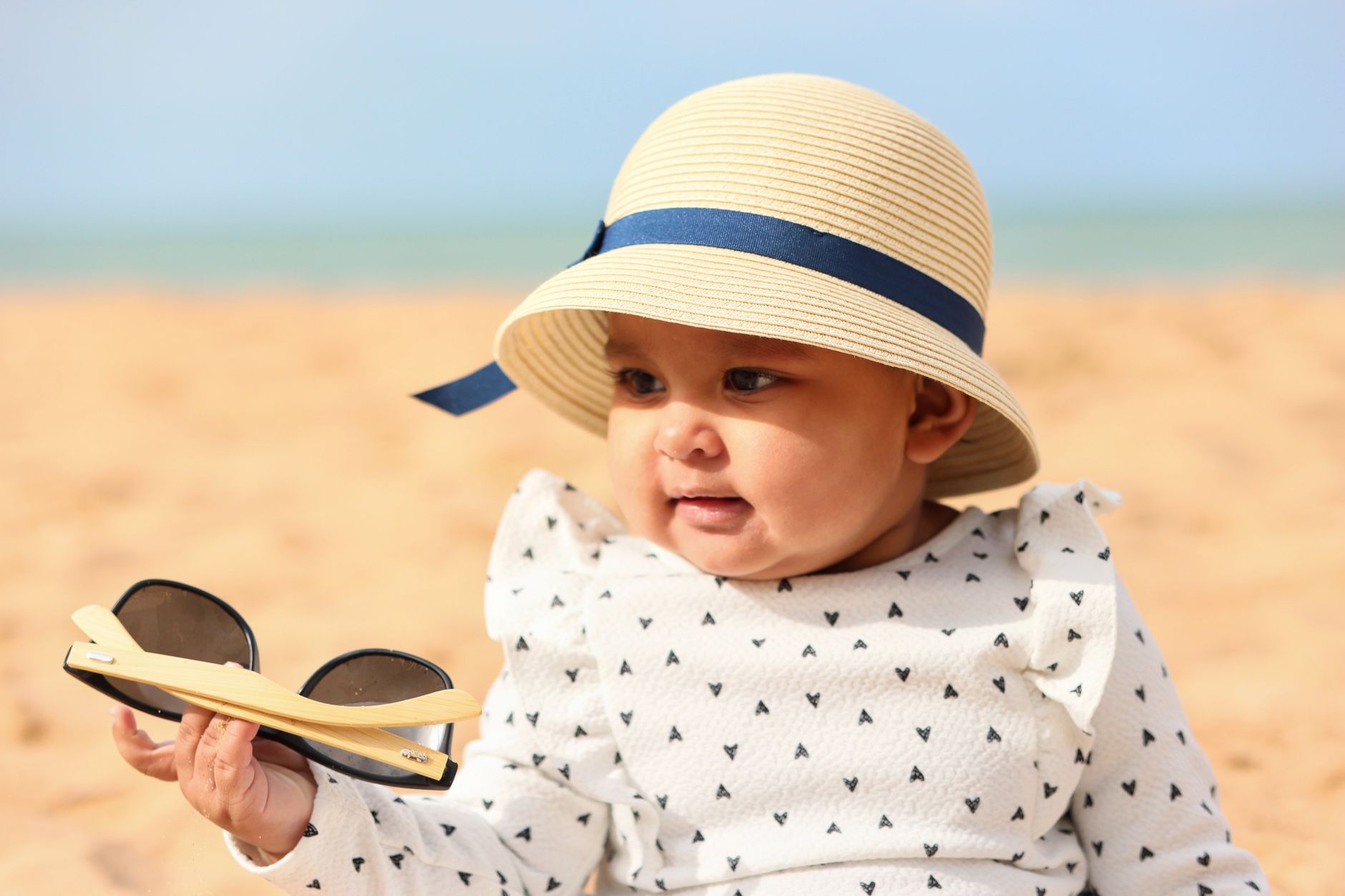
A rash guard is easier to apply than sunscreen and it never rubs off. Clothing rated UPF 15 blocks about 93 per cent of UV, UPF 30 about 97 per cent and UPF 50+ over 98 per cent, and darker, tightly woven fabrics protect better than thin white ones. A long-sleeved swim top, a wide-brimmed or legionnaire hat and a shaded pram or beach tent will out-perform any bottle you can buy in India.
That is also why WHO's advice for babies under 12 months is simply to keep them in the shade: the goal is to reduce the UV reaching the skin, and cloth is a more reliable way to do it than cream on a squirming baby.
"But she needs sun for vitamin D"
Someone will say this. The nuance is worth having ready.
Vitamin D deficiency is widely prevalent in India despite plentiful sunshine, partly because more melanin in darker skin acts as a natural sunscreen and produces less vitamin D, partly because widely eaten foods such as dairy are rarely fortified here. In other words, the country with the most sun still has the deficiency — unprotected beach time was never the fix.
The fix is a supplement. The AAP states that babies under 12 months need 400 IU of vitamin D a day, and that breastfed infants should get it as a supplement. Ask your paediatrician what your baby is already on; most Indian babies are prescribed drops from the newborn weeks. Sun protection and vitamin D are not in competition.
If she does get burnt
It happens, usually on the first day before the routine settles. The NHS advice is to cool the skin with a cool shower, bath or damp towel and apply aftersun or an unperfumed moisturiser — and to get urgent medical advice if a baby or young child is sunburnt at all, if the skin blisters or swells, or if the child is very hot, shivery, very tired, dizzy or sick. A sunburnt nine-month-old is a call to your paediatrician, not a wait-and-see.
There is a long game here too. WHO notes that children are more sensitive to UV than adults, and that sunburns at any age but especially in childhood increase the risk of developing melanoma. Every burn you prevent this trip counts for more than it feels like at the time.
The short version
Buy any SPF 30+ broad-spectrum mineral sunscreen with a stated water-resistance time. Put on twice as much as feels right, half an hour before you go out. Reapply every two hours and after every dip and towel-down. Then do the thing that matters more: keep her in a rash guard and a hat, off the sand in the middle of the day, and in the shade whenever you can.