
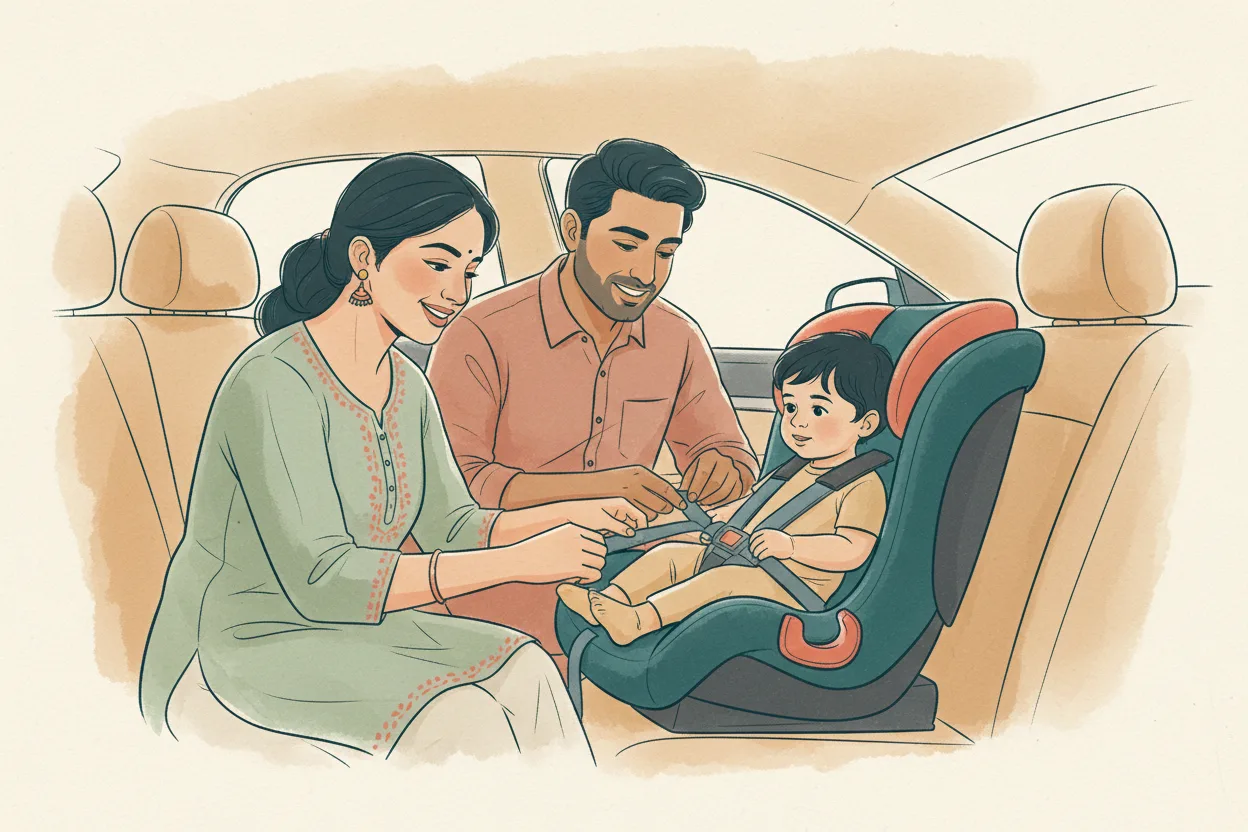
The best car seat for your baby in India is the one that matches their current age and weight, gets installed correctly every single time, and that you actually use — even for the five-minute drive to the pediatrician. The CDC reports that correct car seat use reduces the risk of injury in a crash by 71 to 82 percent compared with a seat belt alone, and that protection only holds if the seat is used, and used correctly, every time.
Not medical advice — a car seat technician or your pediatrician can help with fitting questions specific to your child or vehicle.
Why Car Seats Are a Hard Sell in Indian Homes
A five-minute trip to the temple or to grandma's house can feel too short to bother buckling in. The urge to skip the seat "just this once" is common everywhere, not only in India — but the protection a seat offers has nothing to do with how long the drive is.
The bigger obstacle is often family pressure to hold the baby in an adult's lap, especially from grandparents who travelled that way themselves and reasonably felt it was fine at the time. It helps to lead with the numbers rather than an argument: child restraints reduce the risk of death for infants in a crash by 71 percent, according to the World Health Organization — a bigger single safety gain than almost anything else you can do for your baby in the car.
ISOFIX or Seat Belt — What Actually Matters in an Indian Car
Most Maruti Suzuki, Hyundai, Tata, Mahindra, and Kia models sold in India in the last several years have ISOFIX anchor points built into the rear seats, usually tucked between the seat cushion and backrest and sometimes marked with a small seat icon. If your car doesn't have them, that isn't a dealbreaker: the American Academy of Pediatrics states that installing a car seat with the vehicle's built-in lower anchor system or with the seat belt are equally safe methods, provided the seat is installed correctly.
Installation, not the choice between ISOFIX and seat belt, is where families most often go wrong: the CDC reports that nearly half of car seats and booster seats are used incorrectly in ways that reduce their effectiveness, most commonly a loose installation or a harness or belt positioned wrong on the child. After installing, grip the seat at the belt or ISOFIX path and give it a firm push — a correctly installed seat barely shifts.
Infant Seat or Convertible Seat — Which to Buy First
An infant-only seat is rear-facing, lighter, and often clips into a compatible stroller frame — a good fit for the newborn stage when you're in and out of the car often. A convertible seat is heavier and stays fixed in the vehicle, but grows with your child from rear-facing to forward-facing, so it lasts years longer than an infant seat.
Whichever you choose, the American Academy of Pediatrics recommends keeping your child rear-facing for as long as possible, until they reach the highest weight or height allowed by that seat's manufacturer — usually well past their first birthday, and often into the third year on a convertible seat.
The American Academy of Pediatrics also warns that a rear-facing seat must never go in a front seat with an active passenger airbag — in most Indian cars this settles the question anyway, since front passenger airbags are now standard on the large majority of new cars sold here, and the back seat is the correct place for any rear-facing seat.
Eventually your child moves to a forward-facing harness and then a booster. The American Academy of Pediatrics states that children should stay in a belt-positioning booster seat until they can fit an adult seat belt properly, typically around 4 feet 9 inches in height and 8 to 12 years of age — later than most Indian parents assume for "graduating" out of a seat altogether.
| Seat type | Best for | Typical price (India) |
|---|---|---|
| Infant-only (rear-facing) | Newborn to ~12–15 months, portable | Rs. 8,000 – Rs. 18,000 |
| Convertible (rear- and forward-facing) | Birth to ~4–6 years, one seat for longer | Rs. 12,000 – Rs. 30,000 |
| Booster (belt-positioning) | Once forward-facing harness is outgrown, until the adult belt fits | Rs. 3,500 – Rs. 9,000 |
Never Buy a Secondhand Car Seat
Car seats show up often on resale apps and in parent groups at a steep discount. Resist it: the NHS advises that parents should never buy a secondhand car seat, since it could have been damaged in a previous crash and may be missing parts or instructions. You cannot see structural damage to the shell or straps just by looking at a seat, and a missing manual means you could install it wrong without ever knowing it. Buy new, or accept a used seat only from a family member whose crash history you know first-hand.
Making the Case to Skeptical Grandparents
If a grandparent wants to hold the baby "just this once" instead of buckling them in, numbers tend to land better than arguments. Correct car seat use lowers the risk of injury in a crash by 71 to 82 percent compared with a seat belt alone, reports the CDC, and child restraints specifically cut the risk of infant death by 71 percent, according to the WHO. Framing it as guidance from established health authorities — not a modern-parenting trend — tends to land better with someone who travelled with babies on their lap for decades without incident.
A practical middle ground that avoids the argument entirely: install the seat and buckle the baby in before anyone else gets in the car, so it becomes the default rather than a decision made under time pressure at the door.
Products Worth Considering
| Product | Price Range | Where to Buy |
|---|---|---|
| Infant car seat (rear-facing, stroller-compatible) | Rs. 8,000 – Rs. 18,000 | Amazon.in / FirstCry |
| Convertible car seat (ISOFIX + seat belt install) | Rs. 12,000 – Rs. 30,000 | Amazon.in / FirstCry |
| Belt-positioning booster seat | Rs. 3,500 – Rs. 9,000 | Amazon.in / FirstCry |
Frequently Asked Questions
Is ISOFIX compulsory in an Indian car seat? No — a car seat installed correctly with the vehicle's seat belt works just as well. The American Academy of Pediatrics states plainly that the seat belt and the built-in lower anchor system are equally safe installation methods, as long as the seat is installed correctly. Use whichever your car and seat support and double-check the fit.
Should I buy an infant seat or go straight to a convertible? Either can be correct. An infant seat is easier to carry in and out for the newborn stage; a convertible seat costs more upfront but covers years of growth in one purchase, since it can stay rear-facing well past the first birthday, per AAP guidance.
When can my child stop using a booster seat? Typically once they reach about 4 feet 9 inches in height and are between 8 and 12 years old, per the AAP — the real test is whether the adult seat belt sits low across their hips and snug across their shoulder, not their age alone.
Is a secondhand car seat ever okay? Health authorities advise against it in general, since crash damage isn't always visible. A seat from a trusted family member whose driving history you know is the only exception worth considering — a seat of unknown history from a resale app or stranger is not.
Our only car doesn't have a front passenger airbag switch — is the back seat still required? Yes for a rear-facing seat regardless: an active front passenger airbag and a rear-facing car seat must never be in the same seating position. Put any rear-facing seat in the back seat.
How do I get grandparents on board without a fight? Demonstrate it in practice rather than debate it. Buckle the baby in before they get in the car so it's simply how the family travels, and mention that the practice is backed by both American and global health bodies rather than presenting it as your personal rule.