
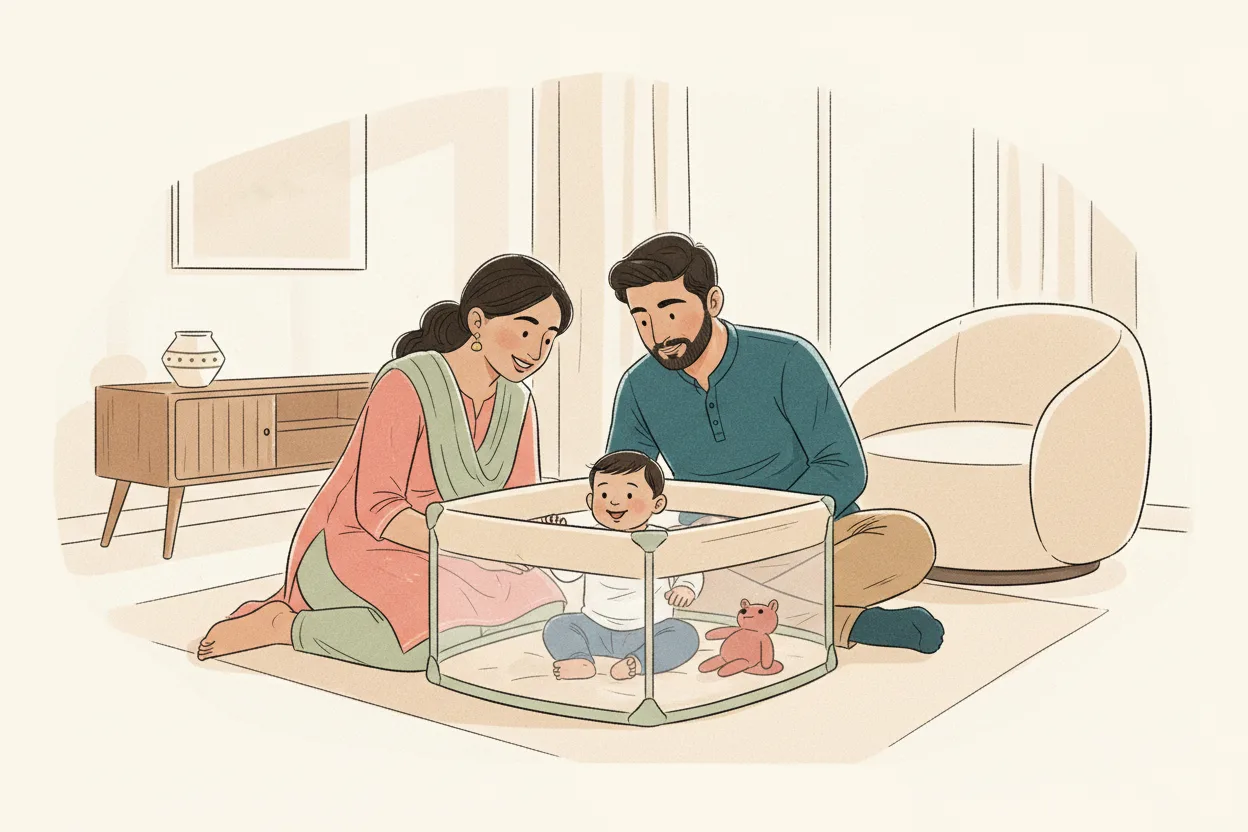
A playpen gives you one enclosed, predictable spot to put your baby down for a few minutes — brushing your teeth, plating lunch, answering the door — instead of carrying them from room to room. It buys you those minutes; it doesn't buy you an unattended nursery. Nemours KidsHealth notes that playpens are no substitute for adult supervision, and a child should never be left unattended in one, even briefly.
Not medical advice — consult your pediatrician for guidance specific to your child.
Mesh vs Wooden vs Foldable — What Fits a Small Apartment
The right type depends less on brand and more on how much floor space you can permanently give up, and whether you're renting.
| Type | Best for | Footprint | Typical price (India) |
|---|---|---|---|
| Mesh (fabric/nylon, folds into a bag) | Renters, 1–2BHK homes, travel and grandparents' houses | Collapses flat, easiest to stash in a cupboard | Rs. 3,500 – Rs. 7,000 |
| Wooden (fixed or hinged panels) | A dedicated corner in a living room or nursery you're keeping long-term | Bulkier, usually stays assembled | Rs. 5,000 – Rs. 12,000 |
| Interlocking foldable (plastic/rubber panels) | Flexible shapes — can wrap a corner, or double as a room divider | Flat panels stack against a wall when not in use | Rs. 2,500 – Rs. 6,000 |
A mesh playpen is the practical default for most Indian apartments — it goes up for the afternoon and disappears into a cupboard for guests or a puja at home. Wooden playpens make more sense if you have a spare corner you're happy to dedicate permanently, since they're heavier to move around. Interlocking panel sets sit in between: less portable than mesh, but you can reshape them around an odd-shaped living room.
Safety Checks Before You Buy
Whatever type you pick, check three things on the listing before you order — not just the price and the photos.
Gap size. The American Academy of Pediatrics (HealthyChildren.org) advises that a safe playpen's mesh openings are less than 1/4 inch (0.6 cm) across, so your baby's fingers and clothing buttons can't get caught in the weave. Skip any mesh that looks loose or stretchy enough to poke a finger through easily.
Height and age range. The US Consumer Product Safety Commission (CPSC) states that a playpen is primarily intended for children under about 35 inches tall who cannot yet climb out of it. Once your child passes that height, or you catch them getting a leg over the rail, it's time to retire the playpen — no listing's suggested age range overrides what your own child is actually doing.
Toys you put inside. Treat the toy basket the way you'd treat a crib. The American Academy of Pediatrics advises avoiding toys with small or detachable parts, and keeping other small household items out of reach of infants and young children, since these are choking hazards.
Where you put it. Set the playpen up away from any window. The American Academy of Pediatrics (HealthyChildren.org) advises keeping a crib or child's bed away from windows, since a nearby blind or curtain cord is a strangulation hazard — the same logic applies to a playpen, especially one you also use for naps.
What Goes In, and What Doesn't
A playpen is for supervised awake time, not for solving nap logistics with extra padding.
If you also use it for a daytime nap, keep the base firm and flat. The American Academy of Pediatrics recommends keeping soft objects and loose bedding out of a baby's sleep area — this includes pillows, quilts, comforters, non-fitted sheets, and bumper-type products, all of which raise the risk of entrapment, suffocation, or strangulation.
Skip the extra blanket even if the room feels a little cool. NICHD's Safe to Sleep campaign states that overheating from excessive clothing or blankets, and a too-warm room, is associated with increased SIDS risk — dress baby for the room, not for "just in case."
When to Start, and When to Stop
Most families introduce a playpen once baby can sit with some support and prop themselves up. The CDC's Learn the Signs. Act Early. milestone checklist states that by around 6 months, babies typically lean on their hands to support themselves when sitting — that's the stage many parents start supervised, seated floor play in a playpen, rather than only holding baby or using a bouncer.
On the other end, the CPSC's height-and-climbing rule above is the real stop signal: once your toddler is climbing, standing and rocking the panels, or has topped 35 inches, the playpen has done its job and it's time to move on to gated-room or open-floor supervision instead.
Is a Playpen Actually Worth It?
This is the real question for most first-time buyers, and it comes down to your home layout rather than any safety verdict.
A playpen earns its keep when there's no single room you can fully baby-proof on its own — a shared living-dining space, a rented flat where drilling socket covers or furniture straps into every wall is off the table, or a joint-family home where the living room stays a common space all day. It gives you a contained zone in the middle of a room everyone else is also using.
Baby-proofing one whole room instead can work out better if you do have a spare room or a nursery corner you're willing to dedicate: corner-guard the furniture, cover the sockets, anchor anything that could tip, and baby gets to crawl freely rather than being fenced into a smaller footprint. It's more setup work upfront, but it scales better as baby starts crawling further and needs more room to move.
Many families end up doing both in sequence — a playpen for the newborn-to-crawling stage when a contained spot is genuinely useful, then a baby-proofed room once baby is mobile enough that a small enclosure starts to feel restrictive.
Where to Buy
| Product | Price Range | Where to Buy |
|---|---|---|
| Mesh travel playpen | Rs. 3,500 – Rs. 7,000 | Amazon.in / FirstCry |
| Wooden playpen | Rs. 5,000 – Rs. 12,000 | Amazon.in / FirstCry |
| Interlocking foldable playpen | Rs. 2,500 – Rs. 6,000 | Amazon.in / FirstCry |
Search current listings rather than fixing on one brand, since models and stock change often — check the mesh gap, the stated height limit, and the base material (a padded, wipeable base is easier to keep clean than bare fabric) before you order.
Frequently Asked Questions
Can I leave my baby in the playpen while I shower or cook? Only for the length of time you can still hear and check on them, and only once they're old enough that a fall or climb-out isn't a risk yet. Nemours KidsHealth is clear that a playpen is no substitute for supervision — never leave a child unattended in one.
What mesh gap size should I check for on a listing? Less than 1/4 inch (0.6 cm) across. The AAP's playpen safety guidance uses this exact measurement so fingers and buttons can't get caught in the weave — measure it yourself on delivery rather than trusting the listing photo.
When should I stop using a playpen? Once your child passes about 35 inches tall or starts climbing out, per the CPSC's play yard standard — whichever happens first, regardless of the age printed on the box.
Is it okay to let my baby nap in the playpen? Yes, as long as the base is firm and flat with no pillows, quilts, bumpers, or loose bedding, per AAP safe-sleep guidance, and the room isn't overheated, since NICHD links overheating to higher SIDS risk.
At what age can I start using a playpen for supervised play? Many families start around 6 months, when the CDC's milestone checklist notes babies typically lean on their hands to support seated play — before that, most babies aren't yet steady enough to make independent seated play worthwhile.
Do I need to worry about the toys I put inside? Yes. The AAP advises avoiding toys with small or detachable parts and keeping other small objects out of reach, since these are choking hazards for infants and young children — check every toy that goes in the same way you'd check one going into a crib.
Does it matter where in the room I set up the playpen? Yes — keep it away from windows. The AAP notes that a nearby blind or curtain cord is a strangulation hazard for a crib or child's bed, and the same caution applies to a playpen.