
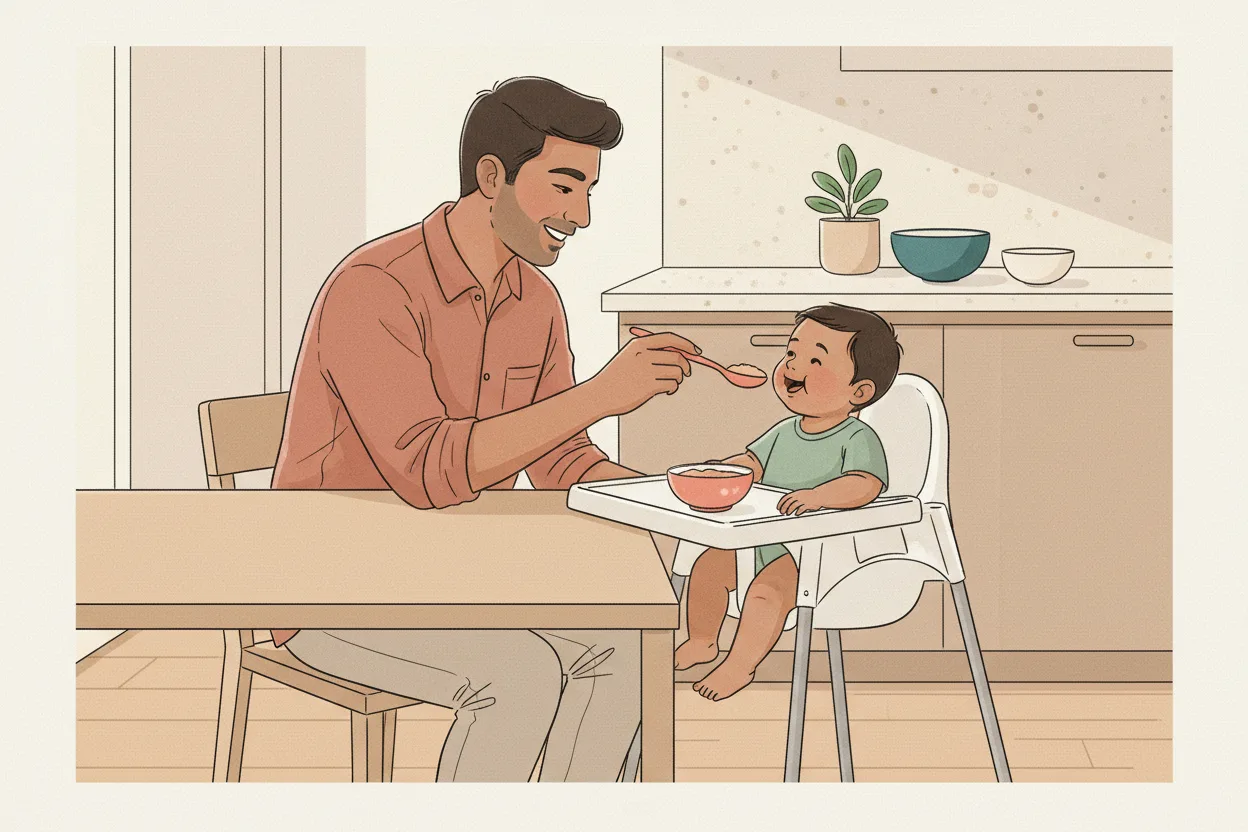
For most Indian families, the IKEA Antilop (around Rs. 1,499 for the chair and tray) is the best budget high chair — it's light enough to carry between rooms, wipes clean in seconds, and costs less than most local alternatives once you add up what those are missing. The catch is comfort: the hard plastic seat has no footrest built in, so budget an extra Rs. 300–500 for one before mealtimes get long.
Not medical advice — consult your pediatrician for feeding or development concerns specific to your baby.
Why This Decision Matters More in India
The Indian Academy of Pediatrics' parent guideline states that you should start complementary feeds only after your baby completes 180 days — six months — of age. That's roughly when regular high-chair mealtimes begin for most Indian babies, since before then feeding is milk-only and doesn't need a chair at all.
It also means you have time to shop carefully instead of grabbing whatever's in stock at the last minute. A high chair in an Indian home tends to see years of use — through grandparents' visits, a nanny or domestic help feeding the baby, and eventually as a regular chair for toddler meals at the family table — so the choice is worth thinking through once rather than replacing a wobbly one soon after.
Safety Comes Before Comfort
Whatever chair you pick, a few things matter more than price. AAP's HealthyChildren.org advises using the safety straps — including the crotch strap — every single time your baby is in the chair, and never leaving them unattended in it, even for a moment. Whoever is feeding — you, your partner, a grandparent, or house help — should know this is non-negotiable, not optional on "easy" days.
Before you start spoon-feeding solids at all, AAP's HealthyChildren.org notes your baby should have good head and neck control and be able to sit supported in a high chair. If your baby still slumps or needs constant propping up, hold off a couple more weeks — the chair should support good posture, not substitute for it.
Sitting your baby down to eat, rather than letting them wander around with food in hand, also matters for safety. AAP's HealthyChildren.org advises that children eat at the table or sit down when they eat, with an adult actually watching the whole meal — not glancing over from the sink every so often. That's the real job of the high chair: it keeps your baby seated, secured, and in view.
There's also an interesting posture argument for letting your baby self-feed finger foods in the chair rather than only spoon-feeding. A 2025 study in the journal Children (Basel) found that infants who self-feed typically adopt more upright postures and stay more attentive while chewing than when they're passively spoon-fed — a posture pattern linked to lower choking risk. A chair with a stable tray at the right height makes that self-feeding easier to do safely.
India doesn't yet have its own mandatory high-chair safety standard, so it helps to borrow a global benchmark when comparing budget options. The US Consumer Product Safety Commission's mandatory rule states that every high chair sold in the US must comply with ASTM F404, which covers stability, restraint systems, and structural-strength testing. When you're comparing an Antilop, an unbranded local plastic chair, and a premium option side by side, checking whether the listing even mentions ASTM (or an equivalent test standard) is a reasonable, quick proxy for how seriously the manufacturer took the build.
The Footrest Question
This is the crux of the Antilop debate, and it's worth taking seriously rather than treating as a nice-to-have. A pediatric feeding-positioning review by Redstone and West notes that providing foot support adds to a baby's overall postural stabilization during feeding — a footrest that lets your baby's feet rest flat and supported helps stabilize the pelvis and improves control at the table, which in turn makes for calmer, less messy meals.
The Antilop ships without one, and IKEA sells a matching footrest separately (roughly Rs. 300–500) that clips onto the legs. Most local budget chairs and all premium options build a footrest or adjustable footplate in from the start — so the "cheaper" local chair can work out about the same price as an Antilop-plus-footrest once you add that in, while giving your baby better support from day one.
Antilop vs Local Budget Brands vs Premium: The Comparison
| IKEA Antilop | Local budget plastic chairs | Premium (e.g. wooden grow-with-baby chairs) | |
|---|---|---|---|
| Typical price | Rs. 1,499 (chair + tray) | Rs. 1,800 – 3,500 | Rs. 14,000 – 22,000+ |
| Footrest | Sold separately (~Rs. 300–500) | Usually built in | Usually adjustable, built in |
| Tray | Included, single piece | Included, often double-layer/removable | Often sold separately |
| Recline / height adjustment | None | Some models offer 2–3 recline positions | Multiple height and depth settings |
| Material | Molded plastic, easy to wipe | Plastic, sometimes padded fabric seat | Solid wood, fabric harness |
| Longevity | Toddler years only | Toddler years only | Converts into a child/adult chair for years |
| Portability | Very light, easy to carry room to room | Bulkier, often on wheels or wider base | Heaviest, usually stays in one spot |
Padded fabric seats on local budget chairs are comfortable but harder to keep genuinely clean after every meal — a wipeable plastic seat like the Antilop's is easier to keep hygienic between feeds, which matters more in India's heat and humidity. If you do go with a padded chair, look for a removable, machine-washable cover rather than a fixed pad.
Where to Buy
The Antilop and its footrest are usually easiest to find at an IKEA store or through Amazon.in. For local budget brands, compare a few current listings on Amazon.in or FirstCry — check the photos for a five-point or crotch strap, since not all budget models show this clearly. Premium wooden chairs are widely available on Amazon.in as well, usually at a significant price jump over both other categories.
Frequently Asked Questions
At what age should I buy a high chair? There's no harm buying one early, but you'll only need it in regular use once your baby starts complementary feeding after 180 days and can sit with good head and neck control. Buying a couple of weeks before you plan to start solids is plenty of time.
Is the IKEA Antilop safe without a full five-point harness? The Antilop comes with a simple strap and crotch piece rather than a padded five-point harness. AAP's HealthyChildren.org advises always using the safety strap, including the crotch strap, every time your baby sits in any high chair — so as long as you use what it has, consistently, it meets that core requirement.
Do I really need to buy the footrest separately? It's not mandatory, but it's worth it. Postural-control research notes that foot support helps stabilize a baby's pelvis and improves control while eating, and it's a small, one-time cost compared to buying a whole new chair with one built in.
Are unbranded local high chairs as safe as the Antilop? It varies by brand and model, since India doesn't have its own mandatory high-chair safety standard the way the US does with ASTM F404. Check the strap system, tray lock, and base width in listing photos and reviews before buying, regardless of brand or price.
Can I let my baby self-feed in the high chair instead of only spoon-feeding? Yes — research shows babies who self-feed tend to sit more upright and stay more attentive while chewing than when passively spoon-fed. Just stay within arm's reach and follow standard choking-prevention guidance — sit baby down, stay seated yourself, and watch the whole meal.
Is a premium wooden chair worth it over a budget one? Only if you want it to last well beyond the toddler years and convert into a regular chair — that's the main return on the extra cost. For safety and comfort during the high-chair years specifically, a well-chosen budget chair with a footrest covers the essentials just as well.