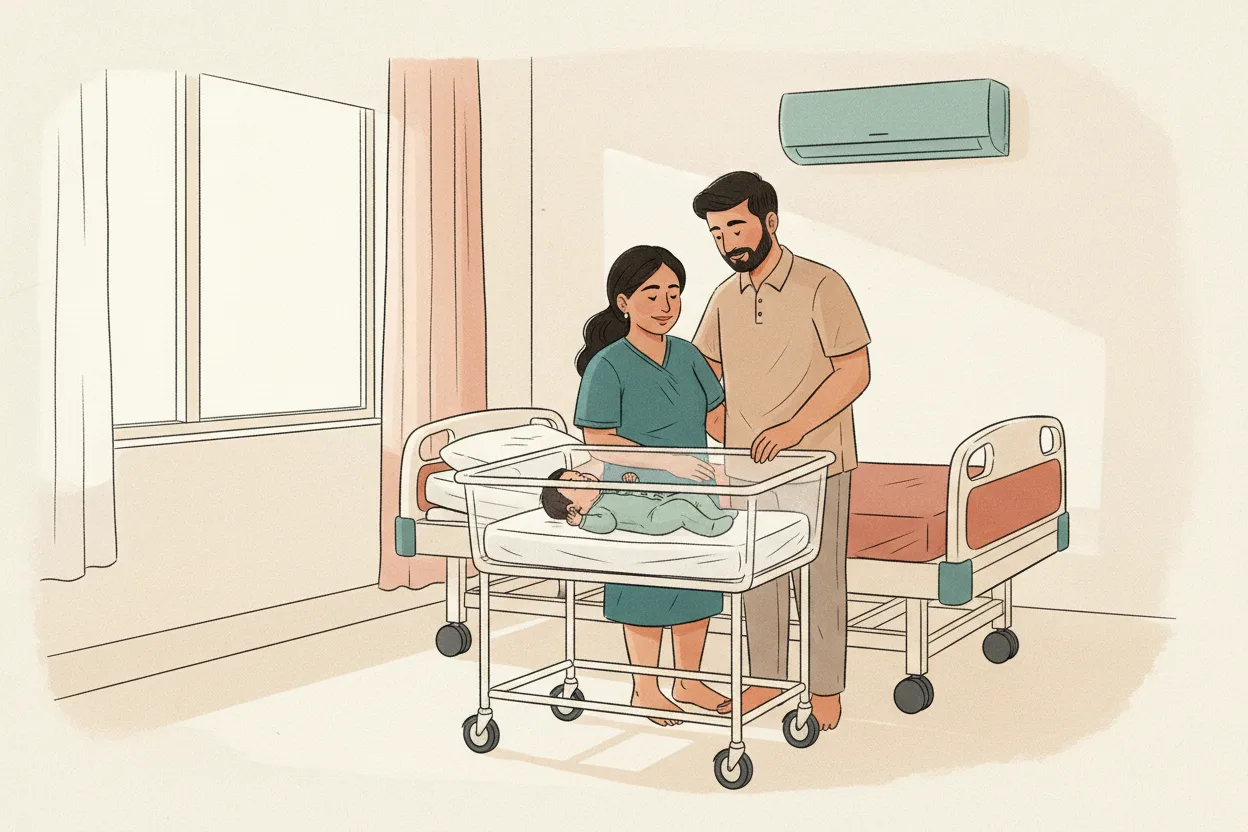

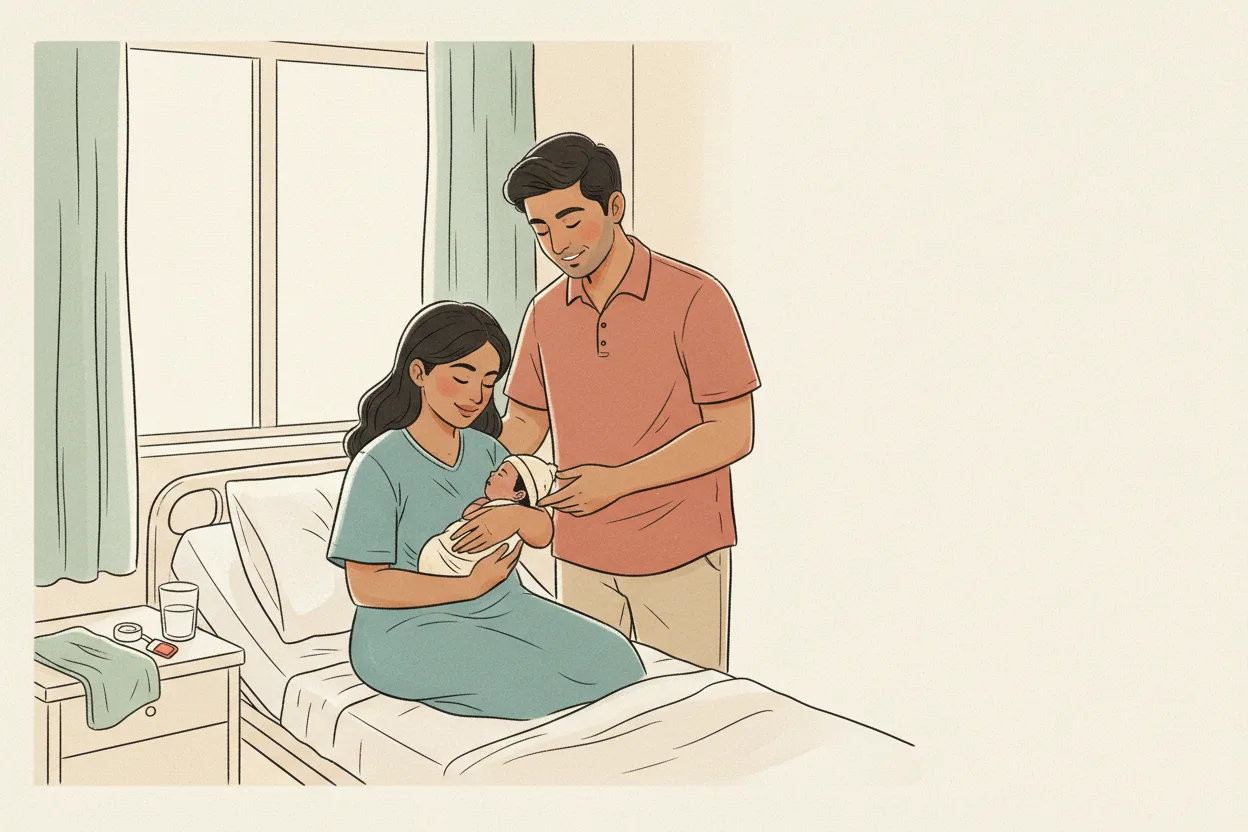
Yes — in an uncomplicated delivery you get your baby almost straight away, on your chest, before the cord is even cut, because the NHS explains that skin-to-skin contact helps regulate your baby's temperature, breathing and heart rate. The rest of that first hour is a short, fixed sequence: dry the baby, clamp and cut the cord, a quick scoring check, then weighing, a vitamin K injection and the birth vaccines. You move to your room after that.
Here is the whole thing in order, so nothing in the delivery room is a surprise.
Not medical advice — every hospital runs its own protocol. Ask your obstetrician and paediatrician what yours does.
The First Hour, Step by Step
Your baby is put on your chest. The NHS explains that skin-to-skin contact also helps regulate your baby's temperature, breathing and heart rate. It is part of the clinical care, not a photo op — which is why staff lift the baby onto you before anything else happens.
Your baby is dried, and the cord is clamped a minute or so later. A WHO brief on its postnatal care guidelines states that immediately at birth all babies should be dried thoroughly and their breathing assessed, and that the cord should be clamped and cut only after 1–3 minutes, unless the baby needs resuscitation.
That wait matters: a Cochrane review of 15 randomised trials concluded that a more liberal approach to delaying cord clamping in healthy term infants appears warranted, given growing evidence it may benefit infants' iron stores in the longer term. If your partner wants to cut the cord, this is the moment to ask.
Your baby is scored, twice. The American Academy of Pediatrics (AAP) explains that as soon as your baby is born a delivery nurse sets one timer for one minute and another for five minutes, and that most newborn infants have Apgar scores greater than 7. You will hear the numbers called out. A perfect 10 is rare; 8 or 9 is completely normal.
The first feed happens in this hour. WHO recommends early initiation of breastfeeding within one hour of birth, with the mother holding the baby on her chest in skin-to-skin contact immediately after birth. Very little may come out, and that is expected — the thick yellow colostrum comes in drops. Ask for the lactation nurse in this window, not the next morning.
The Checks and Injections in the First Day
Once the first feed is done, the paediatric team does a proper examination — usually on a warmer trolley a few feet from you, or right beside your bed.
The examination and weighing. The NHS describes the routine as your baby being examined by a midwife, neonatal nurse or paediatrician, then weighed and possibly measured, and given a wrist or ankle band with your name on it. That band, plus a matching one on you, is how the ward identifies your baby — check the spelling before you leave the labour room.
The vitamin K injection. The AAP's position statement says the injection is given in your baby's thigh within 6 hours of birth, and that one shot is all it takes to protect your baby from vitamin K deficiency bleeding. You will be asked to consent, often in the admission paperwork.
The birth vaccines. India's National Immunization Schedule, published by the National Health Mission (MoHFW), lists the hepatitis B birth dose at birth or as early as possible within 24 hours, BCG at birth or as early as possible, and OPV-0 at birth or as early as possible within the first 15 days. Most Indian hospitals give all three before discharge and stamp the card. Keep it — every future paediatrician asks for it.
| What | Roughly when | What you'll notice |
|---|---|---|
| Skin-to-skin and first feed | First hour | Baby on your chest, lights dimmed |
| Cord clamping and cutting | A minute or so after birth | Partner may be offered the scissors |
| Apgar scoring | At 1 minute and 5 minutes | Numbers called out loud |
| Weighing, measuring, ID band | After the first feed | Baby taken a few feet away |
| Vitamin K injection | Same session | A quick jab in the thigh |
| BCG, hepatitis B, OPV | Before discharge | Card stamped and handed to you |
| Hearing screening | Before discharge | A probe in the ear while baby sleeps |
Screening tests. The AAP notes that a baby's first hearing screening happens within 1 to 2 days of birth, will probably happen before you go home if you deliver in a hospital, is pain-free, and takes around 5 to 10 minutes. Larger Indian hospitals also run a heel-prick blood test; ask whether it is in your package or billed separately.
Beyond the hospital's own package, India's Rashtriya Bal Swasthya Karyakram (RBSK), run under the National Health Mission, describes comprehensive newborn screening at delivery points to screen birth defects of the newborn, covering defects at birth, diseases, deficiencies and development delays across 32 common health conditions.
Why Nobody Bathes Your Baby Straight Away
This one surprises almost every Indian family, because the maalish-and-bath ritual is such a fixed idea. WHO's newborn care guidance says to wipe the baby dry and clean and delay the first bath for at least 24 hours.
So your baby is wiped, wrapped and capped, not washed, and the waxy white vernix is left on the skin. If your mother or mother-in-law expects a bath that evening, tell them the hospital's policy in advance — it saves an argument at the moment you have least energy for one. The oil massage and bath can start once you are home and your paediatrician has cleared the cord stump.
When You Move to Your Room
In most Indian hospitals you stay in the labour room or a recovery bay for an hour or two of monitoring, then get shifted to your ward or private room with the baby.
Your baby normally comes with you rather than going to a nursery. WHO's review of rooming-in defines it as mother and infant being placed in the same room immediately after leaving the delivery suite, with the infant either in a stand-alone cot by the bedside or bed-sharing by attached side-car crib. Ask which arrangement your hospital uses.
Expect to stay put for a day at least. WHO's 2022 postnatal care guideline recommends high quality care in health facilities for all women and babies for at least 24 hours after birth, with a minimum of three additional postnatal checkups in the first six weeks.
The family question. Most Indian hospitals allow one attendant with you and keep everyone else in the waiting area until you are shifted. Decide in advance which one person stays overnight — often your partner — and tell the rest of the family the visiting rules well before the day. That conversation is far easier in your last trimester than at midnight with relatives in the corridor.
If You Have a Caesarean
The sequence is the same, just stretched and reordered. The NHS explains that in a caesarean birth the whole procedure usually takes around 40 to 50 minutes, your baby is lifted up for you to see as soon as they have been delivered and brought over to you, and you are usually moved from the operating room to a recovery room straight afterwards.
In practice your partner may hold the baby skin-to-skin while you are being stitched, and your own first feed often starts in recovery rather than on the table. Ask your obstetrician beforehand whether the hospital supports skin-to-skin in theatre — many Indian hospitals now do, but you have to ask.
What the Hospital Actually Expects You to Bring
Most Indian hospitals supply the first nappy, a wrap and a cap, then hand you a list. Pack these in a separate bag you can point at:
- Newborn-size nappies and a pack of cotton wool or fragrance-free wipes
- Cotton mittens-and-cap sets and a couple of muslin swaddles
- Front-open cotton onesies or jhablas, plus socks
- A soft wrap for the ward's air conditioning
- Your maternity file, ID, insurance card and a holder for the immunisation card
Skip anything for bathing — it will not be used.
FAQ
Do I get to hold my baby immediately? In an uncomplicated delivery, yes — the NHS explains that skin-to-skin contact helps regulate your baby's temperature, breathing and heart rate, so it is done first, before the weighing and injections.
Why did they not bathe my baby before handing them to me? Because WHO's guidance is to wipe the baby dry and clean and delay the first bath for at least 24 hours. Your baby is cleaned, not washed.
What is the number they keep calling out? The Apgar score. The AAP explains it is taken at one minute and again at five minutes, and that most newborns score greater than 7.
Which injections will my baby get before we leave? India's National Immunization Schedule (MoHFW/NHM) puts the hepatitis B birth dose within 24 hours of birth, BCG at birth or as early as possible, and OPV-0 within the first 15 days — plus the vitamin K injection in the thigh within 6 hours of birth, which is not a vaccine.
Will my baby be taken to a nursery overnight? Usually not. WHO's review of rooming-in describes mother and infant being placed in the same room immediately after leaving the delivery suite, with the baby in a cot by the bedside. Confirm your hospital's practice when you register.
How long will we be in hospital? WHO's 2022 guideline recommends care in a health facility for at least 24 hours after birth, with a minimum of three additional postnatal checkups in the first six weeks. Indian hospitals commonly keep you longer after a caesarean.