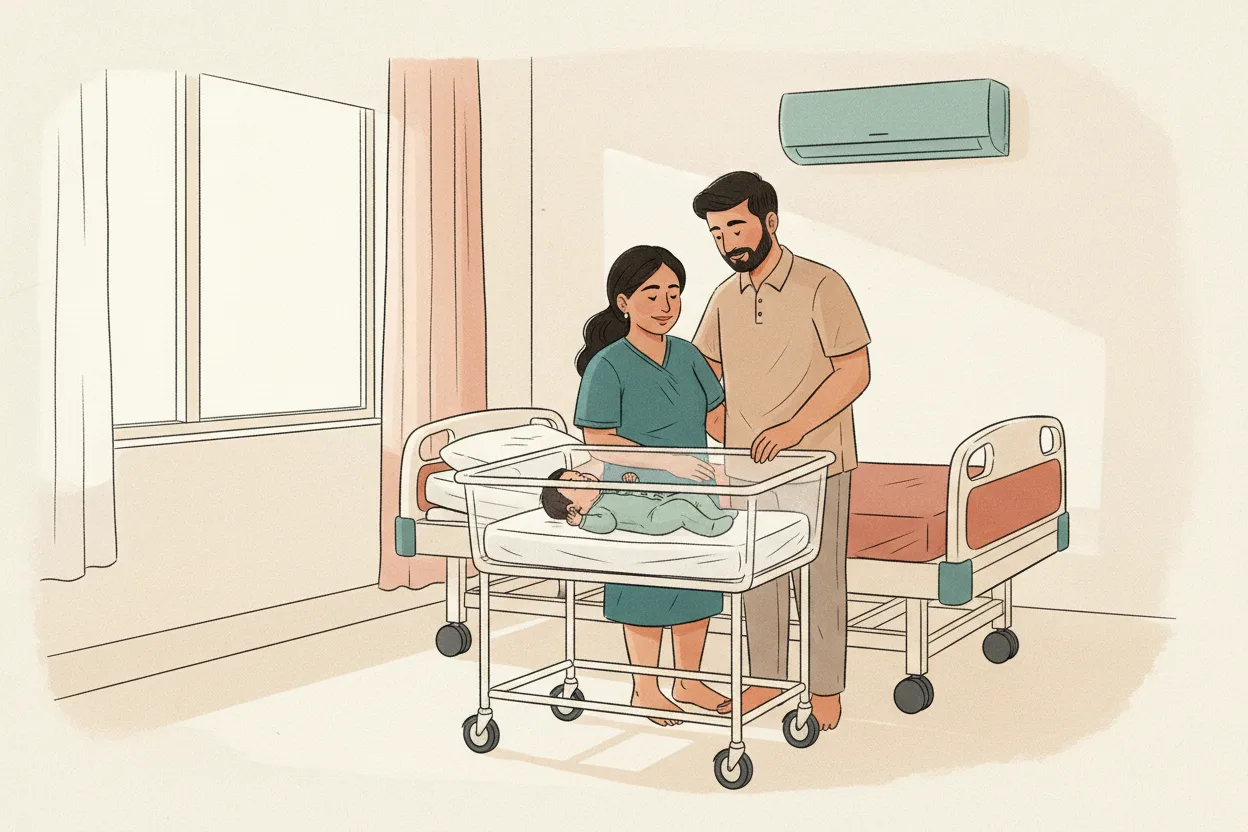
A maternity package is a fixed price for one specific version of your birth — an uncomplicated delivery of a stated type, in a stated room category, for a stated number of nights. Everything outside that description is billed on top of the package, not inside it.
So the gap between the number quoted to you in the second trimester and the number on your discharge bill is usually not a scam. It is the package working exactly as written, on a birth that did not match the version it was priced for.
Not medical advice — discuss your delivery plan with your obstetrician, and confirm all charges with your hospital's billing desk.
Ask What the Package Is Priced For, Not What It Costs
The most useful question is not "how much is your delivery package?" It is: "what is this price assuming, and what happens to it when each assumption changes?"
A quote sits on a stack of assumptions — mode of delivery, room category, length of stay, no complications for you, none for the baby. Get the hospital to state each one and price the alternative. Two figures beat one: the package price, and the realistic ceiling if things escalate.
This is a documented entitlement, not a cheeky question. The Charter of Patients' Rights approved by the National Council for Clinical Establishments gives every patient the right to "adequate relevant information about the nature, cause of illness, proposed investigations and care, expected results of treatment, possible complications and expected costs."
What Usually Sits Inside a Package
Definitions vary by hospital, so treat this as the shape of the thing. A typical private maternity package bundles the obstetrician's delivery charge, the labour-room or theatre charge, routine nursing, room rent for a set number of nights, standard newborn checks before discharge, and the hospital's own delivery-related consumables. What it leaves out is anything conditional: a different mode of delivery, extra nights, specialists called in, the baby's own admission, and items billed by actual usage.
The Escalations That Break a Package
| What changes | Why the package stops covering it | Ask before you book |
|---|---|---|
| Normal delivery becomes a caesarean | A different, surgical procedure with its own theatre, surgeon and anaesthetist charges | "Is the normal-delivery amount already paid adjusted against the caesarean package?" |
| You stay beyond the package nights | Room rent, nursing and food are priced per day past the bundle | "What is the per-day charge after the package period, by room category?" |
| An epidural or other anaesthesia is used | An anaesthetist is a separate specialist; drugs and monitoring are separate line items | "Is anaesthesia inside the package — and inside the caesarean package too?" |
| Labour is induced | Admission starts before labour does; induction drugs and monitoring are billed | "Does the package clock start at admission or at delivery?" |
| The baby needs neonatal care | The baby is a separate patient with a separate file and bill | "Is the newborn billed under the baby's name, and what is the neonatal per-day rate?" |
| "Product" and consumables charges | Gloves, drapes, syringes, catheters and dressings are often billed by usage | "Are consumables inside the package or at actuals? Can I see a sample bill?" |
That last row is the one families most often miss. Consumables and "product" charges look small line by line and add up quietly across a stay — and because they are billed by usage, the exact figure stays open until discharge. What you can settle in advance is whether they sit inside the package at all.
Why the "Normal Delivery" Price Is the One You're Least Likely to Pay
If you are booking a private hospital in an Indian city, budget around the caesarean number. A 2025 analysis of NFHS-5 data published in PLOS One reports that private facilities account for 29.6% of all institutional deliveries in India, and that 48% of all deliveries in the private sector were caesarean deliveries.
That is not a reason to distrust your obstetrician, or to refuse a caesarean you need. The NHS explains that a caesarean "is a major operation that carries a number of risks, so it's usually only done if it's the safest option for you and your baby," and that it becomes an emergency decision when "your labour is not progressing or there's excessive vaginal bleeding." Nobody plans that — which is the point of pricing for it.
A high caesarean rate is sometimes presented as a sign of a well-equipped unit. The WHO Statement on caesarean section rates says that "when caesarean section rates rise towards 10% across a population, the number of maternal and newborn deaths decreases. When the rate goes above 10%, there is no evidence that mortality rates improve." WHO's accompanying answers add that "caesarean sections should only be performed when medically necessary."
Ask your obstetrician what would make one the safer call in your case. The same Charter gives you the right to informed consent before treatment such as surgery, and to a second opinion from a clinician of your choice, with your records provided by the treating hospital.
The Baby Gets a Separate Bill
This is the escalation families are least prepared for. The NHS lists the reasons a newborn may be admitted to neonatal care, including being "born early (premature)", being "very small and have a low birthweight", having "an infection", having "jaundice", or having "had a very difficult birth" — none of it predictable while you are choosing a hospital.
The same page notes that "not all hospitals provide specialist neonatal services, so your baby may be transferred to another hospital if they need special care." So ask: is there a neonatal unit on site, at what level, and at what per-day rate? A transfer is a second admission at a second hospital's rates.
Anaesthesia and Induction
The NHS notes that "an anaesthetist is the only person who can give an epidural" and advises: "if you think you might want one, check whether anaesthetists are always available at your hospital." An epidural also brings a drip and continuous monitoring of contractions and the baby's heart rate — separately billable items.
Induction shifts the clock. The NHS states that "induction is always carried out in a hospital maternity unit," and that "if you are induced you'll be more likely to have an assisted delivery, where forceps or ventouse suction are used to help the baby out." Time admitted before labour starts is time a package may or may not count.
Get It in Writing, Because You Can
Rate transparency in India is a legal obligation. The Ministry of Health and Family Welfare's FAQ on the Clinical Establishments Act states that "details of charges, facilities available would be prominently displayed at a conspicuous place at each establishment." The Charter adds a right "to information on the Rates charged for each type of service provided and facilities available," displayed "at a conspicuous place in the local as well as in English language."
The Charter's additional rights include a "right to care according to prescribed rates" and a "right to choose source for obtaining medicines or tests", stating that hospitals "should not force the patients to purchase the medicines from the Hospital Pharmacies." For a planned admission, that matters for take-home medicines at discharge.
Ask for the estimate on hospital letterhead: package inclusions, the per-day charge past the package period, the caesarean price, and the neonatal per-day rate. Photograph it. Do this together at the counselling visit, rather than leaving one of you to reconstruct it from memory at 3 am.
If the Final Bill Doesn't Match
Start with the itemised bill, not an argument. The Charter gives every patient the right "to access a copy of the case papers, patient records, investigation reports and detailed bill (itemized)." Line by line, ask which items sat inside the package and which were at actuals, then compare against your written estimate.
If that does not settle it, there is a defined route. Every hospital must have a time-bound grievance redressal mechanism, with a grievance redressal officer whose "name and contact details will be displayed at a conspicuous place in local language and in English," plus the district registering authority's details for grievances that stay unresolved.
The stakes justify the paperwork. A 2023 study of NFHS-5 data in BMC Research Notes found that "the average OOPE in private hospitals was five times larger than public hospitals," and that "utilizing private facilities, caesarean delivery and duration of hospitalization were the independent predictors of distress financing."
The Family Conversation
In most Indian families the hospital decision is not made by two people alone. Parents and in-laws have opinions, often anchored to a hospital where someone else in the family delivered. Move the discussion from "which hospital is best" to "what is on this estimate" — a printed sheet of inclusions and exclusions is far easier to discuss across generations than reputations are. It also splits the work: one of you handles the insurance pre-authorisation, the other collects written estimates from two or three hospitals.
FAQ
Is the package price negotiable? The structure usually is not, but what goes into it sometimes is — room category is the common lever. Ask for the same package priced across each room category.
If I book a normal delivery package and end up with a caesarean, do I pay both? That depends on the hospital's policy, which is exactly why it belongs in writing beforehand. Ask whether the amount already paid is adjusted against the caesarean package.
Are the paediatrician's newborn checks included? Routine checks before discharge are commonly bundled; anything beyond routine generally is not. Ask whether the baby is billed under a separate file from admission.
What is a "product charge" on a maternity bill? The hospital's term for consumables used during your stay — gloves, syringes, drapes, catheters, dressings — usually billed by actual usage rather than as a fixed amount.
We are choosing between two hospitals. What should I compare? The written, itemised estimate on letterhead, not the brochure. Compare the exclusions column first; that is where two hospitals actually differ.