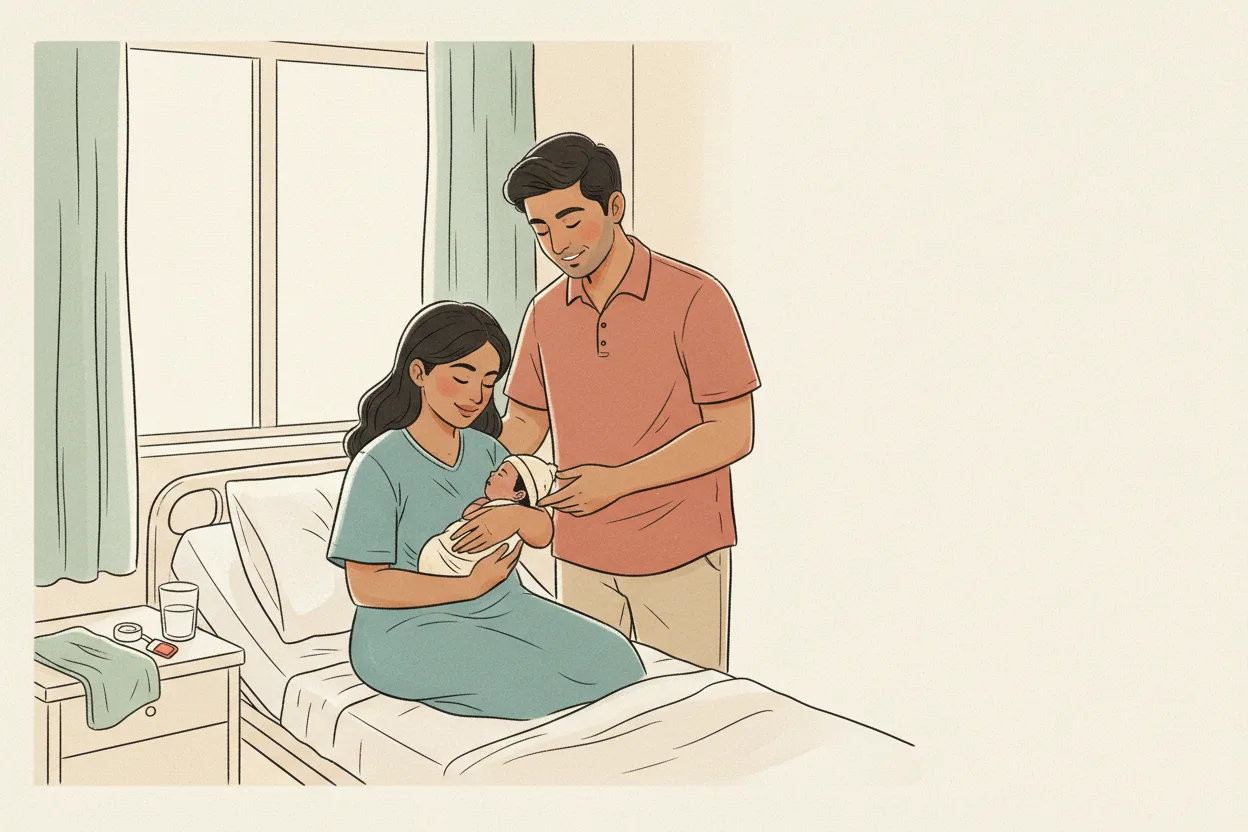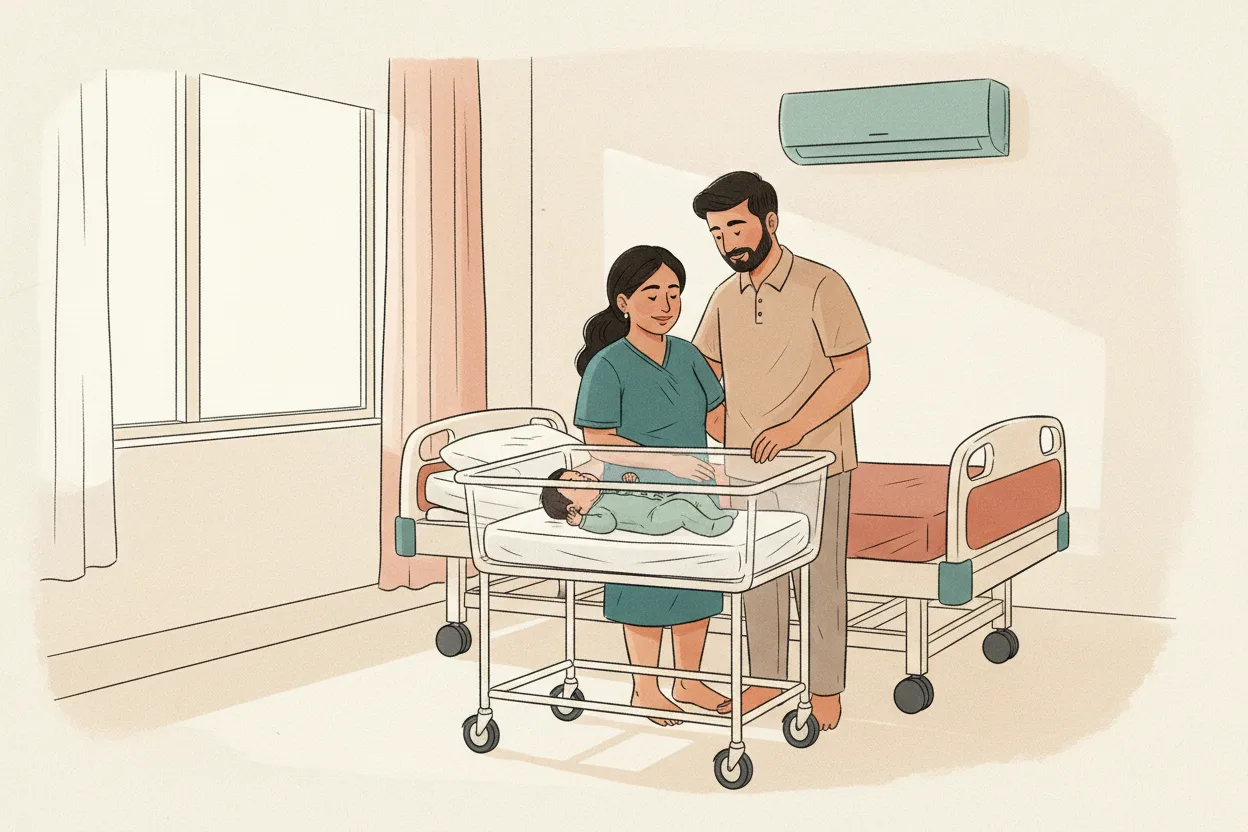
Short answer: the hospital bassinet needs nothing from your bag. Maternity units supply the bassinet and the sheet that goes on it, and the bassinet is meant to stay bare anyway. Practice differs from hospital to hospital, so the one thing worth doing is asking your own hospital at the pre-admission visit: what do you provide for the baby's cot, and what do you want us to bring?
The more useful question is the one underneath it — what belongs in that bassinet, and how you keep a newborn warm in a cold, air-conditioned room without adding bedding. That's what this guide is about.
Not medical advice — consult your paediatrician or your hospital's nursing team for guidance specific to your baby.
Ask Your Hospital, Don't Assume
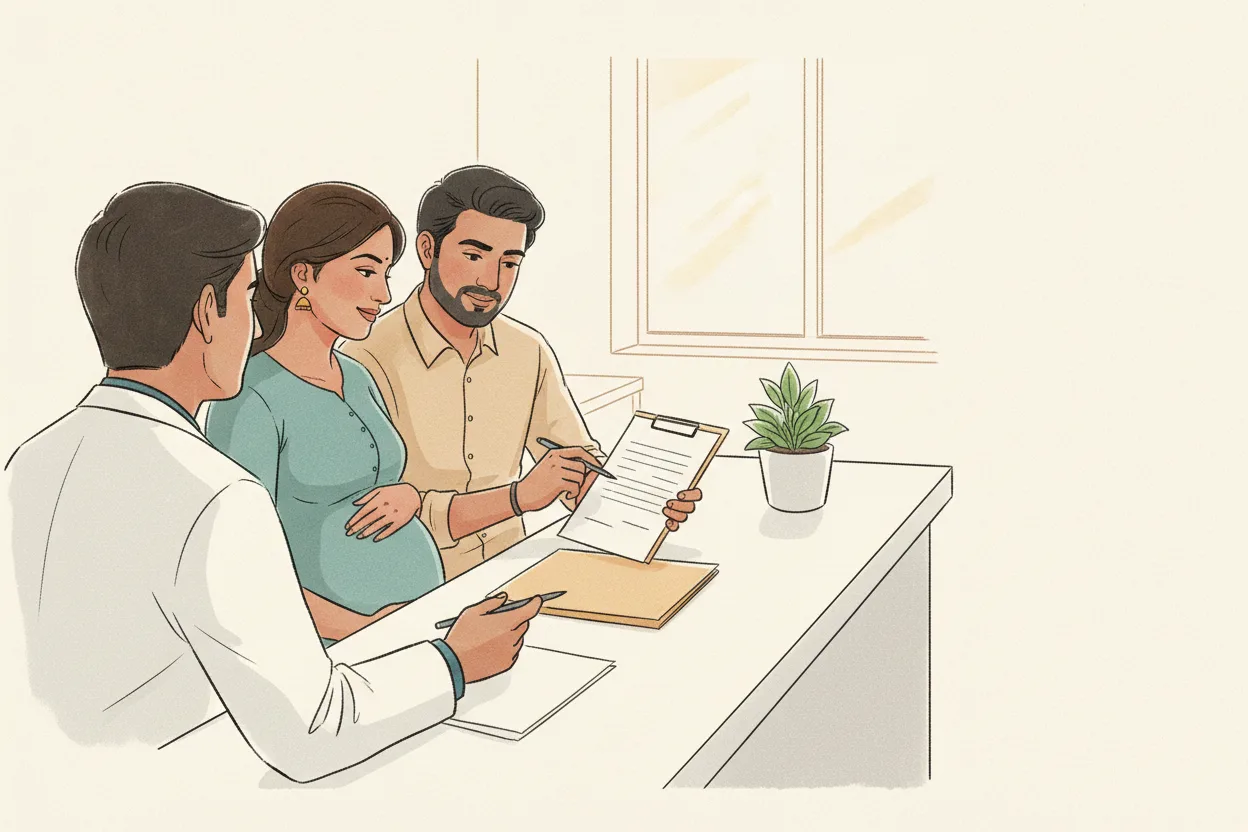
Every maternity unit in India runs its own linen policy — some hand you a fitted sheet and a hospital swaddle cloth, some expect only the baby's clothes. Rather than guessing, put three questions to the nurse or counsellor at your pre-admission appointment:
- Do you provide the bassinet sheet, or should we bring one?
- What should the baby wear in the ward, and can we bring our own clothes?
- Can the air conditioning in our room be adjusted?
Whatever the answer, the contents of the bassinet stay the same wherever you deliver. That part isn't hospital preference — it's safe-sleep guidance, and it applies from the first night.
Why the Bassinet Stays Bare
The rule is unglamorous and easy to remember: a firm flat surface, baby on the back, and nothing else in there.
The surface. The NIH's Safe to Sleep campaign says a baby's sleep surface should be firm, flat, level — "not at an angle or incline" — and covered only with a fitted sheet. A hospital bassinet is built exactly this way. The firmness that makes it look uninviting is the safety feature.
The position. Safe to Sleep advises placing all babies — including those born preterm and those with reflux — on their backs to sleep until they are one year old, and adding warmth as an extra layer of clothing or a wearable blanket rather than as bedding in the sleep space.
The contents. The American Academy of Pediatrics warns that pillows and pillow-like toys, quilts, comforters, mattress toppers, non-fitted sheets, blankets, toys and bumper pads can all increase a baby's risk of entrapment, suffocation or strangulation. The NHS puts the same rule as a single instruction: keep the cot clear of anything that could cover the baby's face and head — no pillows, duvets, cot bumpers, loose blankets, soft toys, or anything meant to keep a baby in place, like pods or nests.
An analysis of the US National Infant Sleep Position Study reports that soft objects and loose bedding of this kind can obstruct an infant's airway and pose a suffocation risk.
The gadgets. Positioners, wedges, nests and anything sold as a sleep aid stay out too. The US Food and Drug Administration states that it is not aware of any clinical or scientific evidence showing that currently available baby products prevent or reduce the chance of SIDS.
Where it goes. Beside your bed, not in it. The AAP's guidance is that room-sharing without bed-sharing helps protect against SIDS in the first year, with the cot within arm's reach — which is how an Indian postnatal room is already set up.
Keeping a Newborn Warm in an Air-Conditioned Ward
This is the real problem for an Indian delivery, and it is why families reach for blankets in the first place. Private rooms run cold, and a newborn fresh from the womb carries very little insulation.
Warmth comes from clothing, a parent's chest, and the room — not from bedding piled into the bassinet.
Skin-to-skin first. WHO advises that skin-to-skin, or kangaroo mother, care start immediately after birth for small and preterm babies, and reports that starting it straight away reduces hypothermia. A parent's bare chest under a shared shawl is the warmest place in the room — and either parent can do it, so dad has an obvious shift while mum recovers.
Fix the room, not the bassinet. ICMR's Standard Treatment Workflow on thermal care of the newborn tells postnatal wards to cover the neonate adequately, practise rooming-in around the clock, and avoid air draughts by closing windows and doors and switching off fans and air conditioners. In practice: ask for the AC to be turned up, and make sure no vent or fan blows directly onto the bassinet.
There is a number you can ask for. WHO's Pocket Book of Hospital Care for Children tells staff caring for a newborn to keep the room warm — at least 25°C — and to check the baby's temperature stays in the range 36.5–37.5°C rectal, or 36.0–37.0°C in the armpit. "Could we keep the room at 25 degrees?" is a request nursing staff will recognise immediately.
Then dress for the room. The NHS says a well-fitting baby sleeping bag reduces risk because it stops babies wriggling underneath their bedding, and rates the lightest bags — 0.5 tog — for warm rooms of 24 to 27°C. Nothing else goes on top of a sleeping bag.
| What you're tempted to use | Why it's a problem | Use instead |
|---|---|---|
| Razai, quilt or thick blanket | Loose, heavy, can cover the face | One more layer of clothing |
| Pillow or mustard-seed (rai) pillow | Soft object in the sleep space | Bare, flat mattress with a fitted sheet |
| Cot bumper or rolled towel at the sides | Soft object against the face | Nothing at the sides at all |
| Nest, pod or positioner | Not proven safe or effective | The bassinet as the hospital supplies it |
| A cap kept on all night indoors | Traps heat | Cap on outdoors, off in the room |
Swaddles and Sleep Sacks, Used Properly
A muslin swaddle earns its place in your bag because it wraps the baby rather than lying loose over them. Two limits matter.
The AAP advises stopping swaddling as soon as your baby shows any sign of trying to roll over, and notes that swaddling can increase the chance a baby will overheat. That milestone is months away in the ward, but the habit you start here is the one you carry home.
The second limit is simpler: a swaddled or sleeping-bagged baby still goes down flat on their back in the bassinet, with nothing over the top.
Reading Your Baby: Too Warm, Too Cold
Cold hands and feet are the commonest reason families add a blanket — and the least reliable signal you have.
The Lullaby Trust notes that the risk of SIDS is higher in babies who get too hot, and that the way to judge a baby's temperature is to feel their chest or the back of their neck. Warm and dry there means your baby is fine, whatever the fingers feel like; damp skin or a sweaty neck means take a layer off.
Ask the nurses to show you once. Ward staff check a newborn's temperature routinely, and asking someone to look because you're unsure is a normal request.
When Family Arrives With a Razai
Someone will bring bedding, and in most Indian families it arrives with real love attached — a soft razai, a rai pillow from a grandmother, a thick shawl "because the AC is too strong." Treating that as ignorance is unkind and counterproductive.
What works is agreeing with the intention and redirecting it: "You're right that this room is freezing — the nurse said the same. They've told us to add clothes rather than blankets, so can you help me get another sleepsuit on him?" Better still, hand over the job that matters — ask them to hold the baby skin-to-skin under their own dupatta while you sleep.
Keep the gifted razai for the pram, over the car seat, or the playmat at home in December. Nothing is wasted; it just stays out of the bassinet.
Frequently Asked Questions
Do Indian hospitals give you a bassinet and sheet? Yes, as standard, and almost always the linen too — but details vary by hospital. Confirm at your pre-admission visit rather than packing on assumption.
What about the mustard-seed (rai) pillow everyone recommends? Keep it out of the sleep space. The AAP counts pillows and pillow-like objects among the items that raise the risk of entrapment, suffocation or strangulation, and that applies to a rai pillow the same as any other.
The ward is at 18°C and my baby's hands are cold. Is that an emergency? Feel the chest or the back of the neck instead — cool hands on a baby whose chest is warm are normal. If you're unsure, ask the nurse to check a temperature; that is a routine request, not a fuss.
Can I put the baby in bed with me for warmth in the ward? The AAP's guidance is to room-share without bed-sharing, keeping the bassinet within arm's reach instead. Skin-to-skin while you are awake and upright is a different thing and is actively encouraged.
Should I buy a special "hospital blanket" set? No. What earns its space is a couple of muslin swaddles, a spare sleepsuit or two, socks and a cap for the journey home. The bassinet itself needs nothing from you.