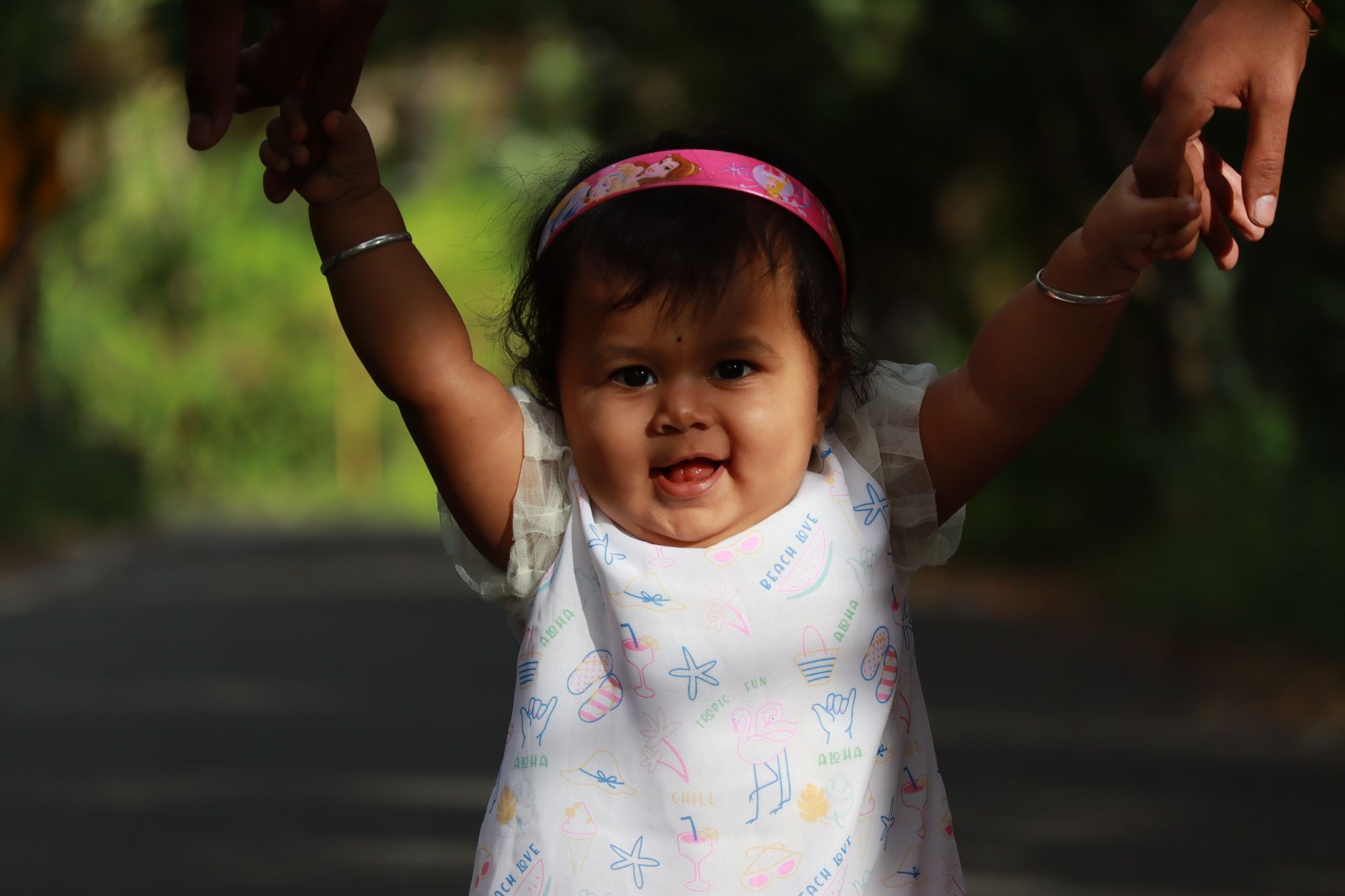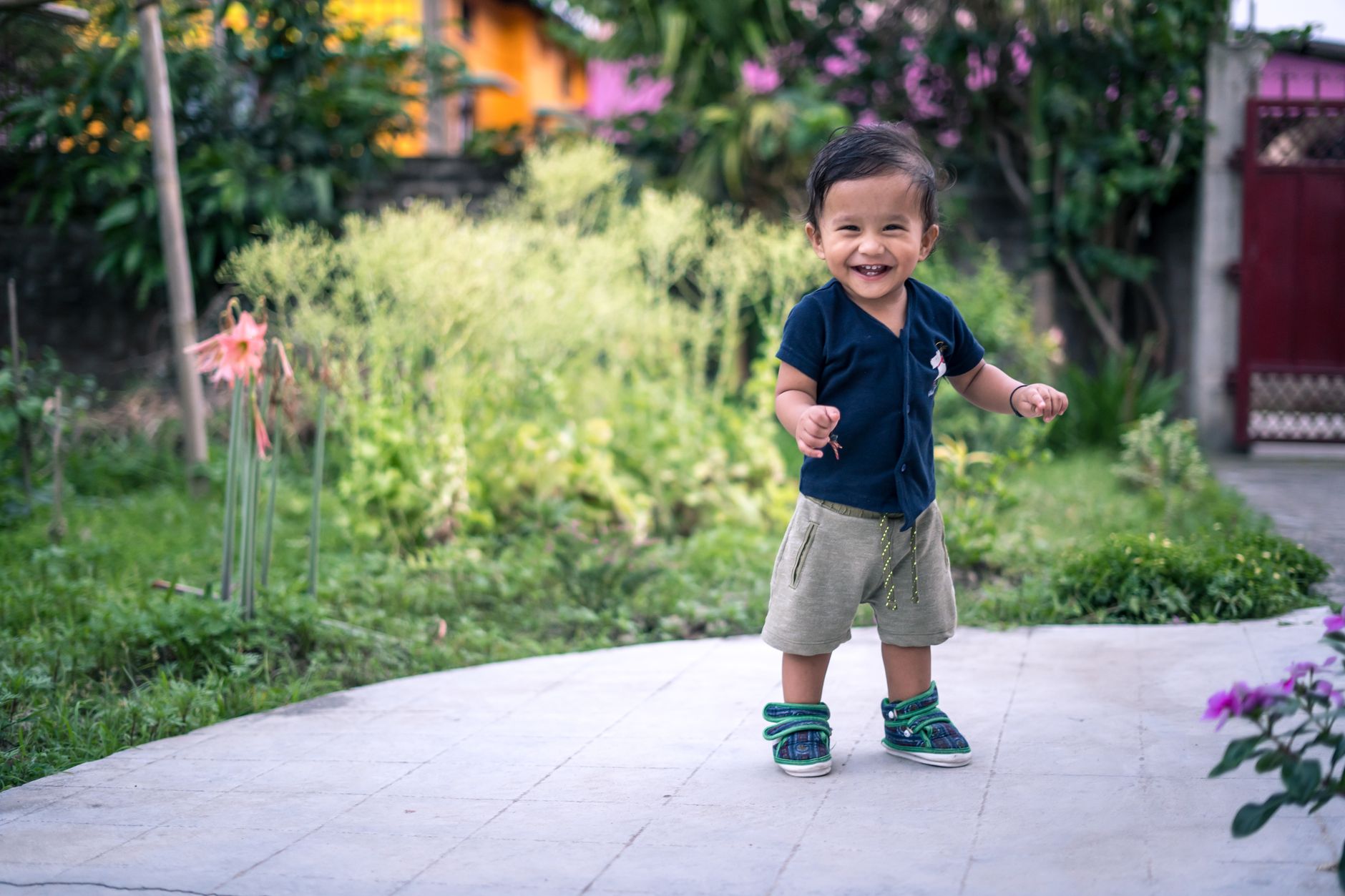
Your one-year-old does not need shoes to learn to walk. A Cleveland Clinic paediatrician puts it plainly: "We need shoes when we're protecting our feet or going outside," and "they're not necessary for a child to learn to walk properly" — indoors, "bare feet or socks with rubber grips on the bottom are just fine."
Worth knowing before any pair, expandable or otherwise, goes into your cart. The American Academy of Pediatrics (AAP) says the same: "In the early months, babies' feet develop best if they're not confined in shoes," and "once children start walking outdoors, they need shoes for protection." Protection is the job a shoe does. Teaching a baby to walk is not.
Not medical advice — consult your paediatrician for anything specific to your child's feet or walking.
Barefoot at home is already how your house works
Convenient, for an Indian family: footwear comes off at the door anyway, so an unshod new walker is already the default in your home and your in-laws'. What our floors add is a grip problem — polished tile, marble and granite are slippery under a wobbling 12-month-old, and worse in the monsoon. The AAP's answer is the sole, not the shoe: "socks are all that's needed to keep their feet warm," and where more grip is wanted, "shoes with nonskid soles, such as sneakers," "help keep your toddler steady on slippery floors." Anti-slip grip socks are the cheap indoor version, and bare feet or grip socks are explicitly fine indoors.
What barefoot is actually doing
Shoes change how a child walks. A 2011 systematic review and meta-analysis of 11 studies in the Journal of Foot and Ankle Research concluded that "Shoes affect the gait of children. Shoes reduce foot motion and increase the support phases of the gait cycle" — adding that "The long-term effect of these changes on growth and development are currently unknown."
Growing up shod is associated with flatter arches. A 2017 study of 810 children and adolescents in Scientific Reports found "flatter foot arches when growing up shod" — an association from a snapshot study, not proof, but pointing the same way as the gait work. Neither supports the idea that a shoe builds a baby's foot.
That is also why arch support is the wrong feature to pay for at one. The AAP explains why toddler feet look flat: "At this age, your child's feet will seem flat" because the arch sits hidden under fat, and "In 2 to 3 years, this fat will disappear and their arch will emerge."
When shoes become necessary
The trigger is independent walking outdoors, not a birthday. Gloucestershire Health and Care NHS Foundation Trust's podiatry leaflet is direct: "There is no need to put your child in shoes until they can walk unaided. Shoes can be reserved for walking outside initially."
So a first pair is outdoor kit — the society compound, the park, hot paving in May, wet grit in July. It also commits you to a consumable: the AAP notes "the first pair of shoes won't last more than 2 or 3 months", which is the real argument against spending heavily now.
Fit, on a foot that changes shape every few months
Fit is not one measurement. Evelina London's footwear leaflet starts in the right place: "Children's feet grow quickly and change shape over time," so "Both feet should be measured for length, width and circumference." A shoe that is right in length can still be wrong in width — the most commonly missed half of the problem.
On a child who cannot tell you it hurts, measure instead of asking. In a community study of 858 pre-school children in BMC Musculoskeletal Disorders, "88.8% of 808 children examined wore indoor footwear that was of insufficient length" and "69.4% of 812 children wore outdoor shoes that were too short" — and "the shorter the shoe, the higher the value of the hallux angle," the sideways drift of the big toe. Their fitting number: a shoe "should be at least 10 mm and optimally 12 mm longer than the foot." Nobody noticed until somebody measured.
Check with both shoes on and fastened and your child standing: find the longest toe rather than assuming it is the big one, feel the gap at the front, then feel across the widest part for pressure. Evelina's test is that your child "shouldn't feel any pinching or pressure" — your hands stand in for their report.
How often? The AAP says "about once a month"; Gloucestershire says "every six to eight weeks"; Cleveland Clinic says "as often as every three or four months," since "Kids' feet often grow about a half size in that time". Take the strictest. And remember the bottom line: "It's better to have no shoes at all than shoes that are too tight."
Expandable shoes: what is known, and what isn't
The pitch is appealing — one pair spanning several sizes, so you stop re-buying. It aims at a real problem, because a first pair genuinely is outgrown in 2 to 3 months.
The honest state of the evidence: we could find no independent trial of expandable or adjustable-length children's footwear — nothing comparing them with ordinary well-fitted shoes on fit, gait or foot development. What exists publicly is patents and sellers' own descriptions. That is not a verdict against them. It means the claim on the box has been tested only by the people making it, and even for ordinary children's shoes the long-term effects of the gait changes they produce "are currently unknown".
So judge the pair in front of you on fit, not on the claim:
- Does the adjustment change width and toe-box depth, or only length? Fit is length, width and circumference — a mechanism that only slides the toe forward solves a third of the problem.
- At its largest setting, does it still fit? The heel should not lift and the toes should lie flat, and the sole should still bend at the front.
- At its smallest setting, is it already too long? A shoe sold to grow starts generous, and more than 3 cm of room is too big — half or a whole size too large leaves a new walker open to trips and falls.
Pass all three at the setting you will use for the next couple of months and the expandability is a bonus. Pass only mid-range and you are buying a shoe that fits badly at both ends.
Hand-me-downs, monsoon, and where to shop
Used shoes are a weaker buy than used clothes. This is reasoning rather than trial evidence: a worn shoe has a sole abraded into another child's gait and an upper stretched to another child's foot shape — exactly the length-and-width fit that nearly 9 in 10 children in that pre-school study were getting wrong in new footwear. A barely-worn pair a cousin outgrew in six weeks is a different proposition from a well-used one, and pre-walker booties do no mechanical work worth agonising over. For the rest of the carton, see our guide to buying second-hand baby gear safely.
Monsoon and heat. An upper that dries and breathes matters more here than in a cold climate — natural materials "can prevent perspiration which may cause fungal infections and blisters", and Cleveland Clinic lists leather, canvas or mesh for the same reason.
Where to shop. We rank no brands, and prices move constantly. Browse first walking shoes on Amazon.in or FirstCry and grip socks on Amazon.in — then buy the outdoor pair somewhere both feet can be measured for length and width.
When it is a paediatrician's question, not a shoe question
Persistent toe-walking, a limp, pain, or feet that look stiff rather than just flat belong with your paediatrician rather than in a new pair of shoes. On toe-walking, Oxford Health NHS Foundation Trust's physiotherapy leaflet notes it "is common for children of 10-18 months to walk on tip toes when they are learning to walk" and "can be a normal part of their development," but that if your child "cannot stand with their heels flat on the floor some intervention may be helpful, you should seek support from your GP." And Cleveland Clinic advises talking to your paediatrician if your child has reached the earlier milestones but is not walking independently by around 18 months.
Frequently Asked Questions
Do soft-soled "pre-walker" shoes help a baby walk sooner or better? No evidence says so. Shoes "are not necessary for a child to learn to walk properly," and being barefoot "may help your child feel the floor better, which could actually help them move along". Pre-walkers are clothing for the feet — a fine thing to want, just not a developmental purchase.
Are expandable shoes worth the money? No one can answer that from evidence, because there is no independent trial of them. Decide on fit: if the pair holds the heel, lets the toes lie flat and keeps about a thumb's width of room at the setting you will use now, the extra months of range are a bonus.
My toddler's feet look completely flat. Does she need arch support? Almost certainly not at this age. The AAP explains that "At this age, your child's feet will seem flat" because fat hides the arch, and "In 2 to 3 years, this fat will disappear and their arch will emerge." Flatness with pain or stiffness is a paediatrician's call, not a shoe shop's.
Can my second child wear the pair my first outgrew? It is the weakest hand-me-down: the sole and upper have taken another child's shape, and fit was what most children's shoes were getting wrong anyway. Barely-worn is reasonable; well-worn is not worth the saving.
How often should I re-measure? Monthly at home is the strictest published advice and costs nothing, with a shop measurement every six to eight weeks for the width you cannot judge by thumb.