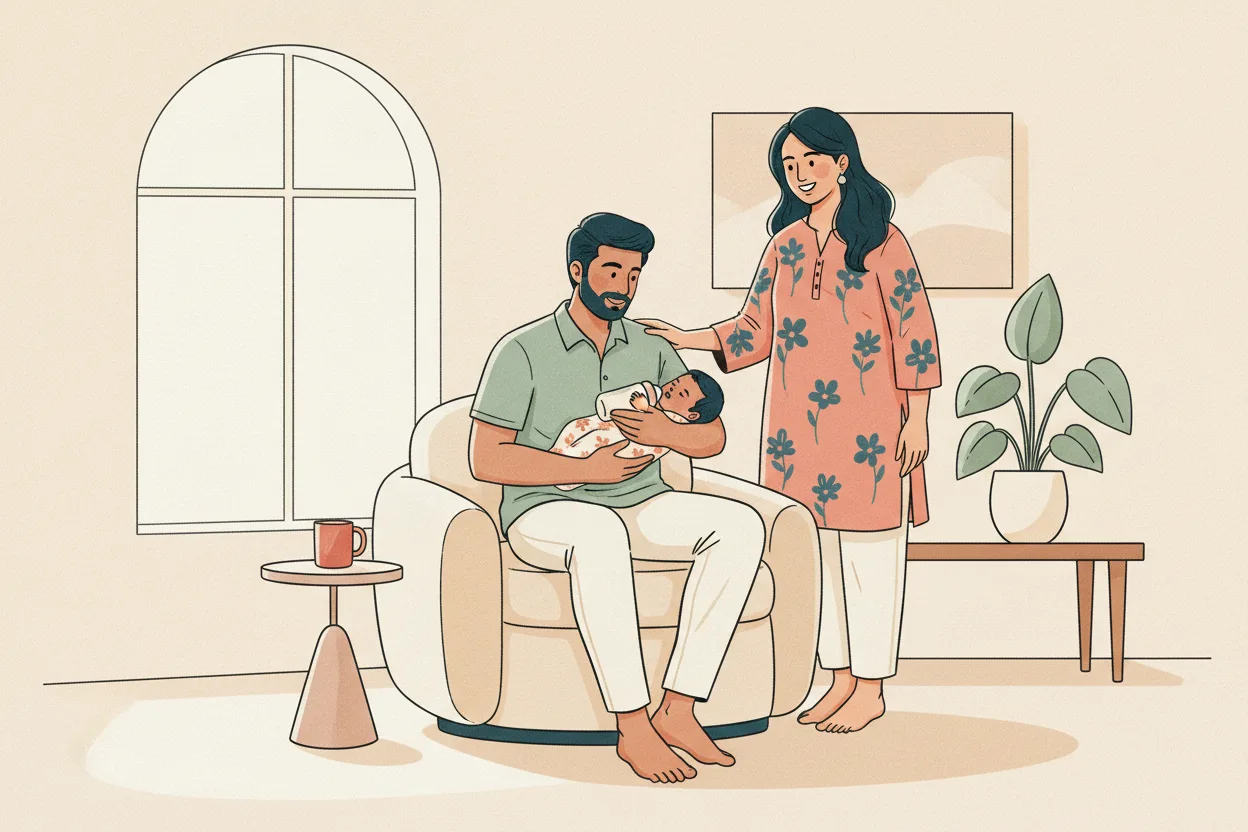

Feeding every unannounced guest is not a rule you are obligated to follow, and holding that line is not rude — it is a boundary you are allowed to set, especially while you are home alone with a clingy toddler and no domestic help. The guilt you feel about resenting hospitality duties is common, and it deserves to be named honestly rather than pushed through.
Not medical advice — consult a mental health professional if guilt, exhaustion, or low mood are affecting your daily life.
Why "Atithi Devo Bhava" Lands Differently When You're a New Parent
"Atithi Devo Bhava" — the guest is god — is a value most of us grew up watching our mothers and grandmothers live out: relatives, religious visitors, or a neighbour dropping by for tea, met within minutes with snacks, a cleared table, and a spotless front room. That expectation does not pause for a newborn's feeding window or a toddler mid-meltdown. When you are the one home with the baby, the same script — cook, serve, entertain, apologize for the mess — lands on you with none of the extra hands that used to share it in a bigger household.
This Isn't Just Tiredness — Name What's Actually Happening
What you are describing is not ordinary tiredness. A peer-reviewed study in Frontiers in Psychology found that parental burnout is "a syndrome related to parenthood and characterized by three dimensions: emotional and physical exhaustion, emotional distancing of parents from their children, and loss of parental accomplishment" — a specific, measurable state, not just a bad day.
Hosting on top of solo childcare is also a textbook case of taking on too many roles at once. A peer-reviewed cross-sectional study found that "role overload is linked to various undesirable outcomes including psychological and physical distress," and cooking, serving, entertaining, and parenting at the same time is exactly that kind of overload.
Your Toddler's Clinginess Around Guests Isn't a Problem to Fix
If your toddler melts down, clings to your leg, or refuses to go to a visiting relative, that is not bad behaviour and not something you owe anyone an apology for. The American Academy of Pediatrics (HealthyChildren.org) states that "although it is an entirely normal behavior and a beautiful sign of a meaningful attachment, separation anxiety can be unsettling for us all" — for you as much as for the guest waiting to be entertained.
A clingy toddler refusing to let go of you while you are also expected to be pouring chai is not a parenting failure you need to explain away. It is two ordinary things — a securely attached toddler and an overloaded parent — colliding at the same moment.
Why the Guilt Feels So Heavy
Guilt over resenting guests usually gets worse the more you try to just push through it. A peer-reviewed study on mothers' mental health found that "research indicates that self-compassion can reduce the association between self-criticism and depression among postpartum women" — meaning being kind to yourself about the resentment is the more protective response, not a self-indulgent one.
It also helps to notice what the pressure is actually revealing. A systematic review and meta-analysis of postpartum depression in India found that lack of support from family networks was among the most commonly cited risk factors across the studies reviewed, showing up as "lack of support from family networks (8/14 studies)" — so if hosting feels unsustainable precisely because no one is helping you cook or watch the baby while you do, that is a real support gap, not a personal shortcoming.
And exhaustion from a late-arriving or overnight guest compounds fast. A study on chronic parenting stress and sleep quality found that "sleep disturbances may exacerbate the association between stress and mood in the context of chronic parenting stress" — so the night's sleep you lose to a guest's late train or an early-morning visit is doing more to your mood than the visit itself.
Practical Scripts for Setting Limits Without a Fight
Holding a boundary doesn't require a confrontation. A calm, specific line said in advance works better than an explanation offered mid-visit.
| Situation | What to say | Why it works |
|---|---|---|
| Relative arrives unannounced, baby just went down | "So glad you're here — give me 10 minutes, [baby] just fell asleep, then I'll put the chai on." | Buys time without refusing them at the door |
| Guest expects a full home-cooked meal you can't manage | "We're ordering in tonight so I can stay with [baby] — hope that works for you." | Reframes ordering food in as a normal choice, not lesser hospitality |
| An overnight guest is coming and you have no extra help | "We'd love to have you — just so you know, [baby]'s routine won't change, so we may turn in early most nights." | Sets the boundary before arrival instead of mid-visit |
| A relative comments on the mess or lack of snacks | "Things look a little different with a baby in the house right now." | Names the reason plainly without over-explaining |
| Guests are coming while your partner is travelling | "Can we push this to the weekend when [partner]'s back?" | Redistributes the load instead of carrying it alone |
Hosting Is a Two-Parent Job
If hosting has quietly become "your department" while childcare also falls mostly on you, that split is worth renegotiating — not just for fairness, but for your stress levels. A peer-reviewed study using the Fragile Families and Child Wellbeing Study found that "fathers' engagement with children and sharing in child-related chores are negatively related to maternal parenting stress" — meaning a father who takes over entertaining the guest, handles the snacks run, or holds the baby while you step back measurably lowers your load, not just symbolically shares it.
A useful way to raise it: before guests arrive, agree out loud on the split of tasks — greeting, serving, and baby duty — instead of defaulting to whoever's free in the moment, which is usually you.
Frequently Asked Questions
Is it really okay to say no to feeding guests when I have a newborn or toddler? Yes. Hospitality can flex around a baby's feeding and sleep windows without being a failure of hospitality. Ordering food in, keeping a visit shorter than usual, or asking guests to call ahead are all reasonable adjustments, not refusals of the value itself.
My mother-in-law says my toddler is "spoiled" because they cry around guests. Is that true? No. HealthyChildren.org describes this clinginess around unfamiliar people as "an entirely normal behavior and a beautiful sign of a meaningful attachment," not a discipline problem.
How do I stop feeling so guilty about resenting hosting duties? Try being kind to yourself about it rather than criticising yourself into pushing through. Research on postpartum mothers' mental health has found that self-compassion can reduce the link between self-criticism and depression — treating the resentment as understandable, not shameful, is genuinely the more protective response.
Could constant guest pressure actually be affecting my mental health, not just my mood? It's worth taking seriously rather than dismissing as normal new-parent stress. Chronic role overload is linked to psychological and physical distress, and a lack of real family support is one of the most commonly cited risk factors for postpartum depression among Indian mothers — so if you're feeling low, numb, or unable to cope, talk to your doctor rather than waiting it out.
How do I get my husband more involved in hosting, not just childcare? Name specific tasks before guests arrive rather than leaving it to whoever's free — greeting, serving, and baby duty split between you both. Studies show that fathers sharing directly in child-related chores is linked to measurably lower maternal stress, so this isn't just about fairness — it changes how the day actually feels for you.
What if I truly have no family nearby to help with hosting or the baby? That is a real, documented risk factor for Indian mothers, not something to manage silently. Mention it to your doctor if it's affecting how you feel day to day, and lean on paid help, a partner's flexible hours, or a trusted neighbour where you can.