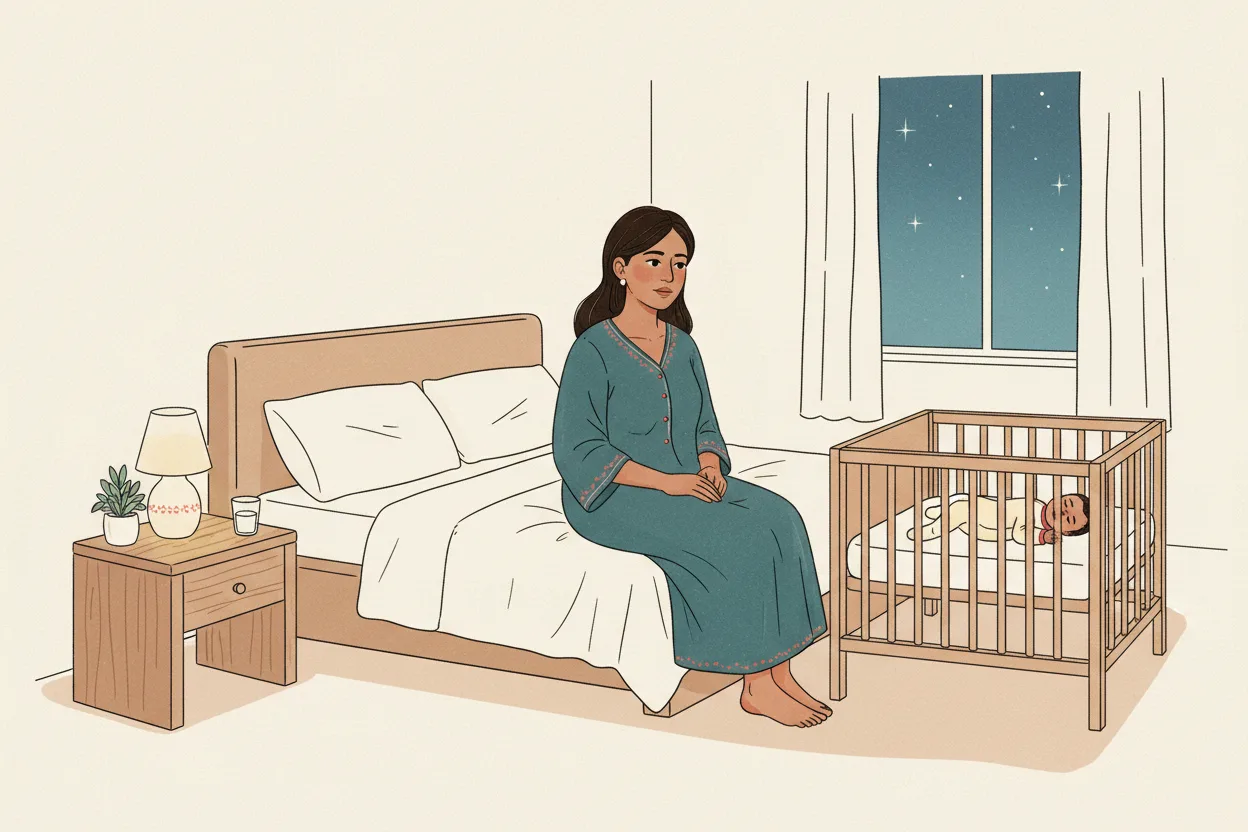


Your husband gives the baby one bath and is "such a hands-on dad." You do bath, feed, and bedtime every night and someone still asks if you're managing okay. You're not imagining the gap — it's a real, well-documented pattern, and it has a real cost to your mental health.
Not medical advice — if what you're feeling starts affecting your sleep, appetite, or ability to function day to day, talk to your doctor.
The Invisible Load Behind the Judgment
The double standard isn't only about who changes more diapers. It's about who is expected to remember, plan, and notice — the vaccination schedule, the diaper stock running low, whether the babysitter confirmed for Tuesday. A study in the journal Sex Roles found that mothers typically do most of the physical housework and childcare, and are also the ones who most often manage, plan, anticipate, and organize both routine and unexpected family needs.
That planning work is invisible — nobody praises you for remembering the pediatrician follow-up — but it's exhausting, and it's measurable. A 2024 study in Archives of Women's Mental Health found that mothers who carry a larger share of this cognitive workload at home report significantly more depressive symptoms, more stress, more personal burnout, and lower relationship quality than mothers who carry less of it. When your husband is praised for a single visible task while you're judged on an invisible, ongoing one, you're being measured on completely different scales — and the harder one is yours.
Why the Criticism Lands on You, Not Him
Part of why this gap persists is a pattern family psychologists actually have a name for: "maternal gatekeeping," where a mother restricts or steps in to correct a father's independent caregiving. A study in the journal Behavioral Sciences found that this kind of gate-closing behavior hinders the father's parenting participation.
Here's the trap: if you're the one who gets criticized when the baby's outfit doesn't match or dinner is late, it's a natural response to just take over and do it "right" yourself rather than be blamed for his way of doing it. But that response quietly deepens the same gate-closing pattern described above — the less he does independently, the more the "default parent" label sticks to you, and the more everything gets judged against your name alone. Naming this cycle out loud, to yourself and to him, is often the first step to breaking it.
Dad's Real Involvement Isn't a Bonus — It Helps the Baby Too
This isn't just about fairness between you and your husband. A Frontiers in Public Health study of rural Indian parents found that higher involvement of fathers in parenting has a role in improving all forms of a child's development — cognitive-academic, social-behavioral, and emotional-psychological. So when the family treats his caregiving as optional and extra-credit, they're not just underrating your work — they're undervaluing something that genuinely benefits the baby when it happens consistently, not just for the camera.
The Real Cost of Going Without Support
This double standard isn't a small annoyance — for many new mothers, it's a real risk factor. A population-based study of Japanese mothers found that a lack of social support is a known risk factor for postpartum depression. Closer to home, a study in the Indian Journal of Medical Research found that a lack of support from the husband and a lack of support from wider family are both named among the identified risk factors for postpartum depression and anxiety in Indian mothers, alongside factors like having a female baby.
The flip side matters just as much: a study on postpartum depression and partner relationship quality found that a stable and supportive partner relationship can be particularly important in helping a woman overcome barriers and find coping resources during the postpartum period. In other words, your husband being an equal, unpraised-for-basics partner isn't a nice extra — it's genuinely protective for you.
What Actually Helps
Assign tasks by name, not by "help." "You're on bath and bedtime tonight" lands differently than "can you help with bedtime" — the first makes it his task, the second keeps it yours with him as backup.
Say the quiet part out loud to visiting family. When a relative praises him for a task you do daily unremarked, a simple "we both do this every day" resets the frame without a fight.
Let him do it his own way. If you correct every choice he makes — the wrong onesie, the "wrong" burping technique — you end up doing the mental work of supervising him on top of your own tasks. Different isn't wrong if the baby is safe and fed.
Track the remembering, not just the doing. Split the invisible planning work explicitly — vaccine tracking, diaper restocking, remembering the next well-baby visit — between you both instead of leaving it all with one person. Naming it makes it shareable.
Build a two-minute nightly check-in. A quick "what's on for tomorrow" conversation as a couple keeps the planning load from defaulting silently to one person.
Frequently Asked Questions
Is it normal to feel resentful when he's praised for basic care? Yes. It's a documented response to an unequal load — mothers typically carry more of the ongoing management and planning work even when the physical tasks are shared, and being praised less for doing more is a reasonable thing to feel frustrated by.
Why do I feel the need to correct everything my husband does with the baby? It's often self-protective — you're the one who gets blamed if something looks "off," so you step in to control the outcome. The research on gate-closing behavior shows this response, while understandable, tends to reduce how much he takes on independently over time.
How do I get my in-laws to stop comparing us? You likely can't control what they say, but you can control what you agree with in the moment. A calm, repeated "we're doing this together" said in front of them, every time, slowly resets the family's expectation of both of you.
Does this praise gap actually affect my mental health, or am I overreacting? It's a real factor, not an overreaction. Lack of support from a husband is named among the identified risk factors for postpartum depression and anxiety in Indian mothers, so the gap you're feeling has a documented connection to how you're coping, not just how you're perceived.
What if my husband genuinely doesn't realize he's doing less? Show him specifically, with the task list and the invisible planning work laid out together, rather than assuming he'll notice on his own. Most fathers respond better to a clear, specific ask than to a general sense that "something is unfair."
When should I look for support beyond talking to friends or family? If the resentment, exhaustion, or low mood is affecting your sleep, appetite, or ability to get through the day, that's the point to talk to your doctor rather than just venting it out — a supportive partner relationship is protective, but it isn't a substitute for professional help when you need it.