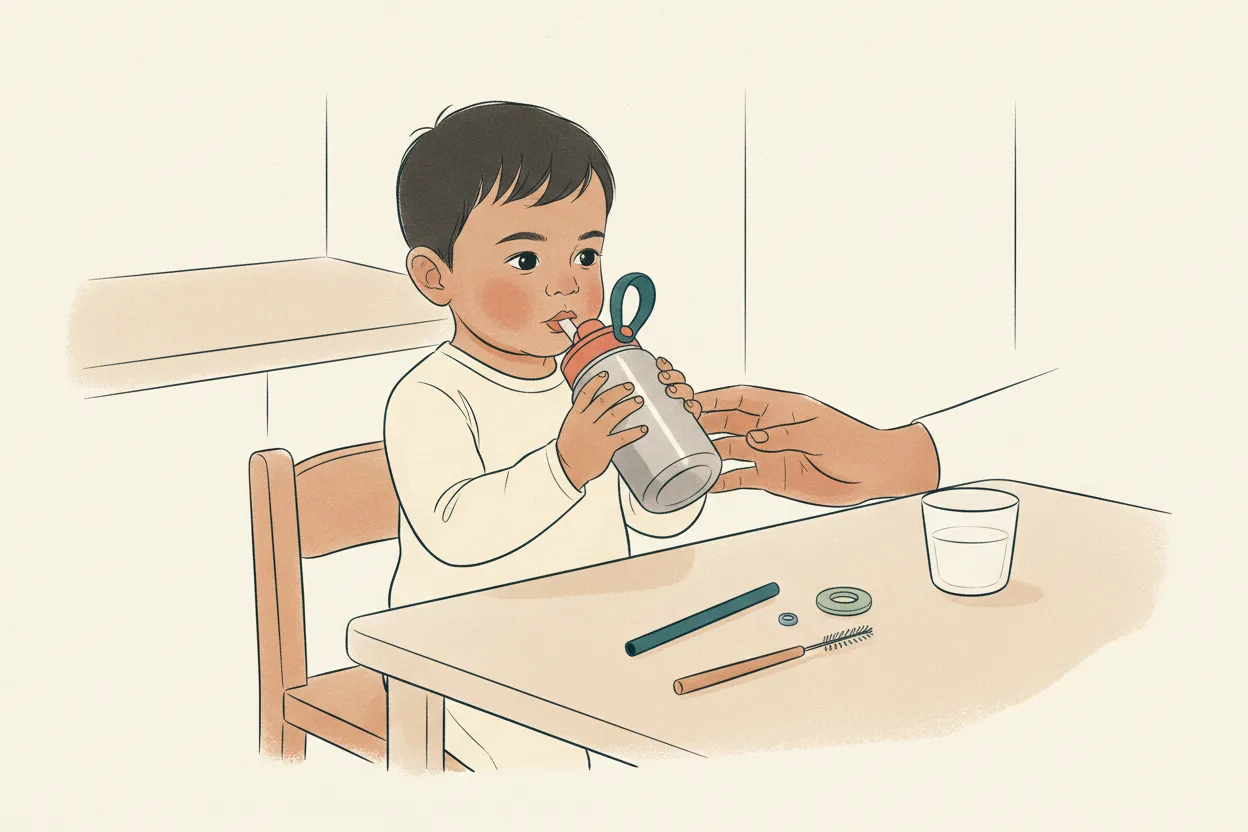
If your one-year-old will only drink water that is properly cold, a small insulated steel bottle with a straw lid is a sensible buy — and you are not going against guidance by choosing a straw. The AAP's advice on moving from bottle to cup offers a spouted training cup or a cup and straw as equally acceptable options, and puts open-cup drinking as the goal by about age two.
So buy the sipper. Just buy one you can take apart and scrub, and keep offering an open cup at the table alongside it.
Not medical advice — consult your pediatrician for guidance about your own child.
Straw, Spout or Open Cup: What the Guidance Actually Says
Three drinking styles, three different jobs.
| Style | What it does | Where guidance puts it |
|---|---|---|
| Spouted "sippy" cup | Child sucks; valve stops spills | An acceptable training step |
| Straw cup | Child sucks through a straw; lips close around it | Equally acceptable training step |
| Open or free-flow cup | Child sips; no valve, no suction | The destination, by about age two |
NHS guidance on drinks and cups is the clearest on why the destination matters: an open cup or a free-flow cup without a valve helps a baby learn to sip rather than suck, and is better for their teeth than a beaker with a teat.
Notice what that guidance is actually comparing — a valve-free cup against a teat. It is not a ruling that straws beat spouts.
Be honest about the straw-versus-spout evidence
You will read a lot online about spouted cups causing speech delay, bite problems and tongue-thrust. The claim exists in the literature: a 2021 paper in the Journal of Rehabilitation and Assistive Technologies Engineering lists improper speech development, abnormal dental occlusion patterns, otitis media, iron deficiencies and dental caries among the concerns raised about traditional sippy cups.
But listing a concern is not the same as proving it. That paper repeats the worry without demonstrating cause, and there is no head-to-head trial of straw cups against spouted cups in healthy toddlers. Treat "straws are better for oral-motor development" as a plausible, popular idea — not a settled finding.
What is well supported is the tooth argument, and it is not about the lid at all. A 2025 review of early childhood caries in Cureus notes that a prolonged duration of exposure to fermentable carbohydrates aggravates caries risk, and NHS guidance on your baby's teeth puts it plainly: the best drinks for young children are plain milk and water, and sweet drinks are damaging because they bathe the teeth in sugar for long periods.
So a bottle of plain water your toddler nurses all afternoon is fine. The same bottle filled with juice, sweetened milk or nimbu paani is not — India's National Health Mission infant and young child feeding guidelines say drinks of low nutritive value such as tea, coffee and sugary drinks should be avoided.
How Much Water a One-Year-Old Actually Needs
Less than most parents assume, because milk and food carry a lot of it.
The AAP's recommended-drinks guidance gives 12–24 months a range of 1 to 4 cups of plain water a day alongside about 2 cups of whole milk. That is a wide band on purpose — a hot Chennai afternoon and a cool Bengaluru morning are not the same day.
Keep the bottle within reach rather than rationing it. A 2024 survey of toddler water intake in Nutrients explains that a toddler's renal function is still immature and their ability to perceive and express thirst is relatively weak — they do not reliably ask. NHS guidance on dehydration warns that children under five have an increased risk of dehydration and should get plenty of fluids.
Offer often, push rarely. A visible bottle at play, at the table and in the pram does most of the work.
What to Check on a Steel Bottle
Compare on things you can verify in your hand or in the listing photos — not on brand reputation, and not on the number of hours the box promises.
1. The steel grade. Look for "304", "18/8" or "SS304" on the bottle or the listing. A 2024 review in Materials describes this austenitic food-grade family as roughly 18% chromium and 8% nickel, which is what gives it corrosion resistance and makes it easy to clean. "Stainless steel" with no grade named tells you nothing.
2. Is it actually vacuum insulated? Double-walled and vacuum-insulated are not the same thing; vacuum flasks say so explicitly. Test it at home: fill it with cold water, leave it an hour, then touch the outside. A genuinely vacuum-insulated body stays at room temperature and does not sweat. Treat the "24 hours cold" number on the box as marketing — a lab figure, not a nappy-bag-in-June figure.
3. The straw path. This decides whether the bottle lasts. Does a straw brush fit inside? Is the straw a simple silicone tube you can pull out, or is it moulded into a lid you cannot open? Anything you cannot get a brush through will go cloudy and stay that way.
4. The gasket. Every leak-proof lid works because of a silicone O-ring. Check you can lift it out with a fingernail and see the groove underneath. A gasket you cannot remove is a gasket you cannot clean.
5. Are spares sold in India? Straws and gaskets are consumables — they tear, discolour and get bitten through. Before buying, search for replacements for that model on Amazon India or FirstCry. If nothing comes up, the whole bottle is the consumable.
6. Weight when full. An insulated steel body is heavy before you add anything, and water adds a gram per millilitre — a small bottle often lands near twice its empty weight once filled. Check the listed empty weight. Two-handed at the table is fine for a one-year-old; carrying it around is what the loop handle and your bag are for.
7. Capacity. For this age, 300 to 400 millilitres is the sweet spot — a meaningful slice of the 1 to 4 cups of water a day the AAP suggests for 12–24 months, and small enough that the water does not sit for days.
8. The base. Turn the bottle over. On an insulated body the vacuum is sealed at the bottom, and that seal has caused real problems: a 2023 US Consumer Product Safety Commission recall of toddler stainless steel bottles was issued because the bottom base could break off and expose a solder dot containing lead. Check the base cap is flush and firmly fixed, and retire any bottle whose base loosens after a drop.
Hygiene, and Why Indian Humidity Makes It Harder
Warmth plus moisture plus sugar residue is how biofilm — that slippery film inside a straw — gets started. This is not a theoretical worry. A 2020 report in MicrobiologyOpen that isolated an antibiotic-resistant, biofilm-forming Klebsiella grimontii from a reusable water bottle concluded that reusable bottles need cleanliness comparable to other reusable culinary items.
A routine that works in a Mumbai monsoon or a Delhi summer:
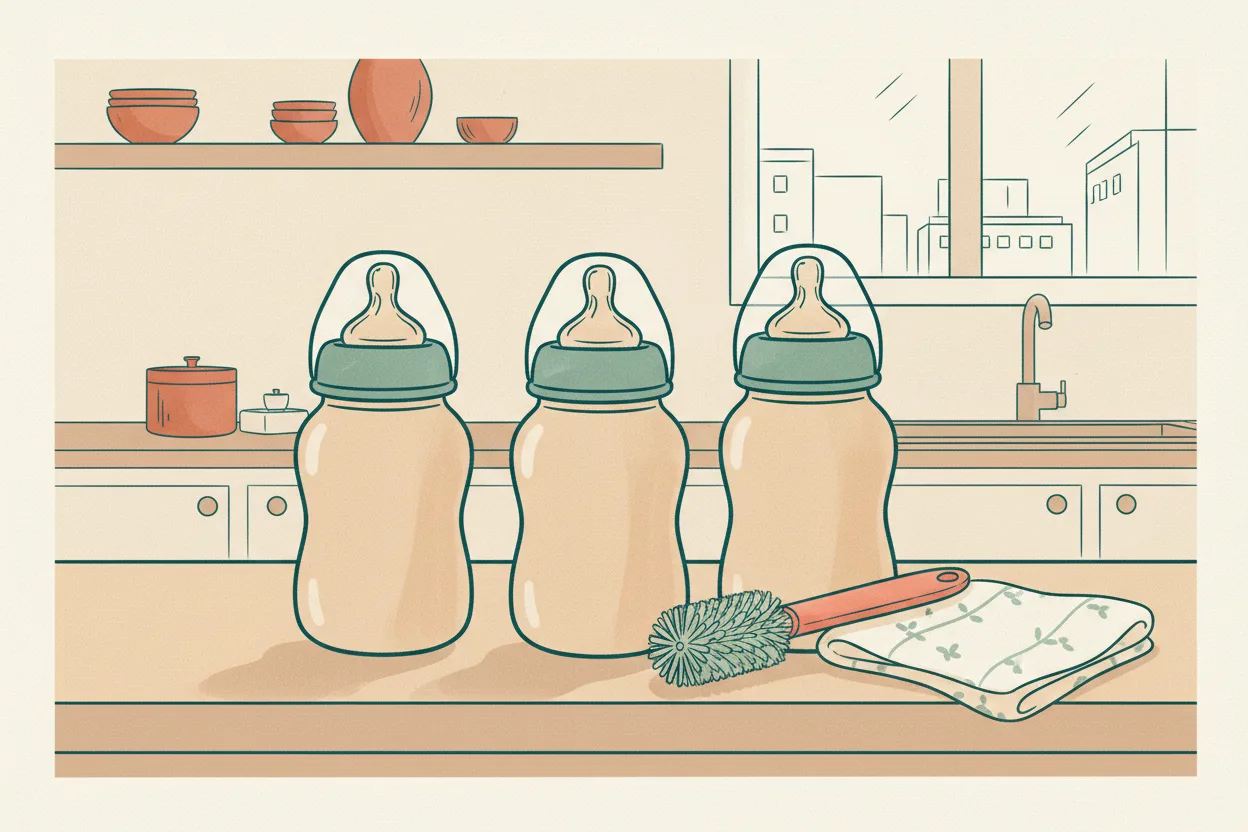
- Take the lid fully apart every evening — lid, straw, gasket, valve — and wash with hot soapy water and a narrow straw brush, the way NHS guidance on cleaning feeding equipment describes for bottles and teats.
- Dry every part separately on a rack. A gasket popped back into a damp groove is the commonest source of that musty smell.
- Empty the bottle at day's end rather than topping it up. NHM's IYCF guidelines stress that hygienic practice matters at every step of preparation, storage and feeding — and humidity is exactly what makes standing water stop being harmless.
- Replace the straw and gasket the moment they go cloudy, stiff or nicked.
On sterilising and dishwashers. NHS guidance says feeding equipment should be sterilised until a child is at least 12 months old to protect against infections such as diarrhoea and vomiting, and that a dishwasher cleans but does not sterilise. Past the first birthday, thorough washing is the routine.
Two cautions specific to steel. Heat can wreck a vacuum seal even when the steel is fine, so keep the insulated body out of the steriliser and dishwasher unless the maker says otherwise. And skip bleach-based soaking solutions on the body: the same Materials review explains that this steel resists corrosion through a thin chromium-rich surface layer, which is exactly what chloride-heavy solutions attack. Lids, straws and gaskets are usually silicone or plastic and can be treated separately.
One Safety Habit Worth Building Now
Teach drinking sitting down. A rigid straw sits in the mouth much like the objects behind mouth injuries: a 2015 case report in the Journal of Emergencies, Trauma, and Shock notes that the most frequent mechanism of injury is a fall while holding an object in the mouth or hands, and a newly walking toddler is the classic candidate.
Sit to drink, then get up and go. Easy to teach at one, hard to introduce at three.
Where to Buy
Search rather than chase a brand — the same bottle sells under several labels in India. Useful searches: insulated steel straw sippers on Amazon India and toddler steel sippers on FirstCry. Filter for a named steel grade, a removable straw, and a seller that lists spares.
The Short Version
Buy the insulated steel straw bottle if it gets your child drinking cold water, fill it with plain water, and keep an open cup on the table alongside it — the NHS is clear that a valve-free cup teaches sipping rather than sucking, and that is where you are heading.
Then judge the bottle on one thing: whether you can get a brush down the straw.
Not medical advice — consult your pediatrician for guidance about your own child.