

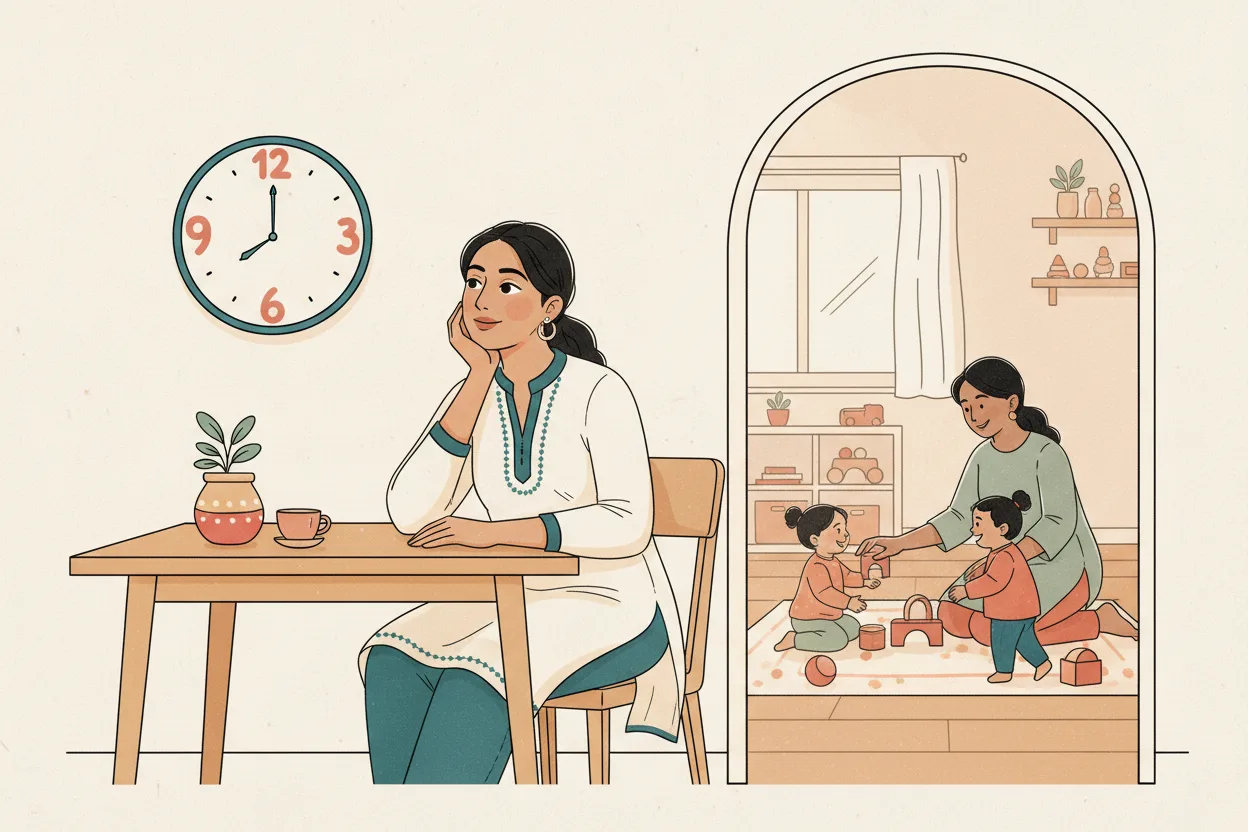
If your nanny keeps shifting her start time and skipping the tasks you agreed on — cooking, washing bottles while the baby sleeps — the decision in front of you isn't really "nanny versus daycare." It's whether the care your baby is getting right now is stable and attentive. The American Academy of Pediatrics (AAP) states that when it comes to healthy brain development, the type of child care arrangement matters less than the quality of care a child receives. So the real question is: can this specific arrangement deliver that quality — and if not, which of your options can?
Not medical advice — this is a practical decision framework, not a substitute for advice from your pediatrician or a family counsellor.
Why "Nanny vs Daycare" Is the Wrong First Question
Before comparing nanny and daycare as categories, it helps to know what actually predicts good outcomes for your baby — because it isn't the label on the caregiver.
The WHO guideline "Improving Early Childhood Development" describes nurturing care — a stable environment built on affectionate, responsive interactions that protects a child and gives them chances to learn — as the thing that drives healthy early development, and it states this can come from parents or from other primary caregivers. Similarly, the NICHD Study of Early Child Care found that children who experienced warm, positive, intellectually stimulating care — whether from a parent or a paid caregiver — had fewer behaviour problems than children who experienced lower-quality, less attentive care.
Put together, this means the fix for a punctuality problem isn't automatically "switch categories." It's "get to warm, consistent, attentive care" — by any of the three routes: a better nanny, a daycare centre, or you.
Why an Unreliable Nanny Is a Bigger Deal Than It Feels
It's tempting to treat a late arrival or a skipped chore as a minor annoyance you can manage around. Two things make it more serious than that.
Instability adds up. A peer-reviewed study (via PMC) found that long-term instability in a child's non-parental caregiving arrangement between birth and age 3 is associated with higher levels of externalizing behaviour problems. A single late start isn't "instability" in that sense — but a nanny who is unpredictable week to week, whom you may end up replacing anyway after a rocky few months, is exactly the pattern this research flags.
Skipped tasks can be a hygiene issue, not just a discipline issue. If bottle-washing is one of the tasks she's skipping while the baby naps, that's not only about broken agreements. The AAP states that bottles must be kept germ-free between uses, since unclean bottles are a route for harmful bacteria to reach a baby. A caregiver who reliably skips this is creating a real gap in your baby's care — reason enough to address it directly and quickly.
When Switching to Daycare Makes Sense
Daycare is worth seriously considering when the underlying issue is that no individual nanny arrangement in your search pool is giving you consistent, attentive care — rather than one person having a bad few weeks.
Daycare is a genuinely good option here, not a fallback: the NICHD Study of Early Child Care and Youth Development (via PMC) found that higher-quality early child care predicts stronger cognitive and academic achievement, with positive effects still visible at age 15. And the AAP notes that stable, nurturing caregiver-child relationships support healthy emotional development — a well-run centre with low staff turnover can offer that stability more reliably than a single individual you're managing solo.
Signs daycare is the better fit for your family right now:
| Situation | Nanny | Daycare |
|---|---|---|
| You've cycled through 2+ unreliable nannies already | Higher risk of more instability | A structured routine, less dependent on one person |
| You need coverage during fixed office hours only | Good if reliable | Good — fixed hours, fixed fees |
| Baby is 10+ months and mobile, benefits from peer interaction | Limited | Structured play, other children |
| You want backup if the primary caregiver is sick | Single point of failure | Staff can cover for each other |
| Budget allows Rs. 8,000–20,000/month (varies widely by city and centre) | Comparable in many cities | Comparable in many cities |
If your city has a daycare centre with visible staff continuity, a clean, child-proofed space, and a transparent daily routine, it directly addresses the punctuality and reliability problem structurally — you're no longer dependent on one person's daily choices.
For a concrete benchmark on staffing, the Ministry of Women and Child Development, Government of India states that under the National Creche Scheme, a crèche should not have more than 25 children, staffed by one worker and one helper. Ask any centre you visit how their own ratio compares to that.
Should You Step Back and Become the Primary Caregiver Instead?
This is the option that feels most "responsible" in the moment — but it isn't automatically the best choice for your baby, and it's worth weighing honestly.
A peer-reviewed study of parenting stress and responsiveness (via PMC) found that for both mothers and fathers, parenting stress was negatively associated with responsiveness, and lower responsiveness is linked to weaker cognitive and social development in the child. If quitting your job to solve a caregiving problem would leave you financially stretched, isolated, or constantly stressed, that stress itself becomes a factor in your baby's care — it doesn't disappear just because you're the one holding the baby. So becoming the primary caregiver is worth choosing only if it genuinely eases the pressure on your household, not simply because it feels like the "safe" default when a nanny arrangement is going badly.
There's also a developmental case for keeping some trusted caregiver besides yourself in the picture. MedlinePlus (U.S. National Library of Medicine) states that letting an infant or toddler spend time with a trusted, consistent caregiver helps them learn to trust and bond with other adults and understand that their parents will return, which eases separation anxiety over time. A baby who only ever experiences one caregiver doesn't automatically benefit from that; a stable second relationship, done well, is a plus rather than a risk.
A Practical Way to Decide
Work through these in order rather than jumping straight to the biggest decision:
- Name the specific problem in writing — punctuality, task refusal, or both? Addressing punctuality directly, with a clear written schedule and a stated consequence, often resolves both.
- Give one clear, final conversation — state the exact start time, the exact tasks, and what happens if either slips again. Many nannies that seem unreliable are testing an unclear boundary rather than being fundamentally unsuitable.
- If it doesn't hold, move to daycare research in parallel — visit a few centres nearby, check staff-to-child ratios and how long staff have worked there, and shortlist one before you need it.
- Only consider stepping back yourself if neither works — and be honest about whether it will ease or add to your household's stress.
Frequently Asked Questions
Is it common for a new nanny to test boundaries at first? Some adjustment period is common — Raising Children Network states that some children settle into a new care arrangement within days, while others are still upset even after the first few weeks, without that being unusual. But a clear pattern of shifting start times and refusing agreed tasks early on is worth addressing directly and quickly rather than waiting it out — see the practical steps above.
How many missed start times before I should worry? There's no fixed number, but a repeated, unpredictable pattern — rather than one genuine one-off — is the kind of caregiving instability linked to more behaviour problems in young children. Treat a second or third slip, after you've clearly stated expectations, as a decision point.
Will switching caregivers hurt my baby? A single, well-planned transition to a stable new arrangement is very different from repeated instability. What the research flags is long-term, repeated churn in caregivers — not one deliberate switch from an unreliable arrangement to a more stable one. To make the handover gentler, the AAP recommends having a new caregiver come for a paid trial hour while you're still home, so you can introduce them to your baby and see the fit before leaving them alone together.
Is daycare safe and good for a baby around 10 months old in India? Quality is what matters, not the daycare label itself — per the AAP. Look for a centre with a low staff-to-child ratio, staff who have been there a while, a clean and child-proofed space, and a routine you can see for yourself on a visit.
What if daycare fees are more than our monthly budget allows and staying home isn't realistic either? Ask whether a shared nanny arrangement with another family nearby (splitting the salary and hours) is available in your building or neighbourhood — it can bring costs closer to a daycare fee while keeping one-on-one care. Some employers also offer childcare allowances or flexible hours worth asking about before ruling either option out.