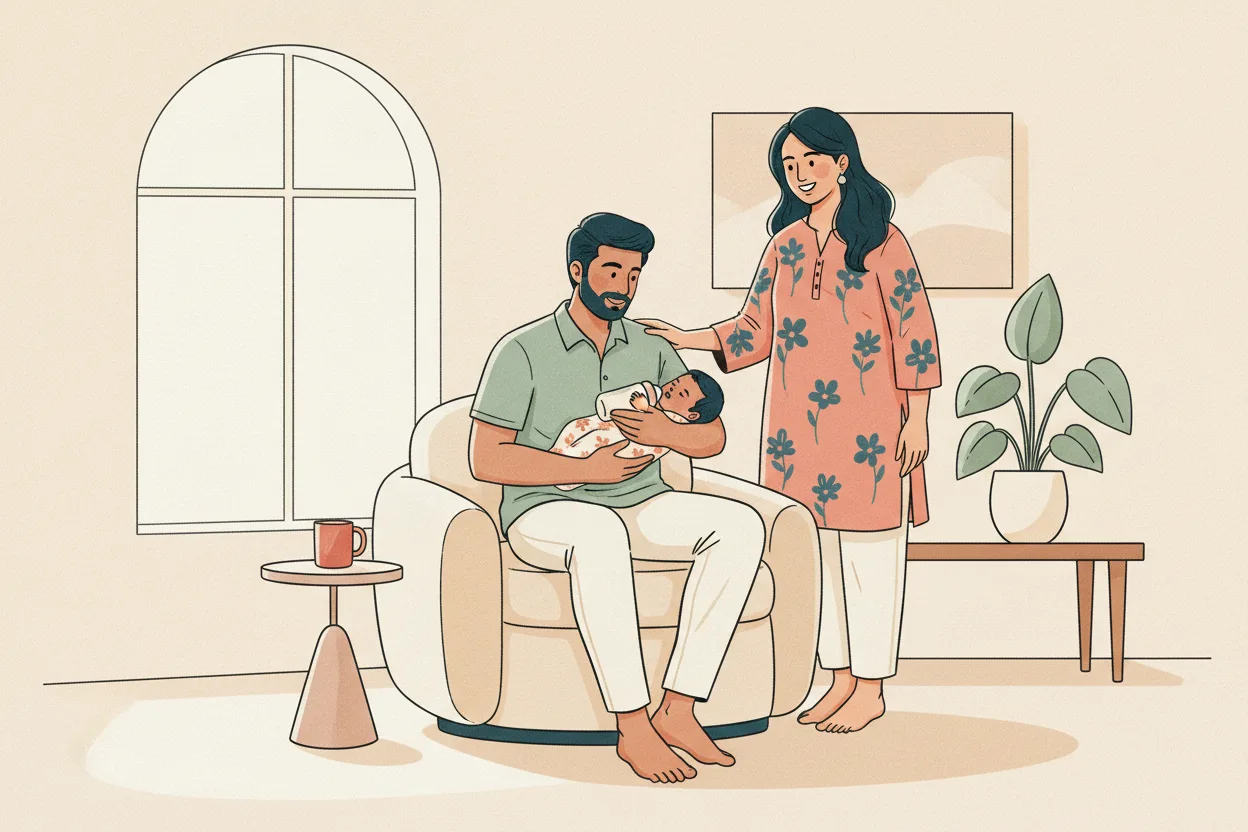


Doing newborn nights completely solo — your husband out of the house for a full workday, no one else around — is one of the hardest stretches of early parenthood, and it does not mean you're failing at this. Newborn babies typically sleep 16 to 18 hours in each 24-hour day, but this sleep is accumulated across a series of naps, not one long overnight block — so the constant waking you're living through is the baby's biology, not a schedule you've failed to set up.
Not medical advice — consult your pediatrician about your baby, and your own doctor if the exhaustion is affecting your health.
Why "No Help" Hits Differently in an Indian Home
Most Indian parenting advice quietly assumes a joint family on night duty — a mother-in-law taking a shift, a dai for the first forty days, relatives cycling through. When your partner is the sole earner and out of the house all day, and there's genuinely no one else around, none of that applies, and generic advice can leave you feeling like you're getting this wrong. You're not. You're doing a harder version of an already hard job, and the strategies below are built for that version specifically — not the one with a full house.
What's Actually Normal (So You Stop Second-Guessing Yourself)
Newborns aren't capable of sleeping through the night, and they're not supposed to yet. Breastfed newborns usually nurse every 2 hours from the start of one feeding to the next, so 10 to 12 feeding sessions in 24 hours is the norm — bottle-fed babies aren't far behind that. That works out to a feed roughly every 2–3 hours around the clock, which is exactly why an unbroken night simply isn't on the table yet, no matter how "good" a baby is or how well you swaddle.
That one fact reframes a lot of what feels like personal failure: there is no schedule trick that gets a two- or six-week-old to sleep through. The biology has to catch up first, gradually, over the coming months.
Protect Your Own Sleep, Not Just Baby's
Fragmented sleep isn't just uncomfortable — it carries real consequences for you specifically. A study in the Journal of Clinical Sleep Medicine found that poor sleep quality in the early postpartum period independently predicts the later development of postpartum depression, which makes protecting even small windows of your own sleep a mental-health priority, not a luxury you're indulging in.
It also helps to know what's ordinary exhaustion versus something that needs attention. Cleveland Clinic explains that baby blues tend to peak in that first week after delivery and resolve within those first two weeks. If low mood, hopelessness, or loss of joy in things continues past that window, treat it as a signal to get a doctor's evaluation for postpartum depression, rather than pushing through it as ordinary tiredness. If arranging that visit isn't immediately possible, India's Ministry of Health and Family Welfare runs the free, 24x7 Tele MANAS helpline, reachable by dialing the toll-free number 1800-89-14416 or short code 14416, so you can talk to someone the same night rather than waiting for an appointment.
Safe Sleep Rules to Never Cut Corners On, Even at 2 a.m.
Exhaustion is exactly when it's tempting to cut corners on sleep safety — and exactly when you shouldn't. The AAP recommends putting your baby on their back for every sleep, nap and nighttime, even for the exhausted middle-of-the-night feed when all you want is to lie back down.
On where baby sleeps: NICHD's Safe to Sleep campaign recommends room-sharing — baby sleeping in the same room as you, in their own separate crib or bassinet near the adult bed, rather than in your bed. This actually works in your favour on solo nights: baby stays within arm's reach for feeds, without the added risks of bed-sharing when you yourself are running on almost no sleep.
Getting Real Help From a Partner Who's Out All Day
"No help" often really means "no help overnight or on weekday evenings," because your partner is at work all day. Restructuring around that is still worth it — the payoff is measurable. A study in Frontiers in Psychiatry found that greater paternal involvement in infant care is associated with lower maternal depressive symptoms and higher maternal life satisfaction; this isn't just about splitting chores, it changes how you cope.
Concretely, HealthyChildren.org advises fathers to take shifts with diaper changes, feeds, and rocking or calming the baby, noting that even a few extra hours in bed can help both parents cope better with the stress of new parenthood. In practice, that can look like: he takes the late-evening or early-morning block on weekdays before or after work, with a bottle of expressed milk ready in the fridge, and takes a full night on a weekend day so you get one genuinely protected sleep block.
Small Things That Help When You're Alone All Day
A short nap is worth more than it feels like it should be. A systematic review and meta-analysis found that napping in the afternoon improved cognitive performance and especially alertness, for up to two hours after the nap — a 20–30 minute nap while baby sleeps can meaningfully sharpen a foggy afternoon, even without fixing the underlying sleep debt.
The evening stretch is usually the hardest, and it isn't something you're doing wrong. Cleveland Clinic explains that prolactin levels are usually lowest in the evening, causing a slight drop in milk supply that triggers cluster feeding — the back-to-back feeds many parents hit right when they're most exhausted. Knowing it's a normal evening dip, not a sign your supply has failed, makes it easier to ride out.
Gear Worth the Money on Solo Nights
| Product | Price Range | Where to Buy |
|---|---|---|
| White noise / sound machine | Rs. 800 – Rs. 2,500 | Amazon.in |
| Video baby monitor | Rs. 2,500 – Rs. 6,000 | Amazon.in / FirstCry |
| Insulated flask (for one-handed night feeds) | Rs. 500 – Rs. 1,200 | Amazon.in |
| Blackout curtains | Rs. 900 – Rs. 2,500 | Amazon.in / FirstCry |
A video monitor is the single most useful item if the baby naps in another room while you get things done — you can see them settle without walking over every ten minutes. The insulated flask sounds trivial until you're one-handing a 2 a.m. feed with hot water already at arm's reach.
Frequently Asked Questions
Is it normal for my newborn to wake up every single hour at night? Yes, in the early weeks. Newborns typically sleep 16 to 18 hours a day but in short, broken stretches, and feeds happen roughly every 2 hours around the clock. Hourly wake-ups in the first weeks aren't a sign of a problem with your baby or your parenting.
How do I get any rest when the baby only sleeps in short stretches? Sleep when baby sleeps where you can, even briefly. A short afternoon nap has been shown to improve alertness and cognitive performance for up to two hours afterward, so even a 20-minute nap is worth protecting rather than skipping to catch up on chores.
Is it safer to just bring the baby into my bed when I'm this exhausted? Bed-sharing isn't the recommended setup. NICHD recommends room-sharing instead — baby in their own crib or bassinet in your room, within arm's reach but on their own separate sleep surface. Keeping the bassinet right next to your bed gets you most of the convenience without the added risk.
My mother-in-law says a bottle at night would let everyone sleep more. What should I know? Whatever you feed your baby, the frequent-waking pattern in early infancy is normal and expected — newborns feed roughly every 2 hours regardless of feeding method, so it rarely buys the unbroken night it promises. Any change to how you feed your baby is a decision to make with your pediatrician, not a quick fix for exhaustion.
How do I know if this is more than normal new-baby exhaustion? Baby blues typically peak in the first week and resolve by around two weeks postpartum. If low mood, hopelessness, or a loss of interest in things continues past that, or shows up alongside the sleep deprivation, get it checked by a doctor rather than assuming it will pass on its own — poor postpartum sleep is itself linked to a higher chance of developing depression later, so it's worth taking seriously early. You don't have to wait for a doctor's appointment to talk to someone: the government-run Tele MANAS helpline is free and available round the clock on the toll-free number 1800-89-14416 or short code 14416.