
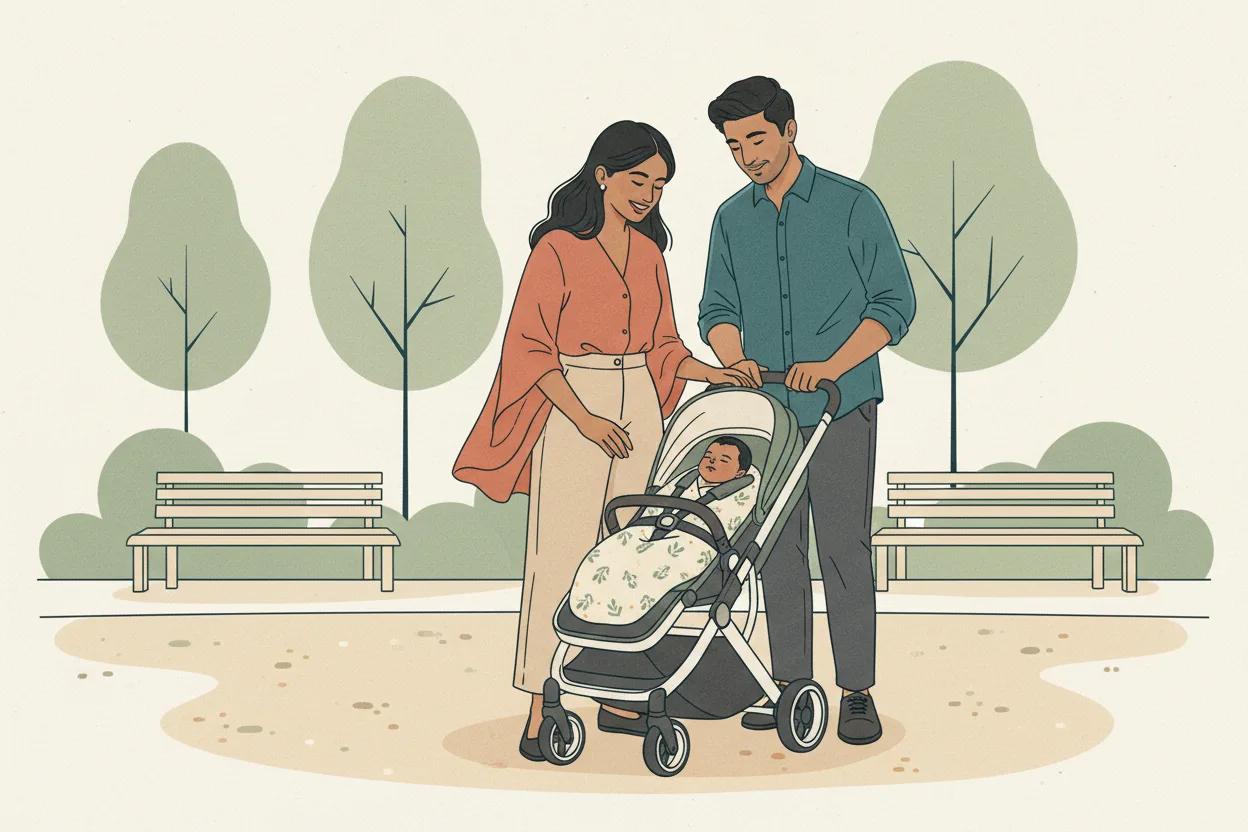
Yes — but only if it reclines all the way flat. NHS guidance states that pushchairs and strollers "are only suitable for young babies if they have fully reclining seats so your baby can lie flat." A stroller that only reclines partway — the semi-upright, "170-degree" seats common on lightweight strollers — isn't a substitute for that flat position in the newborn months.
Not medical advice — consult your pediatrician about your baby's individual readiness for gear and positioning.
Why the Angle Actually Matters
A newborn's neck muscles can't yet hold their head steady, and their spine doesn't have the curves an older baby's does. Left semi-reclined for long stretches, a young baby's chin can drop toward their chest. NICHD's Safe to Sleep campaign warns that "sitting with the head down and the chin on or near the chest could block baby's airway and cause suffocation." That's the core reason a young baby belongs flat rather than angled, whether in a stroller, a car seat, or a swing.
This isn't a theoretical risk. A 2005 cross-sectional study in BMC Pediatrics tested preterm and low-birth-weight infants seated semi-upright in car-seat-style seats and found measurable drops in blood oxygen and heart rate — problems that resolved once the babies were repositioned lying flat: "repositioning from the car seat to the supine position showed normalization of cardio-respiratory function in the majority (83%) of the tested infants." That study was on preterm/low-birth-weight infants, but the effect isn't limited to them: a 2001 study in Pediatrics found that healthy full-term newborns placed semi-upright in car-seat-style seats also had a significant drop in oxygen saturation, from 97% lying flat to 94% after an hour in the seat — "mean oxygen saturation values declined significantly in both preterm and term infants from 97% in the supine position (range: 92%-100%) to 94% after 60 minutes in their car seats (range: 87%-100%)." Full-term babies didn't have the apnea or slowed-heart-rate events seen in the preterm group, but the oxygen dip happened regardless of gestational age — the same mechanism behind the broader caution against propping a young baby upright for long periods.
That's also why sitting equipment in general is a poor substitute for a flat sleep surface. The American Academy of Pediatrics (AAP) states that "sitting devices, such as car seats, strollers, swings, infant carriers, and infant slings, are not recommended for routine sleep in the hospital or at home, particularly for infants younger than 4 months." A stroller is fine for getting around — for actual sleep, at home or in a hotel while travelling, a baby still needs a proper flat cot or bassinet.
The India-Specific Part
Indian cities mean more time in the stroller per outing — a stroll at the neighbourhood park, a wait at the paediatrician's clinic, a trip to an air-conditioned mall. Longer stretches in the seat make the recline angle matter more, not less. Check the recline spec before you buy: many budget and travel strollers sold in India are marketed as "newborn-friendly" while only reclining to a semi-upright angle. Look for "flat recline" or "lie-flat" in the description, and recline the seat yourself in the shop or in photos before ordering online.
When Can the Recline Come Up?
There's no single magic day, but there is a clear physical marker: head control. MedlinePlus's newborn developmental milestones record that by around 4 months, most babies "have almost no head droop while in a sitting position." That's the readiness signal for equipment that expects a baby to hold their own head — a stroller with the seat brought more upright, a baby carrier in a forward or upright position, and similar gear. Until then, NHS guidance is to keep the seat fully reclined flat. Go by your own baby's head control, not the calendar — if in doubt, keep it flat a little longer.
Every Ride: The Harness Rule
Whatever the recline angle, the harness matters just as much. The AAP's HealthyChildren.org recommends that "the stroller should have a five-point harness (with straps over both shoulders, hips and between the legs) that should be used whenever your child goes for a ride." A two-point waist strap, common on cheaper umbrella strollers, isn't enough for a young baby — check for the full five-point harness before you buy, and buckle it in every single time, even for a five-minute walk to the gate.
Pram vs Stroller vs Travel System
Indian retailers use these terms loosely, which makes shopping confusing. Here's what to actually check, regardless of what the listing calls it:
| Type | Typical recline | Good for a newborn? |
|---|---|---|
| Traditional pram / bassinet stroller | Fully flat, separate carrycot | Yes — carrycot is designed to lie flat from birth |
| "Flat recline" / "lie-flat" stroller | Seat itself reclines to ~170–180° | Yes, if it genuinely lies flat — verify before buying |
| Standard/budget stroller ("170° recline") | Often only semi-upright at full recline | Check carefully — "170°" claims vary by brand and don't always mean flat |
| Travel system (car seat + stroller frame) | Infant car seat clicks onto the frame | Only for transit — avoid long stretches in the car-seat carrier itself, see below |
| Umbrella / lightweight fold stroller | Usually semi-upright only | Not for a newborn — better from ~4–6 months |
The Travel-System Trap
A common India setup: click the infant car seat onto a stroller frame and use that combination all day — car, mall, restaurant, park. It's convenient, but the seat itself is semi-upright. NHS guidance from East Lancashire Hospitals NHS Trust states that "research has shown a link between travelling in car seats for long periods and breathing difficulties in young babies," and recommends against leaving a baby in a car seat for more than about two hours at a stretch. Use the car seat for the drive, then move baby into a flat-recline stroller seat, a carrier, or a flat surface for the rest of the outing.
What to Buy in India
| Product | Typical price | Where to buy |
|---|---|---|
| Flat-recline / bassinet stroller | Rs. 6,000 – Rs. 18,000 | Amazon.in / FirstCry |
| Traditional pram with detachable carrycot | Rs. 8,000 – Rs. 25,000 | FirstCry |
| Travel system (infant car seat + stroller frame) | Rs. 15,000 – Rs. 45,000 | Amazon.in |
Whatever you choose, recline the seat yourself before buying — in the store, or from a video if ordering online. "Reclines" and "lies flat" are not the same claim, and only the second one is right for a newborn.
Frequently Asked Questions
Can I use a regular stroller for my newborn if I just recline it as far as it goes? Only if "as far as it goes" is genuinely flat. NHS guidance is specific: the seat needs to let baby lie flat, not just tilt back. Many budget strollers stop at a semi-upright angle even at maximum recline — check the spec, not just the marketing description, before you rely on it for a newborn.
Is it okay for my baby to nap in the stroller while I'm out? A short nap during a walk is common and generally fine as long as the seat is fully reclined flat and you can see your baby's face. For routine, longer sleep, the AAP advises against sitting devices like strollers, especially under 4 months — move baby to a cot or bassinet for actual sleep at home or at a relative's house.
How is a pram different from a stroller for a newborn? A traditional pram uses a separate carrycot designed to lie flat from birth. A "stroller" is the seat-style pushchair — some recline flat (fine for a newborn), others only to a semi-upright angle (not fine). The label matters less than checking the actual recline yourself.
My baby is 3 months old and hates lying flat in the stroller — can I bring the seat up a little? Go by head control, not age. MedlinePlus marks close-to-full head control as typical by around 4 months. If your baby still has noticeable head droop, keep the seat flat and try a change of scenery, a toy, or carrying them for a bit instead of raising the recline early.
Is it fine to leave my newborn in the car-seat-and-stroller travel system for a whole outing? Better not to. NHS guidance links long periods in car seats to breathing difficulties in young babies and suggests capping it at about two hours. Use the car seat for the drive, then move baby to a flat stroller seat, a carrier, or a flat surface for the rest of the day.
Does the harness matter if the seat is already flat? Yes — recline and harness are separate protections. The AAP recommends using the full five-point harness on every single ride, flat or upright, so your baby can't shift or slide inside the seat.