
The fastest fix for baby clutter in a city apartment isn't a bigger flat — it's fewer things visible at once, clothes sorted by size instead of piled together, and a couple of storage rules that keep small parts, medicines, and batteries safely out of reach. That system fits in a single cupboard and a few labelled bins.
Not medical advice — consult your pediatrician for concerns about your child's safety or health.
Why This Gets Overwhelming Fast
Between baby-shower gifts, hand-me-downs from cousins, and things relatives bring on every visit, most parents end up with far more toys and clothes than a baby uses at once. The system below stores most of it out of sight, rotates it in, and sorts what's left by size and use.
Toy Storage: Rotate, Don't Display Everything
Keep a small rotating set of toys out — say, five to eight — and store the rest in a cupboard or under-bed bin, swapping them every couple of weeks. A University of Toledo study published in Infant Behavior and Development found that toddlers played longer and in more varied, creative ways when fewer toys were available at once, compared to having everything out together. A shelf with a handful of toys does more for your child's play than a floor covered in options.
Choosing the storage itself matters. Skip old-style hinged toy chests or trunks with a heavy, free-falling lid. The US Consumer Product Safety Commission (CPSC) warns that lids on these chests can latch shut on their own or fail to stay propped open, trapping or striking a child by the head or neck. Open-top bins, low shelving, or boxes with a light, removable lid are the safer choice for a toy corner.
Small parts need their own check. Anything a baby under three could put fully in their mouth is a choking risk. CPSC's federal small-parts regulation states that a toy piece is a hazard if it fits entirely inside a cylinder sized to a young child's throat — roughly 3–4 cm across. Store any older sibling's small-piece toys (blocks, puzzle pieces, marbles, small figurines) on a shelf above baby's reach, not mixed into the same low bin. If you're buying new toys in India, look for the ISI mark — the Bureau of Indian Standards (BIS) states that its IS 9873 toy safety standard tests for choking hazards from small parts, sharp points, or edges, and requires toys sold in India to bear the ISI mark under a BIS licence.
Clothes: Sort by Size, Not by Season
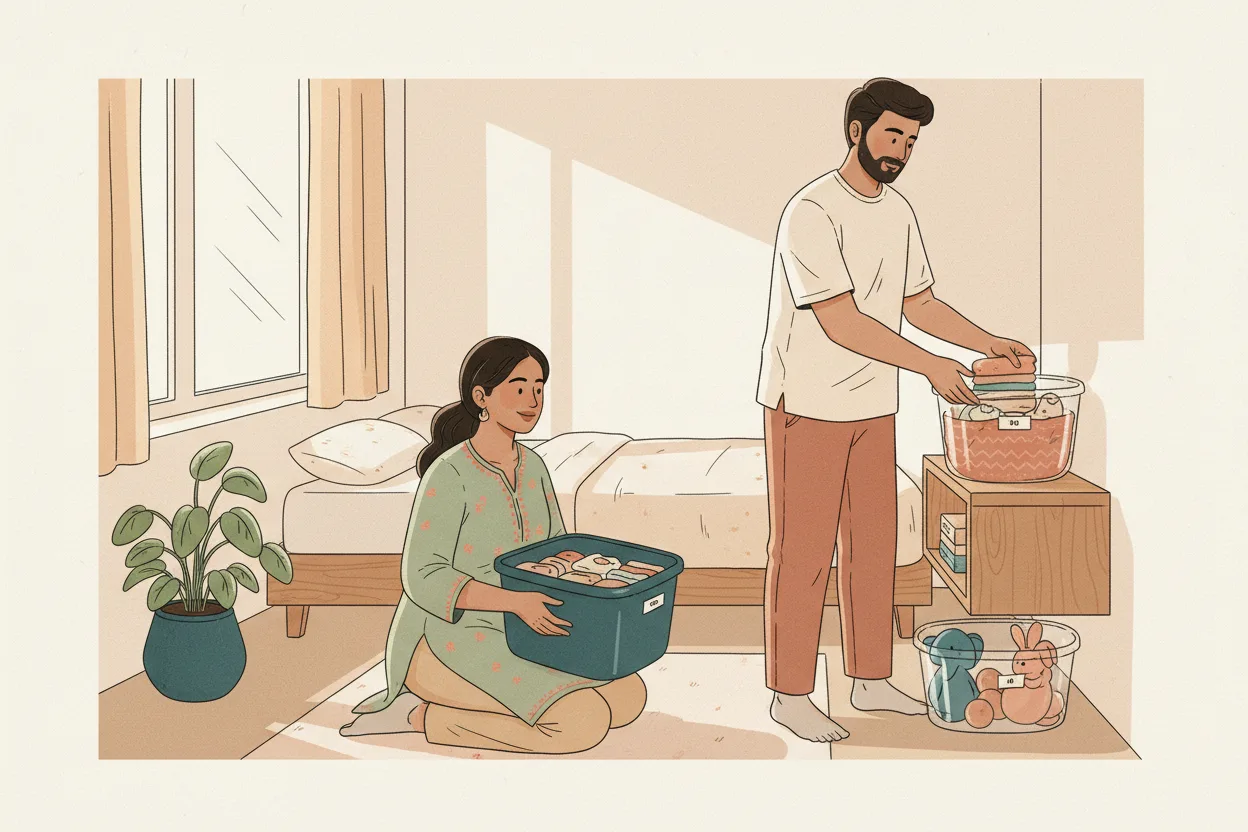
Outgrown-clothes chaos is the most common complaint in small Indian homes, and the fix is simple: sort by size, not occasion. Keep three labelled boxes — "current size," "next size up," and "outgrown" — and move clothes between them at every growth spurt instead of letting everything live in one drawer. Vacuum-storage bags or stackable clear bins under the cot or on top of the wardrobe work well for whatever isn't in current rotation.
New clothes need a wash first, even gifted ones. The American Academy of Pediatrics (HealthyChildren.org) recommends washing all clothes before a baby wears them, since a newborn's skin is more sensitive and you don't know who handled the garment before it reached you. Keep a small "to wash" basket by the door for anything that arrives from relatives or a shop, so it never gets mixed into the clean-clothes shelf by mistake.
Medicines, Bath Supplies, and Batteries: Store Up and Out of Reach
Baby's paracetamol syrup, thermometer, and bath supplies are easy to leave on a low shelf or bedside table for convenience — but that's exactly the height a crawling or standing baby can reach. The US CDC's Up and Away and Out of Sight campaign advises storing all medicine up and away and out of children's reach and sight, every single time, not just when you remember. A high shelf or a small locked box works better than a bedside drawer.
Button batteries deserve their own spot. Remote controls, musical toys, and bathroom scales often use coin-sized batteries that are easy for a baby to swallow. The American Academy of Pediatrics (HealthyChildren.org) advises keeping loose and spare batteries locked away, and storing any product that uses button or coin batteries out of reach of curious children. Check toys and remotes for battery compartments that don't screw shut, and tape or relocate those separately.
Anchor Tall Storage Furniture
Once you start stacking bins on a bookshelf or buying a taller dresser for clothes storage, tip-over becomes a real risk as your baby starts pulling up to stand — the American Academy of Pediatrics (HealthyChildren.org) notes that babies typically start pulling themselves up on furniture somewhere in the 8-to-12-month range, so this is worth doing before that stage, not after. CPSC's Anchor It! campaign recommends securing top-heavy furniture with inexpensive anti-tip brackets, and installing them as soon as the piece comes home rather than after baby starts climbing. This applies to any dresser, bookshelf, or open shelving unit you use for toy or clothes storage, not just nursery-branded furniture.
Keep It Clean, Not Just Tidy
An organized shelf can still be a germ magnet if it's never wiped down. The US CDC's hygiene guidance states that high-touch items like toys carry more germs than surfaces that are handled less often, and recommends sanitizing toys and play surfaces regularly — especially anything that goes in your baby's mouth.
Fabric storage and allergies are linked, too. Overstuffed soft-toy shelves, unaired bedding, and piles of stored clothing hold onto moisture and warmth. A National Institutes of Health (NCBI/StatPearls) clinical review states that dust mites thrive in warm, moist conditions, and that bedding, linens, and soft furnishings that trap humidity are their most favourable environment. Keeping soft-toy and fabric storage decluttered, and airing bins out periodically, helps limit a common childhood allergy trigger.
Travel Packing: One Bag, One System
For weekend trips or a visit to the in-laws, a set of zippered packing cubes — one for clothes, one for feeding items, one for bath and diapering — saves repacking a full bag every time. Keep a small "always-ready" pouch with a spare outfit, diapers, and wipes packed permanently, so a last-minute trip doesn't mean raiding the whole clothes shelf.
Products That Actually Help
| Product | Price Range | Where to Buy |
|---|---|---|
| Stackable clear storage bins (with lid) | Rs. 300 – Rs. 900 each | Amazon.in / FirstCry |
| Fabric toy storage basket (open-top) | Rs. 400 – Rs. 1,200 | Amazon.in |
| Anti-tip furniture anchor brackets | Rs. 150 – Rs. 500 per kit | Amazon.in |
| Packing cubes / pouches (set) | Rs. 500 – Rs. 1,500 | Amazon.in / FirstCry |
| Vacuum storage bags (for outgrown clothes) | Rs. 300 – Rs. 800 | Amazon.in |
Open-top bins and anchor brackets are the two worth prioritizing first — one solves the everyday clutter, the other is a real safety fix once your baby starts pulling up on furniture.
Frequently Asked Questions
Is it safe to use an old wooden toy chest with a hinged lid? Only if the lid stays safely propped open or has been fitted with a slow-close hinge or lid support. CPSC warns that older chests can have lid supports that fail, letting the lid drop shut and trap a child by the head or neck. If you're not certain the lid mechanism is safe, switch to an open bin or remove the lid entirely.
Where should I store baby's medicine at home? Up high, out of sight, and out of reach — never on a bedside table or low shelf, even temporarily. The CDC recommends storing all medicine up and away every time, which matters even more once your baby starts climbing.
Do I really need to wash clothes gifted by relatives before baby wears them? Yes. The AAP recommends washing all new clothes before use, since a newborn's skin is sensitive and you don't know what the garment was exposed to before it reached you.
How many toys should actually be out at once? Less than you'd think. Research in Infant Behavior and Development found toddlers engaged in longer, more creative play when fewer toys were accessible at once — a rotating set of five to eight is a reasonable starting point.
My baby just started pulling up on the bookshelf — is that dangerous? It can be, if the shelf isn't anchored. CPSC's Anchor It! campaign recommends fitting anti-tip brackets to any top-heavy furniture right away — it's a small, inexpensive fix that removes a real tip-over risk.
Where do I keep spare batteries and remotes safely? Locked away and out of reach, separate from toys. The AAP advises keeping loose batteries locked up and storing any battery-powered product out of a curious child's reach.