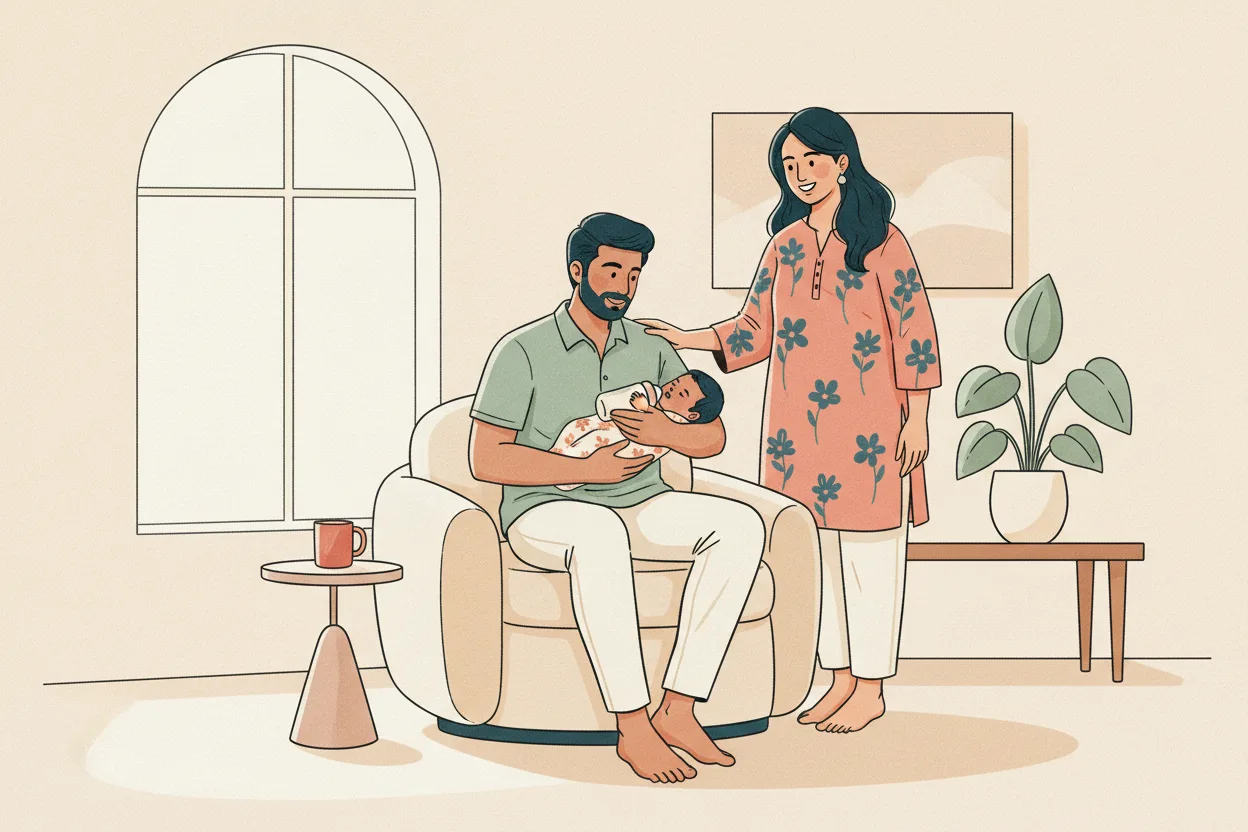


If your partner keeps forwarding parenting Reels and expects each one to become the new house rule, the videos aren't really the problem. The problem is that they've quietly become the deciding vote in every parenting call, instead of one input among several you weigh together. That's a coparenting-authority issue, not a content-consumption issue, and it needs a different conversation than "please stop sending me things."
Not medical advice — if the tension is affecting your wellbeing or your relationship isn't improving with these approaches, a couples counsellor or your doctor can help.
This Isn't the Same as In-Law Interference
An overbearing relative weighing in from outside the household is one kind of friction. A partner is supposed to be inside the decision with you, not appointing himself its checker. HealthyChildren.org, the American Academy of Pediatrics' parenting resource, advises that "it is critical that parents support, rather than undermine, the other's parenting authority" — and that cuts both ways. If a Reel becomes grounds to override a call you already made, the pattern is working against both of you, not just against the video's content.
It also helps to know that disagreement itself isn't the danger here. A 2019 study in the Journal of Family Psychology found that "it isn't whether parents fight, but how parents fight that matters for children's development." You don't need to agree with every Reel, or pretend to. You need a way to disagree that doesn't turn into one of you overruling the other in front of the baby.
Why the Reels Keep Coming
He's very likely not trying to score points — parenting content is genuinely everywhere, and it's easy to mistake volume for authority. A WHO-commissioned review found that an overload of health information and misinformation online — sometimes called an "infodemic" — brings "incorrect interpretations of health information" that "often negatively impact people's mental health and increase vaccine hesitancy, and can delay the provision of health care." Applied here: a constant feed of 30-second parenting takes, stripped of context, is a plausible source of confident-sounding "rules" that were never actually guidelines.
The scrolling itself can also be doing something to his state of mind, not just yours. A 2024 study in JMIR Pediatrics and Parenting found that "SNS [social networking site] use was related to psychological distress only at higher levels of parenting anxiety" — meaning heavy parenting-content consumption tends to track with distress specifically in parents who are already anxious about getting it right, not with casual scrollers. If the sending has picked up alongside visible anxiety on his end, the content may be a symptom of that anxiety as much as a cause of the friction.
When Disagreement Turns Into Undermining
Occasional pushback is normal. The pattern worth naming is different: a Reel arrives, and he expects the household to switch to whatever it showed, without a conversation about whether it fits your baby, your read of the situation, or the call you'd already made together. That's the part worth addressing directly, per the AAP guidance above — parenting authority holds up better when both of you visibly back each other's calls, even the ones you'd have made slightly differently.
There's also a two-way relationship between stress and how well coparenting is going, so this friction can compound if it isn't addressed early. A 2025 study in the journal Family Process found that "elevations in both maternal and paternal postpartum parenting stress were uniquely and significantly associated with lower dyadic coparenting quality." In plain terms: the more stressed either of you is, the shakier the teamwork gets — and shakier teamwork is, in turn, more stressful. Catching the Reels-as-override pattern early, before it becomes a recurring fight, protects both directions of that loop.
When It's More Than the Reels
Two things are worth checking honestly before you assume this is just an annoying habit.
Is he anxious or low, not just opinionated? A review in the Industrial Psychiatry Journal found that "the peak incidence of depression (25.6%) in fathers was between 3 and 6 months after the birth of the child," and that one partner's depression significantly raises the risk of the other's worsening. Fixating on parenting content and needing to control outcomes can sometimes be how anxiety or low mood shows up in a new father, rather than genuine disagreement with your choices. If he seems persistently anxious, low, or irritable beyond the Reels themselves, that's worth naming gently and bringing to a doctor together.
Is everyone just exhausted? The Sleep Foundation reports that "higher levels of stress are associated with difficulty regulating emotions, which may explain why caregivers who have less or fragmented sleep, or who take longer to fall asleep, show less positive parenting." A sleep-deprived partner is more likely to dig in over a Reel than to have a calm conversation about it. If nights are still rough, protecting even a couple of uninterrupted stretches for each of you may lower the temperature on everything else.
How to Reset the Dynamic
There's no need to ban the Reels — a shared filter for what earns a place in an actual decision does the job instead. This is worth getting right beyond just reducing the friction: a 2016 study in the journal Sex Roles found that among new parents, "mothers reported less conflict when they perceived the division of childcare as less unfair to themselves" — so restoring an actual felt say in decisions, not just quieting the Reels, is what protects the relationship.
- Separate "interesting" from "decided." Agree on a phrase for content he wants to flag without it becoming policy: "worth a look" versus "let's actually change something." That one distinction removes most of the pressure.
- Ask for the source, not just the clip. "Where's this from — is there a study or a paediatrician behind it, or is it just the creator's opinion?" is a fair, non-confrontational question that slows down reflexive overrides.
- Bring decisions back to your paediatrician. When a Reel conflicts with what your paediatrician has told you directly, that's the tiebreaker, not the algorithm.
- Say the authority piece out loud. "I need you to back the calls we've already made in front of him, even if you saw something different online today" states the actual ask plainly, instead of relitigating each video.
- Protect a no-scroll window together. A defined hour without either of you on parenting content gives you time to actually talk to each other instead of talking through what you each watched.
Frequently Asked Questions
Is it normal for one partner to send parenting content constantly? It's common, and it often reflects information overload rather than bad intent — a lot of confident-sounding short-form content, not necessarily concern about your parenting specifically. The issue to address is what happens next: whether it stays a suggestion or becomes an expected rule change.
How do we disagree about parenting without it affecting the baby? Research is consistent that the manner of disagreement matters more than its existence. Take the disagreement out of the moment — discuss it later, privately — and present a united front once you've actually decided together.
Could this be about his own anxiety, not our parenting choices? Possibly. Paternal depression and anxiety peak in the first several months after a baby arrives, and can show up as controlling or fixated behavior rather than obvious sadness. If it's persistent, raise it with a doctor together rather than treating it purely as a communication problem.
Does constant disagreement over parenting actually hurt our coparenting? Yes, if it's left unaddressed — stress and weaker coparenting quality reinforce each other in both partners. Fixing the pattern early is easier than untangling it once it's a recurring fight.
We're both exhausted — is that making this worse? Likely yes. Poor or fragmented sleep is linked to less positive, more reactive parenting, which makes any disagreement — Reels included — harder to have calmly. Protecting sleep, even in small blocks, tends to lower the friction on everything else.