
Handfuls of hair in the shower drain and skin that suddenly won't stop feeling dry are two of the most common complaints new parents raise a few months after delivery — and both are usually normal. A case-series study in the Journal of Clinical and Aesthetic Dermatology, via PMC, reports that postpartum hair shedding — called telogen effluvium — affects an estimated one-third to one-half of women after delivery. Dry, sensitive skin in the same window is common too, and both usually settle on their own within months.
Not medical advice — consult your dermatologist or gynaecologist for personal guidance.
Why Your Hair Falls Out After Delivery
During pregnancy, high estrogen keeps more hair follicles than usual in their growing phase, which is why hair often looks thicker while you're pregnant. After delivery, estrogen levels fall sharply, and a large batch of those follicles shifts into the shedding phase together — that sudden, synchronized shedding is telogen effluvium, not permanent hair loss. Cleveland Clinic explains that the shedding should last less than six months, and hair should regain its fullness by the time your child turns one.
If you're wondering whether your current shedding is "on track," NIH's StatPearls on telogen effluvium notes that the gap between a triggering event — in this case, childbirth — and the onset of visible shedding is typically around 3 months, though it can range from 1 to 6 months. So the heaviest shedding usually shows up somewhere in that 3-to-4-month postpartum window, not immediately after birth.
Does Breastfeeding Make It Last Longer?
Many mothers notice shedding continues for as long as they're nursing, and there's a reason for that. A questionnaire-based cross-sectional study, via PMC, found that continuing to breastfeed for 6–12 months or longer is associated with a higher risk of postpartum hair loss than stopping within 6 months, likely because breastfeeding delays the recovery of estrogen levels after birth. This is not a reason to stop breastfeeding early — it's simply useful context for why the shedding phase can feel longer for mothers who nurse for longer.
When Hair Fall Might Point to Something Else
Hair shedding by itself is a poor guide to thyroid trouble. A PMC-published study on postpartum thyroiditis symptoms found that hair falling out was reported by about a third of postpartum women who tested negative for thyroid autoimmunity in the study — meaning hair loss alone is common even without a thyroid problem, and a thyroid function test is needed to confirm a thyroid cause.
Persistent dry skin paired with fatigue is a more specific combination worth flagging to a doctor. NIH's StatPearls states that dry skin and fatigue, alongside constipation, impaired concentration, cold intolerance, and paresthesia, mark the underactive phase of postpartum thyroiditis, a condition that affects roughly 5–8% of postpartum women. If both show up together and don't fade in a few weeks, get a thyroid function test rather than assuming it's just new-parent exhaustion.
Iron, Ferritin, and Hair Fall — Especially Relevant in India
Low iron stores are another common, checkable cause of heavy or prolonged hair shedding. A systematic review and meta-analysis, via PMC, found that ferritin levels below 30–40 ng/mL are more sensitive and as specific for the diagnosis of iron deficiency as the older, stricter 10–15 ng/mL cutoff — so it's reasonable to ask for a ferritin test if hair loss feels heavier or is lasting longer than expected, even if a standard iron report comes back "normal" by the older cutoff.
This is particularly relevant in India. A PMC review of Indian anemia management guidelines states that India's National Iron Plus Initiative recommends 100 mg of elemental iron and 500 mcg of folic acid every day for at least 100 days, reflecting how widespread iron-deficiency anemia is among Indian women around pregnancy and delivery. If you were started on iron-folic acid tablets during pregnancy, ask your doctor at your postpartum check-up whether you should continue them — heavy hair fall is a reasonable prompt to bring it up if no one has mentioned it since delivery.
Do Hair-Fall Treatments Actually Help?
Once the causes above are ruled out, the next question is usually whether anything speeds up regrowth. Biotin supplements are the most heavily marketed option, but a review in the Journal of Clinical and Aesthetic Dermatology, via PMC, found that biotin has no proven efficacy for hair or nail growth in healthy people who don't have a documented biotin deficiency — for most postpartum shedding, which isn't caused by a biotin deficiency, supplementing is unlikely to make a difference.
Minoxidil (the active ingredient in Rogaine-type products) is sometimes suggested for hair regrowth, and NIH's LactMed database states that maternal topical minoxidil is acceptable once breastfeeding is established, though it's not something to start without a doctor's input — and the treated scalp should never touch the baby's skin, since minoxidil absorbed that way can affect an infant. There isn't good evidence that minoxidil specifically shortens ordinary postpartum telogen effluvium, so this is a conversation to have with a dermatologist rather than a default purchase.
Diet is a more actionable lever. Ordinary postpartum shedding isn't caused by under-eating, but going the other way — a very restrictive postpartum diet, whether for weight loss or from simply not having time to eat properly — can add its own hair loss on top of it. A PMC-published review on vitamins, minerals, and hair loss notes that a marked caloric or protein deficiency can itself trigger telogen effluvium-type shedding, with cases reported starting 2–5 months after beginning a vigorous, restrictive weight-loss diet. For breastfeeding mothers on a typical Indian diet, that mostly means not skipping meals or cutting portions too aggressively — dal, dairy, eggs, and other everyday protein sources are enough for most people, without needing a special supplement.
Postpartum Dry Skin — Why It Happens
Hormones don't only affect hair — they affect skin too. Medical News Today explains that even after the baby is born, hormones and immunity can take several months to return to pre-pregnancy levels, which is part of why dry, sensitive skin or eczema-like flares are common in this window. For parents who already have eczema, a BMJ clinical review on eczema in pregnancy, via PMC, states that approximately 10% of cases flare specifically in the postpartum period. For most parents this settles gradually as hormone levels stabilise.
In the meantime, a few simple habits make dry skin more comfortable: a fragrance-free moisturiser applied right after a bath while skin is still damp, lukewarm water instead of hot for washing, and a room humidifier during the dry winter months in northern India.
Products That Actually Help
| Product | Price Range | Where to Buy |
|---|---|---|
| Wide-tooth comb (for wet, shedding-prone hair) | Rs. 100 – Rs. 300 | Amazon.in |
| Sulphate-free, gentle shampoo | Rs. 300 – Rs. 800 | Amazon.in / FirstCry |
| Fragrance-free body moisturiser | Rs. 250 – Rs. 700 | Amazon.in |
| Satin or silk pillowcase | Rs. 400 – Rs. 1,200 | Amazon.in |
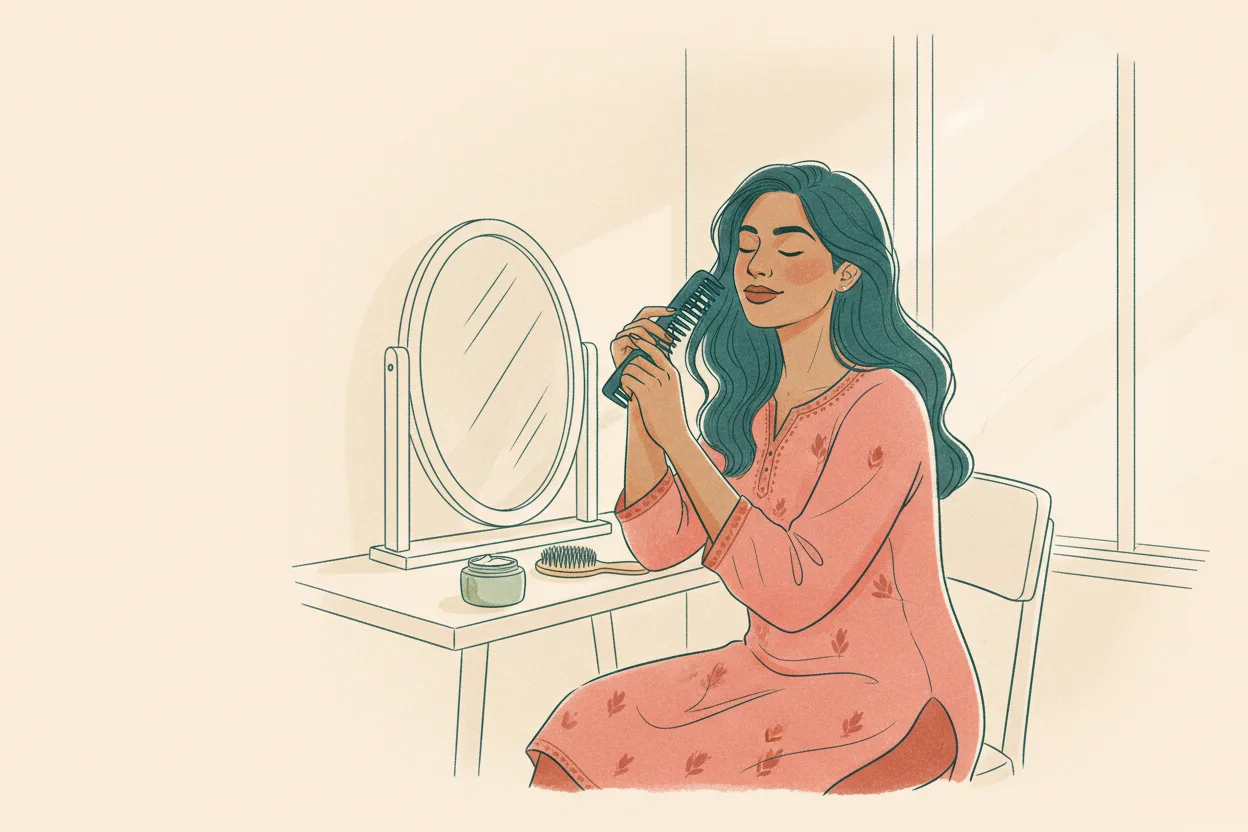
A wide-tooth comb used on wet hair, rather than a fine-tooth comb or hard brushing, is a small change many parents find easier on hair that's already shedding. None of these products treat the underlying hormonal shift — they just make the months while it resolves more comfortable.
Frequently Asked Questions
How long does postpartum hair fall usually last? Cleveland Clinic states that shedding should last less than six months, with hair regaining its fullness by your child's first birthday. If it's still heavy well past that point, mention it to your doctor.
Does breastfeeding for longer make hair fall worse? It can extend the timeline. A cross-sectional study, via PMC, found that breastfeeding for 6–12 months or longer is associated with a higher risk of postpartum hair loss than stopping within 6 months, likely because it delays the recovery of estrogen levels. This isn't a reason to stop nursing early if you don't want to.
Should I get my thyroid checked because of hair fall? Hair fall alone usually isn't enough to diagnose a thyroid issue — a PMC study found that about a third of postpartum women without thyroid autoimmunity also reported hair falling out. But if it comes with dry skin and fatigue, NIH's StatPearls lists these together as signs of the underactive phase of postpartum thyroiditis, so a thyroid function test is worth asking for.
Can low iron cause postpartum hair fall? Yes — research shows ferritin below 30–40 ng/mL is a more sensitive cutoff for iron deficiency than the older 10–15 ng/mL threshold, and low iron is linked to hair shedding. India's National Iron Plus Initiative recommends daily iron-folic acid supplementation for at least 100 days around pregnancy and delivery, so ask your doctor whether you should still be on it.
Why is my skin so dry months after having a baby? Hormones and immune function can take several months after delivery to return to pre-pregnancy levels, and that shift is a common trigger for dry, sensitive skin or eczema-like flares. A fragrance-free moisturiser and lukewarm baths usually help while it settles.
When should I actually see a doctor about this? See your doctor if hair fall is still heavy well past six months, or if dry skin shows up together with ongoing fatigue — both are listed as symptoms of the underactive phase of postpartum thyroiditis, which is worth ruling out with a simple thyroid test.