

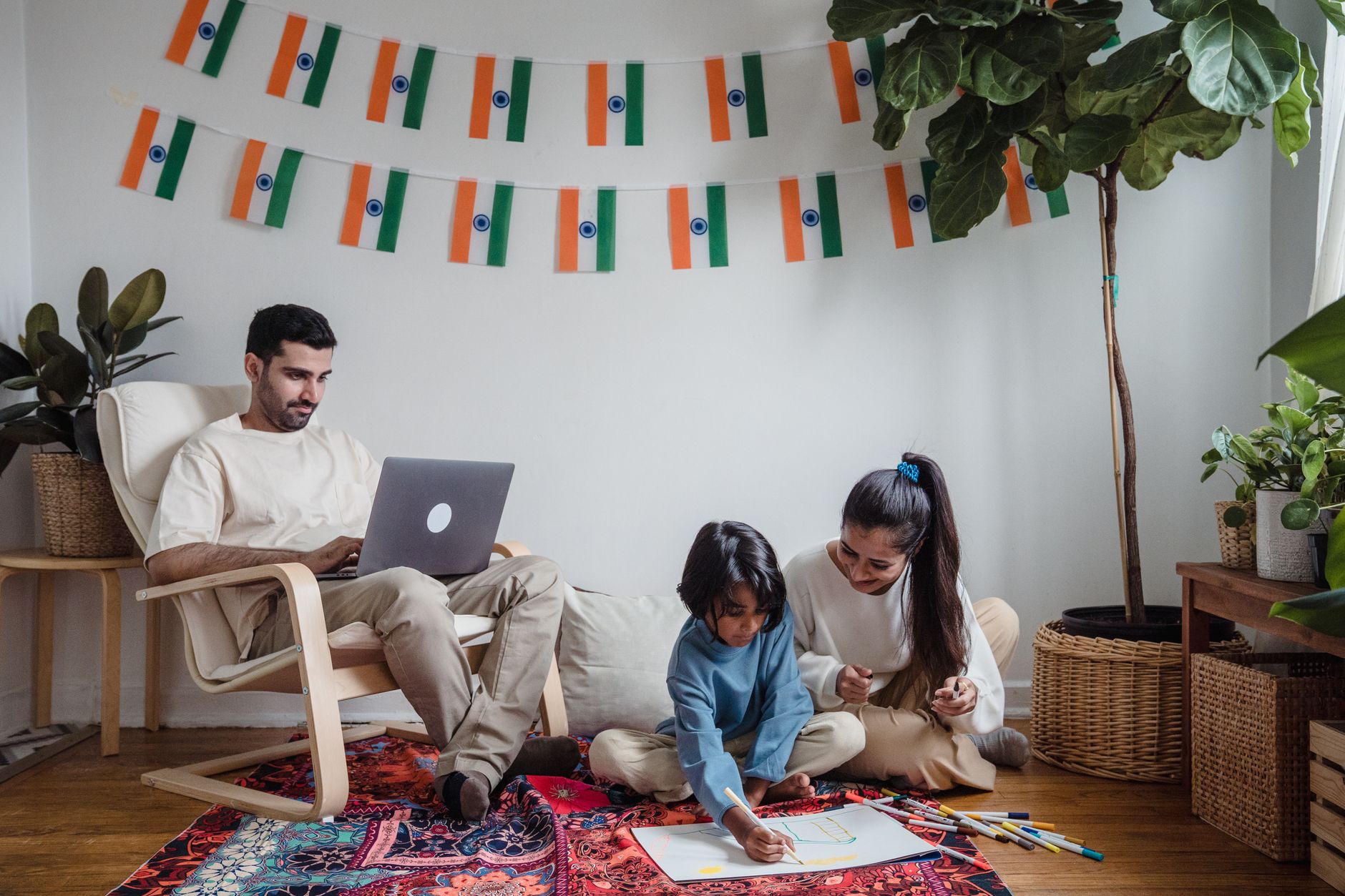
You don't need to build the volcano, stitch the costume, or laminate the family tree yourself. At three to four years old, children are only just learning to draw circles and squares — so a neat, ribbon-finished project was never a realistic ask from your child in the first place. It was always yours. Which means you get to decide, on purpose, how much of it you actually do.
Not medical advice — this article covers parenting stress and child development guidance; talk to your pediatrician if guilt or exhaustion feels unmanageable.
Why Urban Indian Preschool "Projects" Become a Parent's To-Do List
In most urban Indian preschools, the class WhatsApp group turns a simple worksheet into a competition. One parent posts a photo of a beautifully finished ecosystem-in-a-shoebox at 11 p.m., and by the school run next morning, everyone else feels they need to match it. A fun, hands-on toddler activity becomes two hours of a parent's evening — glue gun included — plus quiet guilt about not doing enough.
That pressure comes from how preschool culture works here: a visible group chat, competitive comparison, and teachers sometimes expecting a polished result. None of that changes what's actually appropriate for a young child, or what actually helps them learn — and that's where the evidence is useful.
What a Preschooler Can Realistically Do
The American Academy of Pediatrics' developmental milestones page notes that a typical three- to four-year-old is only just learning to draw circles and squares — not neatly cut shapes, symmetric collages, or captions written in a straight line. Scissor work lags the same way: a developmental milestones review (NIH's StatPearls) states that at four years, a child "hops on 1 foot, can stand on 1 foot for 2 seconds, cuts with scissors" — cutting is filed alongside skills that are visibly still wobbly, not a polished ability. If a finished "kid's project" looks like an adult made it, that's because an adult did. Matching your expectations to what's actually age-appropriate is the first real step to feeling less guilty about handing your child a fat crayon and letting them make a mess of it.
Why Doing It For Them Doesn't Actually Help
The AAP states that the most powerful way children learn isn't in a classroom or from a polished handout, but through play — "on playgrounds and in playrooms." A shoebox diorama assembled mostly by you teaches your child far less than the twenty messy minutes they'd have spent tearing coloured paper and deciding, badly, where to glue it.
This lines up with how early learning works more broadly. WHO's early childhood development guideline FAQ states that opportunities for young children to learn come naturally through everyday activities like feeding, bathing, and playing — not through separate, adult-produced project work. The developmental value was never in the finished diorama. It was in the shared, messy process of making it.
The Research on Parental "Help"
It's tempting to believe that stepping in gets your child a better-looking project, worth any guilt about stepping in. The evidence points the other way. A peer-reviewed study on parental homework support found that when help is given without the child inviting it, that help is linked to lower standardized test scores and grades, in students of all ages from elementary school through high school. Uninvited help doesn't lift outcomes — it correlates with worse ones.
Over-involvement has a second, quieter cost beyond the project itself. A systematic review found that over-controlling, "helicopter" parenting can reduce a child's sense of autonomy and competence rather than build it. Every project you quietly take over is one more small signal to your child that you don't trust them to attempt it themselves.
The Guilt Is Normal — It Isn't a Verdict on Your Parenting
If you already feel like a bad parent for sending in a lopsided, glue-smudged project while a beautifully finished one circulates the group chat, that feeling is common — not a sign you're failing. Cleveland Clinic explains that the guilt that comes from making seemingly impossible choices between competing demands can happen to any parent or caregiver. It isn't specific to you, and it isn't proof that you've fallen short.
What actually eases that guilt isn't doing more — it's how you talk to yourself about doing less. A study on treating parental burnout found that practising self-compassion reduces self-criticism, rumination, and feelings of shame and guilt. Answering the guilty thought the way you'd answer a friend — "you did a reasonable, age-appropriate thing" — isn't a platitude; it's the actual intervention shown to help.
What Indian Pediatric Guidance Actually Backs
This isn't just global advice landing awkwardly in an Indian context. The Indian Academy of Pediatrics' position paper states that responsive, nurturing parenting — not polished academic output — is what actually drives early childhood development, and recommends that this be built into standard pediatric practice in India. Sitting beside your child while they attempt, and mess up, their own project is closer to what IAP is describing than finishing it for them ever was.
A Script for the Class WhatsApp Group
The group chat requires no explanation from you, but a short one can head off the comparison spiral for you and any other parent feeling the same pressure:
- When you post: "Here's [child]'s project — she did the cutting and gluing herself, so it's wonderfully lopsided!" Naming it as child-made resets the bar for everyone reading.
- When someone else's looks store-bought: No comment needed, no need to redo yours. Simply mute the thread if it helps.
- When the teacher expects polish: "We're letting [child] do this mostly herself so it's actually her work" is a reasonable boundary, not a confrontation.
- Share the load: project evenings work well split between parents — one gathering supplies, the other sitting with the child — rather than defaulting to one person every time. A study on father involvement among rural Indian parents found that higher involvement of fathers in parenting improves children's cognitive-academic, social-behavioral, and emotional development, so splitting project time isn't just fairer to you — it's good for your child too.
What to Do vs. What to Skip
| Situation | Skip This | Do This Instead |
|---|---|---|
| Cutting shapes | Cutting it perfectly yourself | Give child-safe scissors and let them try, wobbly lines included |
| Painting / colouring | "Fixing" their colour choices or going over their lines | Let their choices stand, even if the sky is purple |
| Writing labels or captions | Writing it in adult handwriting | Let them scribble, or write a few letters they know, even if illegible |
| Assembling the final piece | Gluing every part exactly in place | Sit with them, hand them the glue stick, let them place it |
| Group-chat pressure | Redoing your child's work after seeing others' | Post it as-is, or don't post at all |
Frequently Asked Questions
How much should I actually help with my preschooler's project? Enough to keep them safe (holding scissors correctly, not eating glue) and to keep the activity moving if they lose interest — not enough to finish it for them. At this age, drawing basic shapes is still an emerging skill, so a rough, child-led result is the expected outcome, not a failure on your part.
My child's project always looks messier than the others in the WhatsApp group. Is that a problem? No. It's usually a sign the project is genuinely theirs. The guilt that comes from comparing yourself to other parents is a near-universal experience, not a signal that you're doing something wrong.
Is it ever okay to just do most of it myself if we're genuinely out of time? Occasionally, yes — but don't let it become the default. Uninvited, adult-led help is linked to worse outcomes for kids, not better ones, so a mostly-parent-made project isn't the "safe" choice it feels like.
What if the teacher genuinely expects a polished, finished-looking project? A short, direct message to the teacher explaining that your child did the work themselves is a reasonable boundary. Responsive, hands-off parenting — not academic polish — is what pediatric guidance says actually supports early development, so you're not out of step with expert advice by sending in imperfect, child-made work.
Does my child even learn anything from a messy, child-led version? Yes — arguably more than from a polished one. Play-based, hands-on activity is how young children learn best, and that everyday, unstructured interaction is where real early learning happens — not in a picture-perfect finished product.
How do I actually stop feeling guilty about this? Notice the guilty thought, then respond to yourself the way you would to a friend in the same spot. Self-compassion has been shown to reduce the self-criticism and shame that drive parental guilt — it's a practised skill, not a personality trait some parents have and others don't.