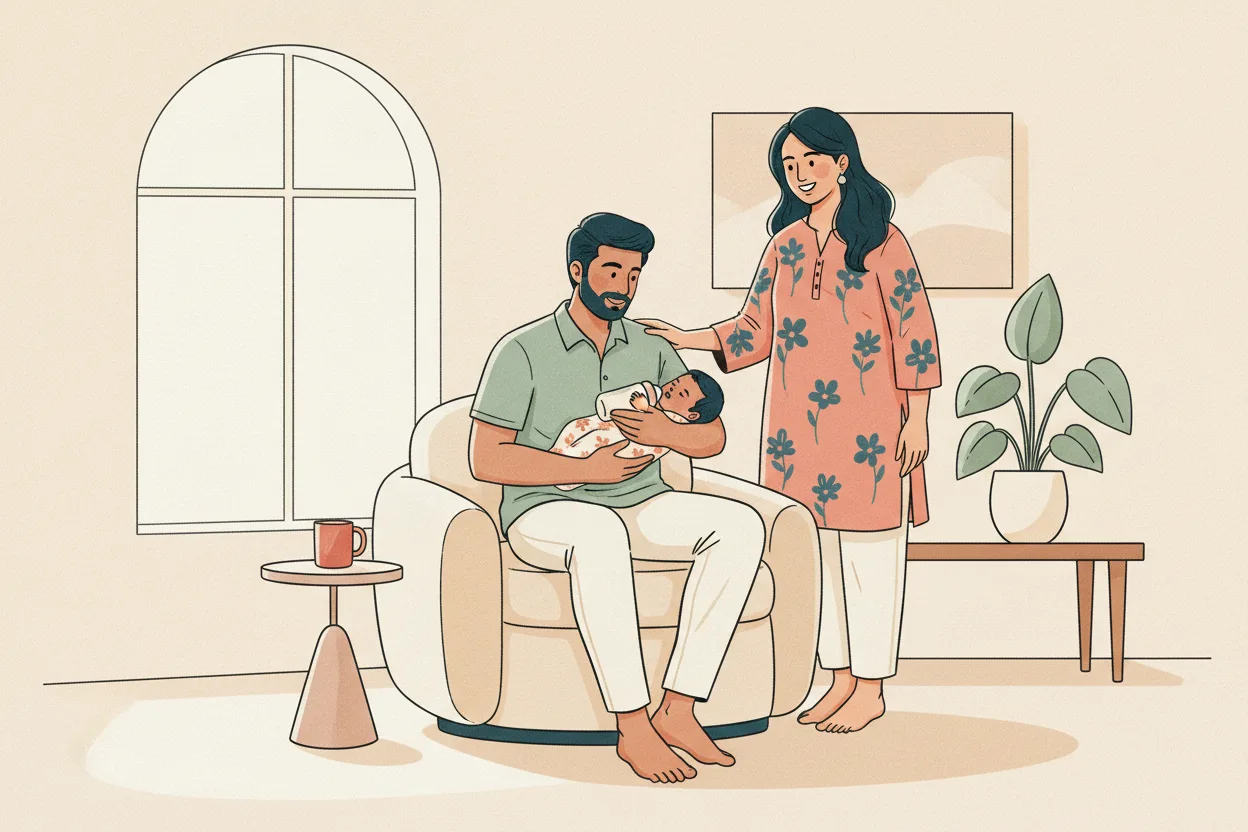

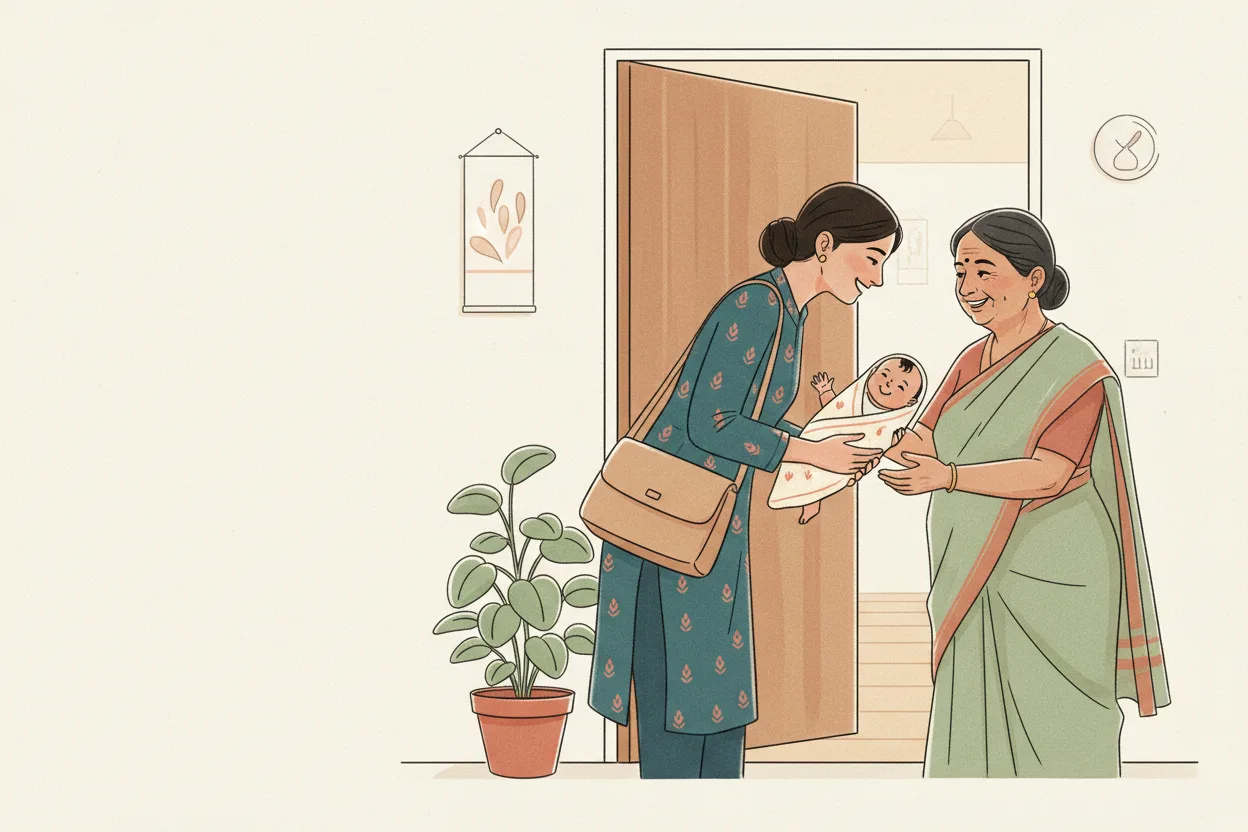
Handing your baby to your mother-in-law and walking out the door for work does not mean you are being replaced. It means your baby is getting a second person to love them — and the research on attachment says that is good for your baby, not a threat to your bond.
Not medical advice — if the grief or low mood around returning to work isn't easing, talk to your doctor.
Why This Hits Differently in an Indian Joint Family
In many Indian homes, the return-to-work handover isn't to a stranger or a daycare — it's to your baby's own grandmother, often living under the same roof. That closeness is a huge practical gift: no commute for a caregiver, no daycare fees, someone already devoted to your child. But it also makes the grief sharper. You're not just missing your baby during the day — you're watching someone else, in your own house, get the first steps and the daytime giggles while you're in a meeting. The guilt of going back to work and the specific fear of your MIL becoming baby's primary daytime attachment figure are two different feelings, and both are worth taking seriously.
Part of why the handover can feel so abrupt is the timeline itself. India's Press Information Bureau (Ministry of Labour & Employment) states that the Maternity Benefit Act, as amended in 2017, "increased paid maternity leave from 12 weeks to 26 weeks" for eligible women — generous by global standards, but it still means most mothers are back at work well before their baby's first birthday, often right as the baby is becoming more socially aware of who's who.
Will My Baby Forget Me — or Love Grandma More?
This is the fear underneath the guilt, and it's worth answering directly: no. A peer-reviewed review of attachment research found that "children can establish attachment relationships with their day care providers" — babies are built to form real, secure bonds with more than one steady caregiver. Your baby having a warm attachment to your MIL doesn't use up a fixed quota of love meant for you; it adds a second secure relationship on top of yours.
What determines how secure your baby feels with you isn't how many hours your MIL logs during the day. An NICHD Study of Early Child Care and Youth Development analysis found that "higher-quality child care positively predicted security in late adolescence above and beyond demographic covariates and parental sensitivity" — the quality and warmth of the care your baby gets, from whoever gives it, shapes attachment outcomes, not a rivalry between caregivers. Your bond is built in the hours you do have, not eroded in the hours you don't.
Grandparent Care Is Good for Your Baby — Not a Threat to You
Beyond simply being "safe," warm grandparenting has its own measurable upside for your child. A systematic review and meta-analysis found that "positive dimensions and styles of grandparenting are negatively associated with mental health conditions, whereas negative ones are positively associated" — a loving, attentive grandmother is linked to lower depression and anxiety in children, while a cold or controlling caregiving style, from anyone, is linked to worse outcomes. A close, affectionate MIL isn't diluting your baby's wellbeing; she's actively contributing to it, provided the caregiving itself is warm.
When It's More Than Guilt
Some sadness and worry around this transition is common, and it tends to ease as you and your baby settle into the new routine. But it's worth knowing the difference between adjustment grief and something that needs medical support.
| Normal adjustment | Talk to your doctor |
|---|---|
| Tearful drop-offs in week 1–2, easing as routine sets in | Low mood that persists beyond two weeks |
| Missing your baby during the day but functioning fine at work and home | Sadness or anxiety that stops you coping with everyday life |
| Occasional jealousy watching MIL soothe the baby | Persistent guilt, worthlessness, or loss of interest in things you used to enjoy |
Cleveland Clinic states that depression symptoms persisting beyond two weeks are a signal to seek help — that applies whether they show up right after birth or resurface around the stress of returning to work.
If you're worried the job itself is the problem, the evidence is more specific than "working is hard on new mothers." A peer-reviewed study found that "employed participants at 7 months postpartum were less likely to report higher depression symptomatology than non-employed women" — being employed isn't itself a depression risk. What does raise risk is the quality of that work: a longitudinal cohort study found that "precarious working conditions and psychosocial work stress have important implications for maternal peripartum mental health" and "might act as prospective risk factors for PPD during the period of maternal leave." A genuinely high-pressure or insecure job is worth raising with your manager, your partner, and your doctor — it's not a sign you're failing as a mother.
Staying Bonded During Work Hours
Staying your baby's parent, day in and day out, comes down to a few hours a day rather than round-the-clock presence. Two things make the biggest difference with the hours you do have.
Keep feeding part of your role, if you were breastfeeding. MedlinePlus (U.S. National Library of Medicine, NIH) states that "you can continue to give your baby breast milk when you return to work" — expressing and storing milk for your MIL to feed during the day keeps that piece of the routine yours. A good insulated cooler bag (Rs. 500–1,200) and a set of storage bottles or bags makes the handoff simple for whoever's home with the baby. So your MIL isn't guessing about timing, HealthyChildren.org (AAP) states the simple rule of "4 hours at room temperature and 4 days in the refrigerator!" — label each bottle with the time you pumped it, and anything not used within that window should be discarded rather than reheated and re-offered.
Make your time count, not just last longer. The American Academy of Pediatrics' HealthyChildren.org states that "your infant will become accustomed to your scent, your voice and your touch while they're in your arms" — holding, skin-to-skin time, and talking to your baby during the mornings, evenings, and weekends you do have builds their sense of you as safe and familiar. A focused 20 minutes of holding and talking, phone away, does more for that recognition than a distracted hour in the same room.
A Simple Handover Routine That Helps
A predictable routine at the door helps everyone, baby included, feel more settled. A short, unhurried goodbye — a cuddle, a few words, then leaving without lingering or sneaking off — tends to work better than either a rushed exit or a long, anxious one. Ask your MIL to keep a simple diary or send a few photos/voice notes during the day; it gives you something to look at in a hard moment and helps you feel looped into the milestones you're missing, even secondhand. And set a "your turn" ritual for the evening — bath, feed, or bedtime story that's specifically yours — so there's a consistent part of the day that's unambiguously about you and your baby.
Frequently Asked Questions
Is it common to feel jealous of my mother-in-law for spending more time with my baby during the day? Yes, it's a common feeling and does not mean anything is wrong with you or your bond. It tends to ease as you settle into the new routine and find your own consistent rituals with your baby.
Will my baby be more attached to my MIL than to me because she's with them more hours? Not necessarily. Attachment research shows that the quality and warmth of caregiving predicts security more than raw hours, and babies can hold secure attachments to more than one caregiver at once.
Can I still breastfeed if my MIL is caring for my baby during the day? Yes. MedlinePlus confirms you can continue giving your baby breast milk after returning to work by expressing and storing it for your caregiver to feed during the day.
How do I know if what I'm feeling is normal guilt or something I need help for? If low mood, anxiety, or guilt is persisting beyond two weeks or making it hard to function at work or home, that's the point to talk to your doctor rather than wait it out.
Does going back to work itself increase my risk of postpartum depression? Not on its own — research found employed mothers were not at higher depression risk than non-employed mothers. What matters more is job stress and insecurity: a cohort study found precarious, high-stress working conditions are a real risk factor worth addressing.
Is it bad for my baby if my mother-in-law is the one who gets their first steps or first words? No — a warm, loving grandmother figure is linked to better, not worse, mental health outcomes for your child. Missing a specific milestone moment is a loss for you to grieve, but it isn't a sign your bond with your baby is at risk.
Does the age at which I return to work matter for how my baby handles the new routine? It can help to know the general developmental timeline. HealthyChildren.org (AAP) states that separation anxiety "usually peaks between ten and eighteen months and then fades during the last half of the second year." If your work start date is flexible, it can help to know your baby may be extra clingy or upset at handovers during that window — it's a normal developmental stage passing through, not a sign the arrangement with your MIL isn't working.