
Your baby's bua (father's sister) has a customary role at a handful of specific ceremonies — not a standing invitation to every visit during your recovery. Once you know which rituals genuinely call for her, it's much easier to say yes to those and set boundaries everywhere else.
Not medical advice — consult your pediatrician for anything specific to your baby's health.
Why This Question Keeps Coming Up
In many Indian families, the first weeks after birth come with a packed social calendar — a bua flying in, a naming date set by the family priest, distant relatives wanting "just a quick visit" to see the baby. As new parents, you're trying to heal, feed on demand, and figure out a completely new routine, often while also feeling obligated to host. The tension is real: you're keen to stay on good terms with everyone, yet just as keen to keep week two calm rather than an open house.
The good news is that most communities' actual customs are narrower than the social pressure suggests. A handful of ceremonies have a defined role for the paternal aunt; everything else is family tradition layered on top, and families can and do adapt it.
What the Bua Traditionally Does, Ceremony by Ceremony
Customs vary a lot by region, religion, and family — treat this as a general map, not a rulebook for your household.
| Ceremony | Typical timing | Bua's traditional role | Strictly requires her? |
|---|---|---|---|
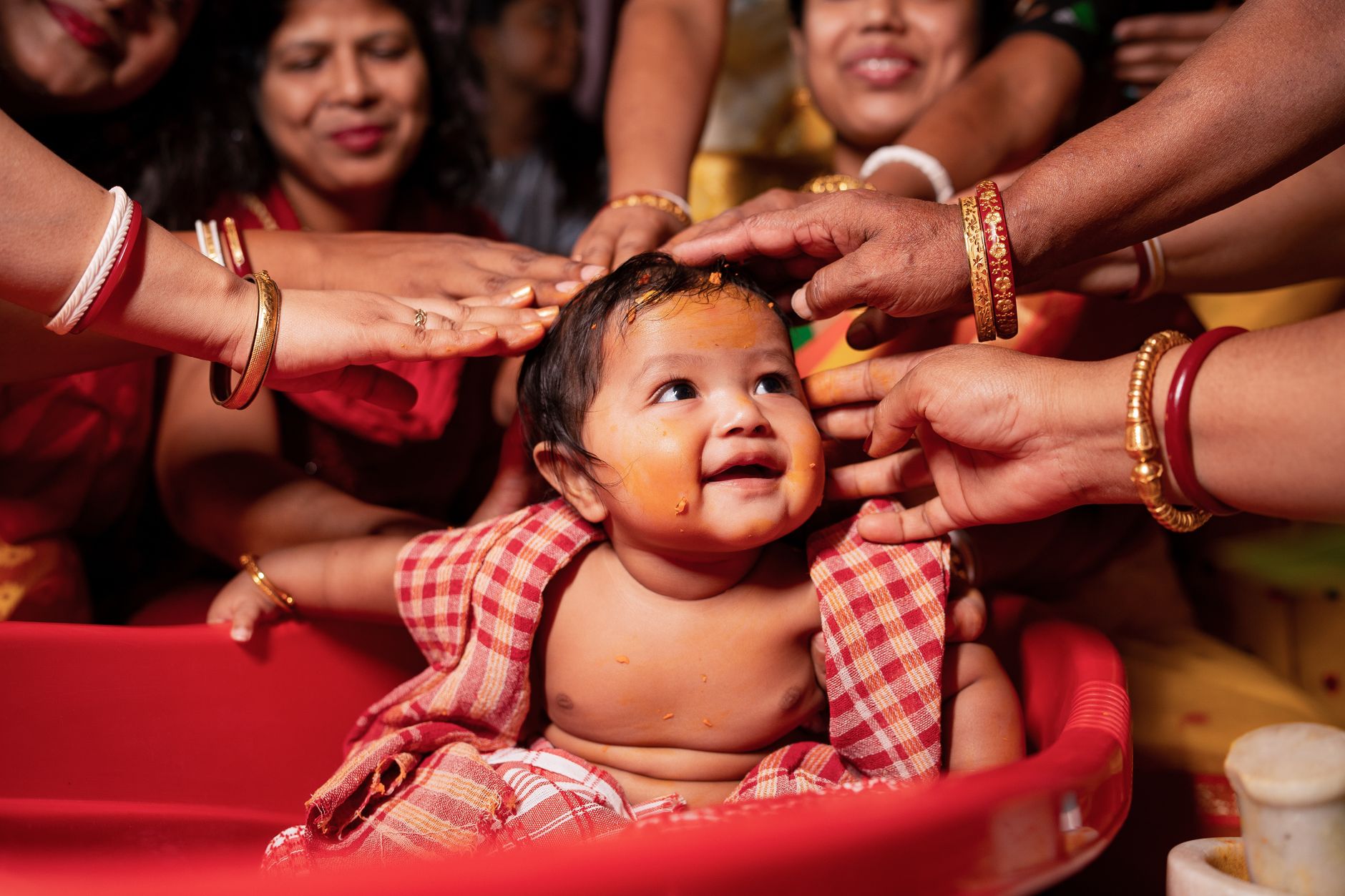
| Chatthi / Chhathi | 6th day after birth | In several North Indian communities, she may apply kajal/surma to the baby's eyes or tie a black thread for protection | Usually a nice-to-have, not a religious requirement |
| Naamkaran (naming ceremony) | Day 11–12, or a date chosen by the family priest | Often whispers or announces the chosen name; sometimes has the honor of contributing to the name | Varies by family — some treat this as central, others as optional |
| Mundan (first haircut) | Anywhere from a few months to a few years old, per family custom or a vowed timeline | May be present but rarely performs the ritual itself, which is usually done by a priest or barber at a temple | Not required — happens later, so timing is flexible anyway |
The common thread: the ceremonies themselves are usually anchored by a priest (purohit) and the parents or grandparents. The bua's part is a warm family tradition, not the thing that makes the ritual valid. That distinction is what gives you room to negotiate.
What Genuinely Needs to Happen vs. What's Negotiable
If you strip each ceremony down to its religious or ritual core, very little of it actually requires a large gathering:
- The naming itself just needs the name chosen and (in many traditions) said aloud or written at an auspicious time — it doesn't need an audience.
- The chatthi rituals are typically brief and can be done with immediate family only, with the bua joining by video call if she can't travel, or her role passed to another close relative present.
- The mundan has no fixed date in most traditions beyond "eventually," so it can be scheduled for whenever the family is genuinely ready to host, not squeezed into the newborn weeks.
What's negotiable is everything built up around the core ritual: the guest list, the catering, how long people stay, and how many separate ceremonies get scheduled back to back. None of that is what makes the ritual meaningful.
Why Limiting Early Visitors Is Reasonable, Not Rude
A smaller gathering is a fine choice on its own — and if your family wants a reason beyond preference, here's a real, cited one for keeping the newborn weeks calmer.
An NCBI Bookshelf postpartum care reference states that the postpartum period lasts approximately six weeks from delivery, while your body is still healing internally and externally — exactly when families often expect visitors and ceremonies too. Protecting that window is a legitimate ask.
There's also a baby-side reason. Cleveland Clinic explains that an infant's immune system doesn't mature until they're about two to three months old, so a newborn is more vulnerable to infections right when the chatthi and naamkaran usually fall. For any ceremony that does go ahead, the AAP advises that relatives handling the baby should be up to date on their vaccinations and practice good hygiene, like handwashing, before passing the baby around — a reasonable ask of every guest, bua included.
Two more things often come up. If relatives worry about yellowish skin at the chatthi, the AAP explains that most babies develop mild jaundice in the first few days simply because it takes time for the liver to clear bilirubin — common, and usually not a reason to delay a ceremony, though check with your pediatrician if unsure. And if anyone suggests home remedies for the umbilical cord stump during a ritual bath, the AAP advises there is no need for alcohol or anything else — just keep it clean and dry until it falls off.
Don't swing to the opposite extreme and cut everyone off, either. A narrative review of postpartum depression risk factors on PubMed Central found that reducing social support is one of the most significant factors in the onset of depression and anxiety after birth. The goal isn't isolation — it's choosing a smaller, calmer circle of the people who actually help, rather than an open door for every ceremony guest.
Practical Scripts for Negotiating the Guest List
- On timing: "We'd love to do the chatthi with just the two families this year, and host a bigger celebration once the baby is a bit older and I'm more rested."
- On the bua specifically: "Can [bua's name] send a video for the naming if she can't make the date? We want her part of it either way."
- On hygiene: "We're asking everyone visiting the baby right now to wash their hands first — nothing personal, it just helps keep germs away this early on."
- On duration: "Let's keep the visit to an hour so the baby can stick to their feeding and nap schedule."
Delegating hosting duties — to your partner, your mother-in-law, or the bua herself if she's staying with you — also matters. WHO advises that skin-to-skin contact should start immediately after birth and continue in the early weeks, and WHO recommends exclusive breastfeeding for the first six months — both easier to protect when someone else greets guests and runs the kitchen on a ceremony day.
Frequently Asked Questions
Is the chatthi ceremony compulsory? No single element of it requires a large gathering. Many families now do a small version with immediate family only, especially when the mother is still recovering.
What if the bua lives abroad or can't travel for the naming ceremony? Most families are flexible here — a video call during the ceremony, or asking another close relative to stand in for her specific part, is common and accepted.
Can we push the naamkaran to a later date than tradition suggests? Yes. The "correct" day varies by community and is often more about astrological or family convenience than a fixed religious deadline — talk to your family priest about options.
How many visitors is reasonable in the first few weeks? There's no universal number. A useful frame is small enough that the baby isn't passed between many hands in one sitting, and short enough that it doesn't cut into your rest or feeding routine.
Do relatives really need to worry about hygiene around a newborn? Yes — it's a real, evidence-based ask, not an insult. Vaccination status and handwashing before handling the baby are standard newborn-care advice, not a judgment on any individual relative.
Will limiting visitors hurt my own recovery or mood? Not if you keep the people who genuinely support you. A narrative review of postpartum depression risk factors on PubMed Central found that reducing social support is one of the most significant factors in postpartum depression and anxiety — so the concern is total isolation, not a smaller, calmer guest list.