
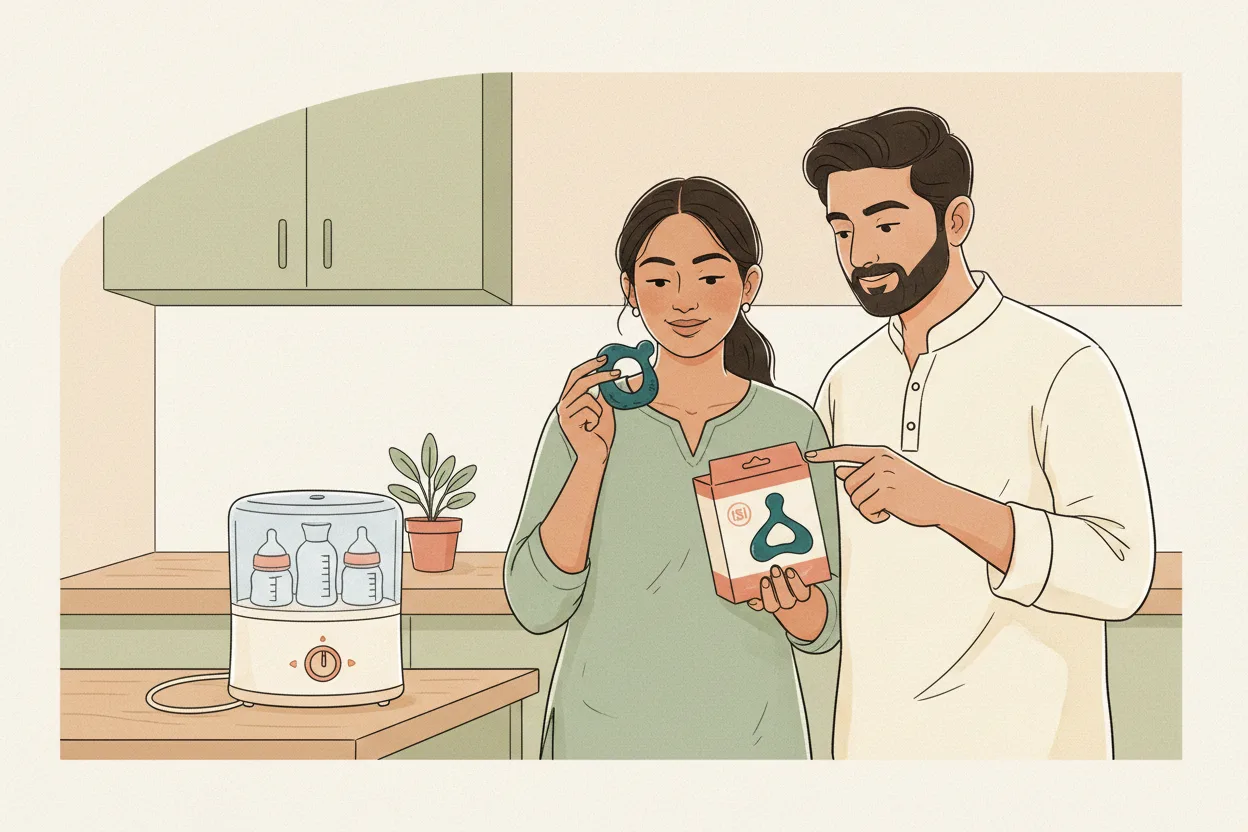
A safe, steam-sterilizable teether is a single solid piece of food-grade silicone or rubber, with no glued-on parts that can detach, and it comes from a listing you can actually verify — not every teether on sale in India meets that bar, and not every online listing is genuine. Here's what to check before you buy, and before you drop it in the steriliser.
Why This Needs Care in India
Online marketplaces in India carry a huge range of teethers, and counterfeit or unverified listings are common alongside genuine ones. The Bureau of Indian Standards (BIS) states that no one is permitted to manufacture, import, sell, distribute, or exhibit for sale toys — which includes teething toys — for children up to 14 years that don't conform to the Indian Standard and carry the "ISI" mark under a BIS licence. That mark, and the licence number that goes with it, is the one concrete thing you can check on a listing or the product itself before you trust it with your baby's mouth.
A "BPA-free" claim in a listing title is not the same as a verified, tested product. A systematic evidence-mapping review published in a peer-reviewed journal found that bisphenols in baby bottles and teethers were among the most frequently detected chemicals of concern when products were independently tested. Treat "BPA-free" as one input, not a guarantee, and prefer listings from a seller you can actually trace back to a manufacturer.
This isn't a hypothetical risk. In a single 2025 raid on an e-commerce warehouse in Delhi, government regulators reported seizing more than 3,500 products worth around 70 lakh rupees, some carrying no ISI mark at all and others carrying counterfeit ISI labels. And it isn't just fringe sellers slipping through — in February 2026, the Central Consumer Protection Authority (CCPA) stated that a major e-commerce marketplace kept non-compliant, non-BIS-certified toys listed as recently as December 2025 despite claiming they'd been removed, because the platform relied only on sellers' own declarations instead of independently verifying them. Don't assume a big, familiar platform has already screened out the fakes for you — check the listing yourself.
What Makes a Teether Physically Safe
Two things matter before you even ask whether something can be steam-sterilized.
No small parts that can detach. US federal regulation (16 CFR Part 1501) requires that children's toys and articles not have pieces small enough to fit inside a defined small-parts test cylinder, precisely because a detached piece is a choking hazard for a baby under 3. Run your fingers over any teether before handing it over: no clip-on rings, no glued beads, no seams that can be pulled apart.
A real cap on certain plasticizers, not just a marketing label. US regulation (16 CFR Part 1307) caps DEHP, DBP, and BBP — phthalate chemicals sometimes used to soften plastic — at no more than 0.1% concentration in children's toys and child-care articles. It's a useful yardstick for how seriously a category is regulated elsewhere, even though it's a US rule rather than an Indian one; a teether that can't say what it's made of, or from a seller with no verifiable brand, is not one to trust on this front.
| What to check | Why it matters | Red flag |
|---|---|---|
| ISI mark + BIS licence number | Legally required for toys sold in India | No mark, or a mark you can't verify |
| One solid piece, no clip-on parts | Prevents a detached piece becoming a choking hazard | Beads, charms, or multi-part rings that pull apart |
| Manufacturer states material clearly | Lets you judge the "BPA-free" claim, not just trust it | Vague listing, no verifiable brand or seller |
| Steriliser-safe stated by the maker | Not every teether tolerates steam heat | No care instructions at all |
Steam Sterilizing: Read the Instructions Every Time
Steam sterilisers are common in Indian homes for bottles and feeding gear, but a teether is not automatically safe in one just because it looks like plastic or silicone. The NHS advises that it's important to follow the manufacturer's instructions, since different sterilising methods suit different items. Some teethers — especially ones with a liquid or gel fill, or wooden teethers — are not built to survive repeated steam heat and will warp, crack, or degrade faster than a solid silicone one. Check the packaging or the manufacturer's page before your first steam cycle, not after.
Once it's clean, resist the urge to pop it in the freezer for extra relief. Cleveland Clinic advises that frozen teething toys can become too hard, and can be so cold they hurt a baby's gums — the fridge gives plenty of cooling relief without that risk. A few hours in the fridge between uses is the right amount of cold.
Teething Myths Worth Retiring
A few widely repeated home remedies and beliefs are worth clearing up before you shop or reach for something in a pinch.
Fever and loose motions are not "just teething." HealthyChildren.org (AAP) states that although many parents expect a fever when baby teeth start to break through, extensive studies show this is a false symptom of teething. If your baby has a real fever or diarrhoea, treat it as its own issue and call your paediatrician rather than waiting it out as teething.
Skip teething jewellery entirely. Amber necklaces and similar bracelets are sometimes sold or gifted as a teething remedy, but HealthyChildren.org (AAP) reports that the FDA issued an official warning after receiving reports of children choking on beads that broke off, including an 18-month-old strangled to death by an amber necklace during a nap. Never put anything around a baby's neck for teething relief.
Avoid benzocaine-containing gels. Cleveland Clinic reports, citing the FDA, that over-the-counter products containing benzocaine have been connected to methemoglobinemia, a potentially fatal blood disorder. A chilled (not frozen) teether, a clean cool cloth, or gentle gum massage are safer options than a numbing gel.
Not medical advice — consult your pediatrician about any teething remedy or if you're concerned about fever, diarrhoea, or your baby's symptoms.
What to Buy: Categories and Price Ranges
Rather than chasing a single "best brand" (listings change constantly, and today's top seller can be tomorrow's counterfeit-riddled one), shop by category and verify each listing yourself using the checklist above.
| Category | Typical price (INR) | Notes |
|---|---|---|
| One-piece silicone ring teether | Rs. 200 – Rs. 600 | Easiest to inspect for seams; usually steriliser-safe — confirm on the pack |
| Textured multi-surface silicone teether | Rs. 300 – Rs. 800 | Good for different gum stages; check for any glued-on decorative pieces |
| Wooden teether (untreated/food-safe finish) | Rs. 250 – Rs. 700 | Often NOT steam-steriliser safe — wipe-clean only unless stated otherwise |
| Water/gel-filled teether | Rs. 200 – Rs. 500 | Chill in the fridge, not the freezer; check the manufacturer's sterilising instructions before steaming |
Search Amazon.in or FirstCry and look for listings that show the ISI mark clearly in product photos, list a real manufacturer, and state whether the item is steriliser-safe — not just "BPA-free" in the title.
Frequently Asked Questions
Can all silicone teethers go in a steam steriliser? Not automatically. The NHS advises following the manufacturer's instructions because different items and sterilising methods don't always match. Check the packaging or product page before your first steam cycle.
Is it fine to freeze a teether to make it extra soothing? No — Cleveland Clinic advises against fully freezing teething toys, since they can become too hard and too cold for a baby's gums. Chill it in the fridge instead.
How do I know a teether sold online in India is genuine? Look for the ISI mark and a BIS licence number on the packaging or clear product photos. BIS states this mark is legally required for toys sold, imported, or distributed in India for children up to 14 years — a listing without it, or one you can't verify, is a red flag.
Are amber teething necklaces safe if I only put them on during the day? No. AAP/HealthyChildren reports real choking and strangulation cases linked to these necklaces, including during supervised time. Don't put any necklace or bracelet on a baby for teething relief.
My baby has a fever along with new teeth coming in — is that just teething? No. AAP/HealthyChildren states that despite common belief, extensive studies show teething does not cause fever. Treat a real fever as its own issue and call your paediatrician.
Is a numbing gel a safe way to ease teething pain? No. Cleveland Clinic reports, citing the FDA, that benzocaine-containing gels have been linked to a potentially fatal blood disorder. Stick to a chilled teether or gentle gum massage instead.