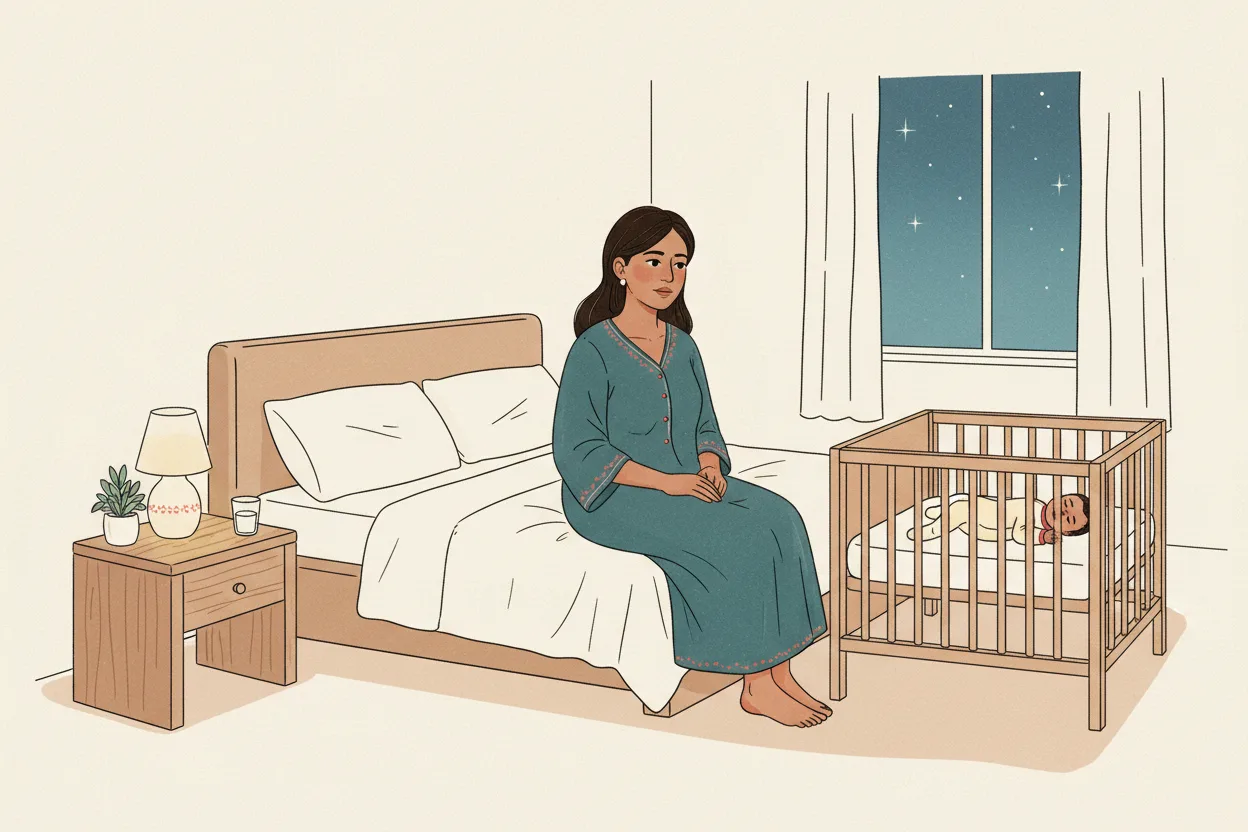


Lying awake running through everything that could go wrong — labor, work, money, whether you'll even be good at this — is one of the most common experiences of the third trimester, not a sign something is wrong with you. Most of it is ordinary anticipatory anxiety that eases with a few concrete coping tools; a smaller amount benefits from extra support, and it helps to know which one you're dealing with.
Not medical advice — if anything below concerns you, talk to your obstetrician or a mental health professional.
Why the "What Ifs" Show Up Now
You're not overreacting, and you're not alone in this. A study cited in a PMC-published India research protocol found that one recent study estimated a prevalence of generalized anxiety disorder of 23% among perinatal women in a tertiary care hospital in South India — roughly 1 in 4. So if you're spiraling about labor, childcare, work, or whether you'll be "good enough," you're in the same boat as a large share of pregnant women around you, even if nobody's talking about it out loud.
It's worth separating that clinical figure from ordinary pregnancy-related worry, which is even more common. A study of pregnant women in Bangalore, published in the International Journal of Women's Health, found that 195 of 380 pregnant women (55.7%) had pregnancy-related anxiety — worry focused specifically on the baby's wellbeing and the birth itself, distinct from a diagnosable anxiety disorder. In other words, the "what ifs" running through your head put you solidly in the majority, not the exception.
The third trimester is also when the "what ifs" get concrete — you can picture the delivery room, the first weeks home, going back to work, and figuring out childcare, all at once. The Sleep Foundation notes that anxiety about labor, new motherhood, and juggling work and home responsibilities is a common reason sleep gets disrupted late in pregnancy — so 2 a.m. scenario-running is a well-documented pattern, not a personal failing.
Normal Worry vs. Something That Needs Support
Most anticipatory anxiety is manageable with the coping tools below and fades once you have a plan and people around you. Occasionally it tips into something that benefits from professional help. A rough way to tell the difference:
| Sign | Usually normal "what ifs" | Worth flagging to a provider |
|---|---|---|
| Frequency | Comes and goes, often triggered by a specific thought (delivery, finances) | Present most of the day, most days |
| Duration | Settles within a day or after talking it through | Persists for two weeks or more |
| Sleep | Occasional racing thoughts at night | Can't sleep even when exhausted, most nights |
| Function | You can still plan, work, and enjoy parts of the day | Hard to concentrate, eat, or get through routine tasks |
NIMH advises that women who experience persistent symptoms like these should see a health care provider rather than wait it out. This matters beyond just feeling better in the moment — a prospective study in PMC found that antenatal anxiety was itself identified as a significant predictor of postnatal depression, so addressing it now is not just about getting through the next few weeks, it's a real investment in how you feel after the baby arrives.
What Actually Helps
Mindfulness practice. A systematic review in PMC found that participation in a mindfulness-based intervention during pregnancy was associated with reductions in perinatal anxiety of moderate to large magnitude. This doesn't require a retreat — ten quiet minutes a day of focused breathing or a guided body scan, done consistently, counts.
Prenatal yoga. A systematic review and meta-analysis in PMC found that after receiving prenatal yoga therapy, pregnant women had significant improvement in anxiety compared with their pre-treatment level. Most Indian cities now have prenatal-specific classes, in person or online, taught by instructors trained to modify poses for the third trimester — check with your obstetrician before starting if you haven't done yoga before.
Leaning on your partner. This one has a payoff that lasts past delivery: a study in PMC found that stronger perceived partner support during pregnancy predicted significantly lower postpartum maternal emotional distress. Concretely, that means bringing your partner into the actual logistics — the hospital bag, the childcare research, the return-to-work conversation — not just venting to them. Two people holding the plan is genuinely lighter than one.
Naming the specific worry. Vague dread ("what if I can't do this") is harder to act on than a specific one ("what if I can't find reliable childcare by the time I go back to work"). Write down your top three "what ifs," and for each, note one next step you can take this week — a pediatrician to call, a childcare option to shortlist. Turning a fear into a task list doesn't erase the anxiety, but it gives it somewhere to go.
When to Get Extra Support
If your worry is closer to the right-hand column of the table above — most of the day, most days, for two weeks or longer, and getting in the way of sleep, eating, or work — it's worth talking to your obstetrician or a perinatal mental health professional, not pushing through alone. A PMC systematic review states that cognitive behavioral therapy (CBT) is effective in the treatment of perinatal mood and anxiety disorders. Many therapists in India now offer teletherapy, which can be easier to fit around late-pregnancy fatigue and appointments than travelling across the city.
Ask your obstetrician for a referral, or look for a therapist listing perinatal mental health as a specific area of practice — the questions and worries of late pregnancy are different from general anxiety, and it helps to work with someone experienced in treating them.
Building Your Support System at Home
You can share the "what ifs" instead of carrying them alone — in a household with a partner, parents, or in-laws around, there's support close by. A few things that make a real difference in the weeks before delivery:
- Say the specific worry out loud, not just "I'm stressed." "I'm scared I won't know what to do the first night home" gets a useful response; "I'm just anxious" doesn't.
- Split the logistics explicitly — decide together which of you handles the hospital bag, which of you researches pediatricians, and which of you manages the work handover. A plan written down is calmer than one held only in your head.
- Set boundaries on advice you didn't ask for. Well-meaning relatives will have opinions on everything from delivery to diet. A simple "we've got a plan for that, thanks" protects your headspace without a confrontation.
- Protect one wind-down routine in the evening — even 15 minutes without your phone — so your mind has a chance to settle before bed.
Frequently Asked Questions
Is it normal to feel scared of motherhood even though I wanted this baby? Yes. Wanting a baby and feeling scared about the unknowns of parenting are not contradictory — they usually happen together. The fear is about the uncertainty ahead, not about how much you want your child.
How do I know if I need to see someone, or if this will pass on its own? Use duration and function as your guide: if the worry comes and goes and you can still get through your day, it's likely to ease as you get closer to delivery and start putting plans in place. If it's there most of the day for two weeks or more and it's affecting your sleep, eating, or ability to function, that's the point NIMH says to check in with a provider.
My partner doesn't seem as anxious as me — does that mean something's wrong with how I'm handling this? No. People process anticipatory stress differently, and a calmer partner is often a genuine source of steadiness. What matters more than matching anxiety levels is whether your partner is actively involved in the logistics and decisions with you.
Will therapy or counseling during pregnancy actually help, or is it just for "after"? It can help now, not just postpartum. CBT is a structured, practical approach — effective for perinatal anxiety — and many people start during pregnancy to build coping tools before the baby arrives, rather than waiting for a crisis.
I'm worried about going back to work and finding childcare — is that a "real" anxiety or am I overthinking it? It's a real, practical worry, not overthinking — work and childcare logistics are consistently among the concerns linked to disrupted sleep and racing thoughts late in pregnancy. Treating it as a task list (research options, shortlist two or three, book a trial visit) tends to bring the anxiety down faster than trying to reason yourself out of it.