
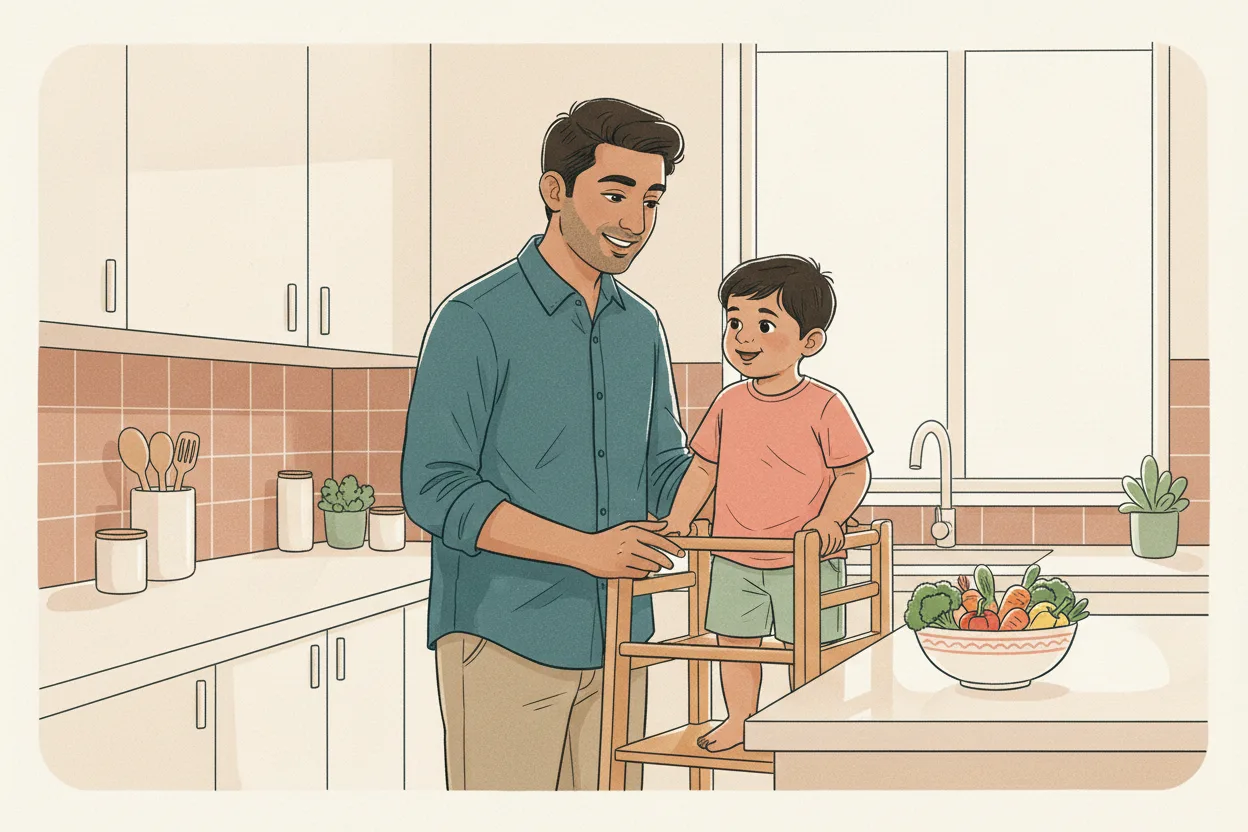
A helper tower is a sturdy, enclosed platform that lets your toddler stand safely at counter height — part step stool, part safety enclosure. If your toddler is tugging at your kurta while you cook, this is the tool that brings them alongside you. The CDC confirms most children are ready from around 18 months, when they can walk without support and climb on and off furniture independently.
The catch in India: popular brands parents discover in parenting videos — Sprout, Guidecraft, Little Partners — are largely unavailable here for domestic purchase, and the few that arrive through grey-channel import carry steep markup. This guide covers the developmental case for helper towers, a safety checklist you should apply to any option, and what is actually available in India right now.
Not medical advice — consult your paediatrician if you have concerns about your child's development or safety.
Why Toddlers Want to Be Part of the Action
NCBI StatPearls states that between 18 and 30 months, individuation (autonomy) emerges in toddlers, and confidence in the child-parent relationship helps the child face environmental challenges more persistently and enthusiastically on their own. Your toddler pulling at the counter is not clinginess — it is autonomy-seeking, and it is developmentally on schedule.
The CDC's developmental milestones confirm that most children at 18 months can walk without holding on to anyone or anything, and climb on and off a couch or chair without help. Those two skills — balance and the drive to climb — are exactly why a helper tower is both timely and necessary at this age. An unsupported climb onto a dining chair is where accidents happen; a helper tower gives that same drive a safe outlet.
What Your Toddler Can Actually Do Up There
The kitchen is for both parents and the toddler. Getting your child involved in real tasks at counter height has developmental benefits beyond just keeping them busy.
A review of Montessori education published in npj Science of Learning found that Practical Life Activities — which include pouring, preparing snacks, cleaning, and laying the table — develop a child's skills for independent living as well as gross and fine motor control. These are real participation, not just imitation.
Guidelines published in Nutrients state that by age 2, a child should be able to follow basic commands from their parents and complete the tasks they are asked to do, and that children aged 2–3 can begin structured cooking participation including washing produce, tearing, rolling, and kneading.
Research published in Child Development Perspectives found that as toddlers zip toy purses, untwist lids of toy bottles, and stir in replica teapots, they practise the unique manual actions used in real household tasks — and that play with objects and real use of objects each reinforce the other. Giving your child a helper tower and a real task builds on what they are already doing in play.
The Safety Case — and What to Check Before Buying
Helper towers are safe when they are well-built. The risks come from unstable, lightweight, or under-engineered products.
A study published in Injury Epidemiology found that unintentional falls were the leading cause of nonfatal injury among children aged 0–4 years. The WHO World Report on Child Injury Prevention states that between the ages of one and three, children are most likely to fall from stairs or steps, baby walkers, furniture, or play equipment — the exact developmental window when helper towers are used.
Research in the Journal of Safety Research found that children under 6 account for 69.9% of furniture and TV tip-over injuries, and that stability requirements — not warning labels — are the key prevention lever. When buying a helper tower, the construction is what protects your child; the warning sticker on the box is not a safety substitute.
Before buying, run through this checklist:
| Feature | What to look for |
|---|---|
| Base footprint | Wide relative to platform height — the wider the base, the harder to tip |
| Enclosure height | Sides at least waist-high on your child; no gaps a foot can get caught in |
| Weight rating | Rated for your child's current weight, with headroom for growth |
| Stability on your floor | Does not rock on tile — test on the actual surface you will use it on |
| No sharp edges or pinch points | Check rail joints and any fold mechanisms carefully |
| Non-slip feet | Rubber feet or pads, especially on polished stone, marble, or tile |
What Is Actually Available in India
The domestic helper tower market is thin. Most of what you find on Amazon India and FirstCry is short step stools or learning step stools with minimal side rails, rather than full counter-height towers with proper enclosed sides. Here is an honest breakdown:
Counter-height helper towers with enclosed rails (₹3,000–₹8,000) The closest to the Western "learning tower" concept. Look for wooden towers with four-sided enclosed rails from Amazon India sellers. Platform height should ideally be adjustable. Read recent reviews carefully for stability feedback — quality in this category varies a lot.
Adjustable step stools with partial rails (₹1,500–₹3,500) Shorter and lighter. These work if your kitchen counter or dining table is lower, and if you are standing directly next to your child throughout. Not the right choice for a child that climbs independently and confidently without supervision.
Locally made towers If you have a carpenter you trust, a solid teak or sheesham helper tower is a practical option at roughly ₹2,500–₹5,000 in materials and labour. The critical requirements: base as wide as possible, rails at least waist-high on your child, all joints checked and tightened before first use.
| Type | Approx. Price | Where to Buy |
|---|---|---|
| Counter-height helper tower (wooden, enclosed) | ₹3,000–₹8,000 | Amazon.in / FirstCry |
| Adjustable step stool with rails | ₹1,500–₹3,500 | Amazon.in / FirstCry |
| Basic step stool (no enclosure) | ₹400–₹1,200 | Amazon.in |
Frequently Asked Questions
What age should we start using a helper tower? Most families start around 18–24 months. The CDC confirms that by 18 months, most toddlers can walk without support and climb on and off furniture independently — the baseline coordination needed to stand safely in a tower. Always supervise directly during use; the tower improves safety compared to an unassisted climb, but it does not replace adult presence.
What can a 2-year-old actually do at counter height? More than most parents expect. The CDC's 2-year developmental milestones confirm that by age 2, toddlers can hold something in one hand while using the other — for example, holding a container and taking the lid off — and can eat with a spoon. Guidelines published in Nutrients confirm that by age 2, children can follow basic commands and complete assigned tasks, making them capable of washing fruit under running water, tearing greens, stirring a batter, or pressing down on dough. Keep the child clear of knives, hot surfaces, and open flames — the WHO notes that children are frequently burned in domestic kitchens from upset hot-liquid receptacles, flames, and cookstove explosions; the tower brings them to counter level, not to adult judgment level.
Why are the popular Western brands not available in India? Brands like Sprout, Guidecraft, and Little Partners have no India distribution. When they appear on Indian marketplace listings, it is usually through grey-channel imports at significant markup. The domestic alternatives are lighter and more variable in quality — which is exactly why the safety checklist above matters more here than in markets where this product category is better regulated.
Is a plain step stool a safe substitute for a helper tower? Not the same thing. A step stool without enclosed rails leaves the child free to fall off any side. A helper tower's four-sided enclosure keeps the child positioned safely. If a step stool is what you have, use it only when you are within arm's reach and can catch a stumble immediately.
Can both parents use this with the toddler? Yes — and both should. Mum and dad taking turns involving the toddler in food prep or washing up normalises participation for both parents and the child. NCBI StatPearls notes that confidence in the child-parent relationship — with either parent — is what helps toddlers practise independence. A helper tower works the same way regardless of which parent is at the counter.
How long will we use it? NCBI StatPearls notes that autonomy-seeking develops between 18 and 30 months — the start of the typical window for helper tower use. Most families get value from it for roughly 2–4 years, from around 18 months through to age 4 or 5. At the older end, children are tall enough and coordinated enough to use a simple step stool safely. Some families keep the tower longer for tasks that require standing at counter height for a sustained period.