
Most toddlers under 3 aren't ready for a real pencil at all — a chunky crayon is the age-appropriate first tool, and holding a pencil between the fingers and thumb instead of a fist is a milestone most children reach by age 4. What you buy before then matters less than the shape and safety of the tool: thick, short, and impossible to fit fully in the mouth.
Not medical advice — consult your pediatrician if you have concerns about your child's development.
Why "Pre-Writing" Doesn't Mean a Pencil Yet
Many playschools and nursery classes in India send home worksheets early, and it's easy to feel your toddler is behind if they're not gripping a pencil "properly." They're not behind — their hand simply hasn't caught up to that expectation yet. The Indian Academy of Pediatrics' own developmental guidelines only flag a fine-motor delay if a child still can't use crayons or scissors by 48 months (4 years) — so even Indian pediatric standards don't expect confident pencil or crayon use any earlier than global charts do, whatever a worksheet-happy playschool implies.
Picking up small objects between the thumb and index finger — the pincer grasp — is an expected fine motor milestone by a baby's first birthday, and it's the physical foundation that pencil grip is built on later. That grasp needs another two to three years of practice — with toys, food, and chunky drawing tools — before it turns into anything close to how an adult holds a pencil.
The Real Milestone Timeline
Use this to set expectations for what tool fits which age, instead of pushing a thin pencil before your child's hand is ready for it.
| Age | Expected milestone | What it means for pencils |
|---|---|---|
| 1 year | Picks up small objects between thumb and finger | Foundation skill only — no drawing tool needed yet beyond safe toys |
| 18 months | Scribbles with a crayon or marker | A chunky crayon, not a pencil, is the right first tool |
| 3 years | Draws a circle when shown how | A jumbo triangular crayon or pencil suits the still-developing grip |
| 4 years | Holds a crayon or pencil between fingers and thumb, not a fist | A standard-size triangular pencil becomes appropriate |
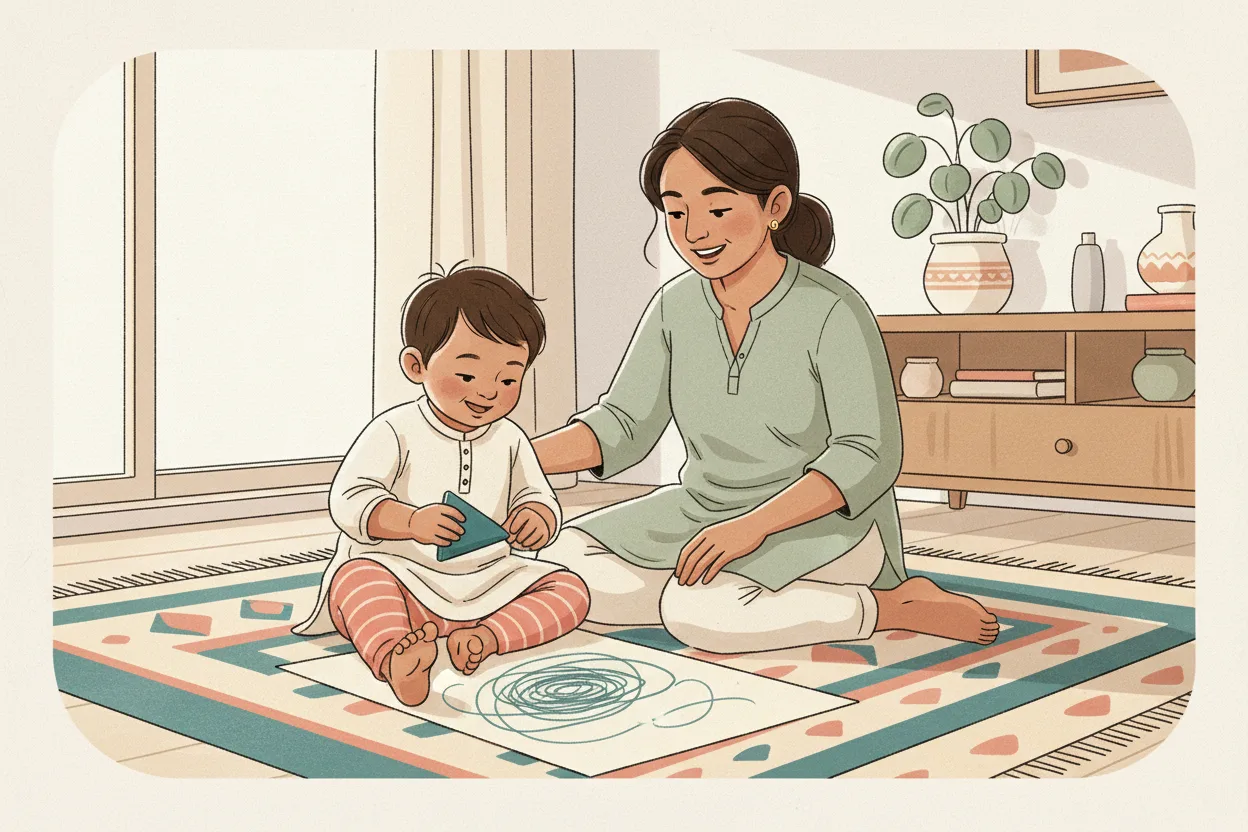
If your 2-year-old is scribbling with a fist grip, that's exactly on schedule — that finger-and-thumb grip isn't expected until age 4, not before.
Don't Force One "Correct" Grip
It's tempting to buy a grip-training pencil and insist your toddler use it a specific way. A study published in the Australian Occupational Therapy Journal, indexed on PubMed/NCBI, found that pencil grasp pattern did not significantly affect handwriting speed or legibility in typically developing children. Let your toddler experiment with how they hold a crayon or pencil rather than correcting them constantly — the grip will mature on its own, and there's no single grip that research shows is necessary for good handwriting later. Commercial pencil grip aids are positioned as a short-term fix for a child who is struggling with an inefficient grip, not something a typically-developing toddler needs by default while their grasp is still maturing on its own.
Safety Comes First When You Pick a Tool
Two safety factors matter more than grip type when a tool is going into a toddler's hands and, often, their mouth.
HealthyChildren.org, from the American Academy of Pediatrics, lists pen or marker caps among recognized choking hazards for young children — so skip pencils and markers with small removable caps or detachable grips for toddlers, and supervise use of anything with an eraser topper that can be pulled off.
The AAP's guidance on buying safe toys advises making sure all toys and parts are larger than your child's mouth to prevent choking — a useful, simple test for picking a pencil too. A short, thick, triangular crayon passes this test easily; a thin standard pencil, especially once sharpened to a point, does not, and is easier for a toddler to snap or chew into pieces. For a more exact benchmark, the U.S. Consumer Product Safety Commission treats anything that fits inside a roughly 3.17 cm (1.25 in) wide, 5.71 cm (2.25 in) deep cylinder as a choking-hazard-sized small part for a child under three — a jumbo triangular pencil's barrel is comfortably wider than that; a slim standard pencil is close to it once you include the sharpened tip and any snapped-off pieces.
What to Buy in India, by Age
| Product | Best for | Price range | Where to buy |
|---|---|---|---|
| Jumbo triangular crayons (e.g., Camlin/Faber-Castell jumbo range) | 18 months – 3 years | Rs. 60 – Rs. 150 | Amazon.in / FirstCry |
| Twistable chunky crayons (no wrapper to peel, no sharpening) | 18 months – 3 years | Rs. 150 – Rs. 350 | Amazon.in |
| Jumbo triangular pencils (e.g., Doms/Apsara/Faber-Castell Grip jumbo) | 3 – 4 years | Rs. 50 – Rs. 120 for a pack | Amazon.in / FirstCry |
| Standard triangular-grip pencils | 4 years and up | Rs. 40 – Rs. 100 for a pack | Amazon.in |
Skip loose caps, screw-on toppers, and novelty pencil-top erasers for the under-4 crowd — plain, one-piece jumbo crayons and pencils are simpler and safer.
Frequently Asked Questions
My 2-year-old holds the crayon in a fist. Should I correct it? No. A fist grip is completely normal at this age — the finger-and-thumb grip isn't expected until around age 4. Let them keep scribbling; the grip develops with practice, not correction.
When should I actually introduce a real, thin pencil? Around age 4, when most children can hold a crayon or pencil between their fingers and thumb rather than in a fist. Before that, a jumbo triangular crayon or pencil is the more appropriate, safer choice.
My playschool wants my 2-year-old practicing with a pencil already. Is that too early? Their hand is still building the control that comes later — drawing a circle when shown how is a 3-year milestone, not a 2-year one. A chunky crayon lets them join in the activity without forcing a grip they aren't ready for yet.
Are grip-training pencils worth buying? They aren't necessary. Research indexed on PubMed found grasp pattern didn't significantly affect handwriting speed or legibility, so there's no evidence a specific "correct" grip needs to be trained early. A comfortable, safely-sized tool matters more than the grip-training claims on the packaging.
What should I avoid buying for a toddler's first pencil or crayon? Anything with a small removable cap or detachable topper — caps are a recognized choking hazard — and anything thin enough to fit fully in your toddler's mouth, since safe toys and parts should be larger than your child's mouth. Jumbo, one-piece crayons avoid both problems.
Does it matter if my toddler is left-handed? Handedness usually becomes clear over the toddler years through which hand they consistently reach and scribble with. Peer-reviewed research finds that hand preference isn't considered reliably established until around age 4, and by some accounts not until age 6, even though a rough leaning can show up by age 3 — so a toddler who still switches hands is not behind. Let them choose freely rather than steering them toward one hand — the milestone checklists above apply to either hand equally.