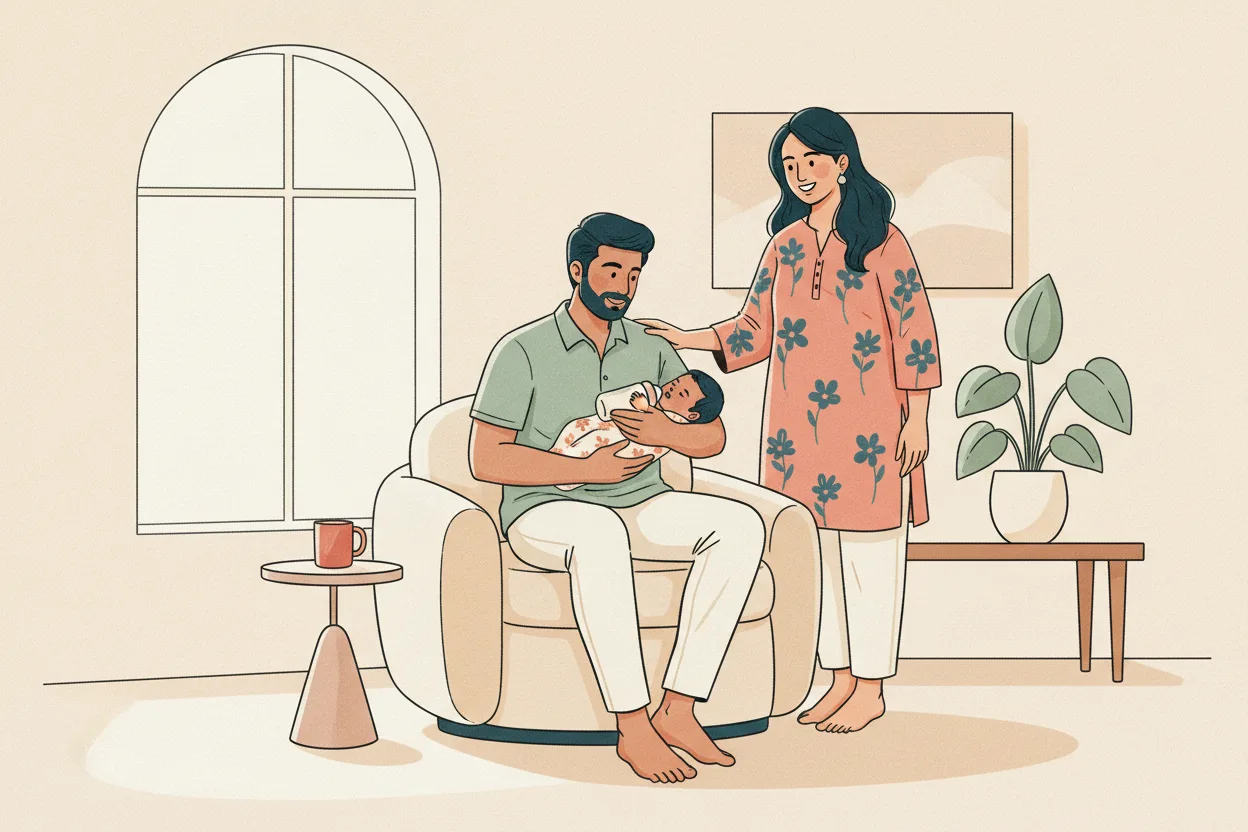


A toddler mid-tantrum and a newborn needing to be fed every few hours, at the same time, is one of the hardest stretches in early parenting — and it is not a sign you are failing at either job. It is genuinely this hard, it is temporary, and there are concrete ways to make the days survivable.
Not medical advice — consult your pediatrician if you're worried about your toddler's behaviour, your baby's health, or your own mood.
Why This Stretch Hits So Hard
Two under two means no "down shift" between kids — you go straight from newborn care into it again, except now there's also a toddler needing supervision, meals, and attention on their own timeline. In many Indian homes, grandparents or other relatives are close by and genuinely want to help, which is a real advantage. But it also means managing everyone's opinions on feeding, sleep, and discipline while you're the one running on the least sleep in the house. Deciding upfront, as a couple, which advice you'll follow saves a lot of friction later.
The Sleep Math Doesn't Work in Your Favour
A newborn wakes every two to four hours around the clock. A toddler often wakes early, resists naps, or wakes at night too, especially with a new sibling around. Both parents end up running a sleep deficit at the same time, and that deficit is not just about feeling tired. A peer-reviewed study on maternal fatigue, sleep quality, and postpartum depression risk found that poor sleep quality is linked with increased depression and anxiety symptoms in women at six months postpartum. Protecting even small blocks of sleep — trading off night shifts, or one parent taking an early morning while the other sleeps in — isn't a luxury here; it's damage control for both of you.
The Terrible Twos Are Real, and They're Not About Your Parenting
If your toddler is melting down more since the baby arrived, it can feel like your parenting is falling apart at the worst possible time. It isn't. HealthyChildren.org (American Academy of Pediatrics) explains that at this age, toddlers "just don't have much control over their emotional impulses." A 2-year-old's brain simply isn't built yet for regulating big feelings, sibling or no sibling — the timing with the new baby is coincidence, not cause.
When Your Toddler Regresses
Potty accidents after months of being trained, wanting a bottle again, or asking to be carried like a baby are common right after a new sibling arrives. HealthyChildren.org (AAP) notes that "your toilet-trained child might suddenly start having 'accidents,' or they might want to take a bottle." Treat it as a phase, not a setback to fix urgently: for potty-training specifically, HealthyChildren.org (AAP) notes that "in many cases, the child picks up where she left off in toilet training after a few days or weeks" — if it drags on for a month or more, that's the point to mention it to your pediatrician rather than something to worry about in week one.
Jealousy toward the new baby is also common, and it responds well to a specific fix: KidsHealth (Nemours) advises parents "give your kids one-on-one attention directed to their interests and needs." Ten minutes of a toddler's favourite game, with no baby in the room, does more for sibling jealousy than any explanation of "the baby needs me right now."
Splitting the Load Between Both Parents
This stage is genuinely too much for one parent to carry solo, night after night. Whoever isn't on baby duty at a given moment is on toddler duty — full stop, not "helping out." A peer-reviewed Delphi consensus study on partner support found that partner support "is a key target for prevention interventions for perinatal depression and anxiety as it is an established modifiable protective factor." A simple written or shared-app roster for night feeds, toddler drop-offs, and meals removes the daily negotiation and makes sure the load is actually split, not just intended to be.
A few things worth arranging early:
- A recurring block of one-on-one toddler time with each parent, even 15–20 minutes
- A shared night-shift roster, swapped weekly so no one parent is always on the hardest shift
- One outside pair of hands — a relative, a part-time helper, or a trusted friend — for a few hours a week so both parents can rest at the same time
Timing a Second Pregnancy Around This Gap
If you're wondering whether your age gap was "too close" or thinking about timing again, the evidence gives a clear number to plan around. The World Health Organization recommends, as cited in a nationwide cohort study on interpregnancy intervals, "an IPI of at least 24 months after a live birth and 6 months after an early pregnancy loss." For families in India specifically, a study using India's National Family Health Survey data found that children born with a gap under 12 months were 1.56 times as likely to be stunted and 1.59 times as likely to be underweight compared to children born 18–23 months after a sibling. If you already have a close gap, this isn't something to worry about retroactively — it's data for planning the next one, not a verdict on the child you have.
When to Get Help for Yourself
Exhaustion and short patience are expected here. What isn't expected, and needs prompt attention, is losing interest in things you normally enjoy, pulling away from people close to you, or having thoughts of hurting yourself or the baby. The CDC's maternal depression guidance states that depression symptoms "may include loss of interest in activities, withdrawing from friends and family, or thoughts of hurting self or baby" — and any of these are reasons to call your doctor the same day, not wait it out. Say the specific symptom out loud to your doctor or partner rather than describing it as "just tired"; it changes how quickly you get the right support.
This isn't rare, and it isn't a reflection of you as a parent: a systematic review and meta-analysis of postpartum depression studies in India found a pooled prevalence of 22% among Indian mothers — roughly one in five. If you don't have a therapist or your doctor isn't reachable right away, Tele MANAS, the government's free, 24/7 mental health helpline, is available on 1800-89-14416 (short code 14416) in English and regional languages — a real number to call the same day, not just your family doctor's.
Practical Help Worth Arranging
| Type of help | What it covers | Typical monthly cost (India) |
|---|---|---|
| Live-in domestic help / maid | Cooking, cleaning, freeing up parent time | Rs. 8,000 – Rs. 18,000 |
| Part-time nanny / baby-sitter (few hrs/day) | Toddler supervision during newborn feeds/naps | Rs. 6,000 – Rs. 15,000 |
| Night nanny (newborn-focused, first weeks) | Overnight newborn care so parents sleep | Rs. 15,000 – Rs. 35,000 |
| Toddler daycare/playschool (half-day) | Structured toddler time out of the house | Rs. 3,000 – Rs. 10,000 |
Costs vary a lot by city and how many hours you need — treat this as a starting point for budgeting, not a fixed rate.
Frequently Asked Questions
Is it normal for my toddler's tantrums to get worse right after the baby's birth? Yes, this is common and usually temporary. It typically eases as your toddler adjusts to the new routine and gets dedicated one-on-one time again.
My toddler started wetting the bed after we brought the baby home. Should I worry? No — regression like this is a well-documented, common reaction to a new sibling, not a medical problem. Stay calm and consistent, and it typically resolves within a few weeks. Mention it to your pediatrician if it continues well beyond that.
How close is too close for a second pregnancy? There's no absolute cutoff, but the WHO-referenced guidance is at least 24 months between a live birth and the next pregnancy, and Indian data shows added risk to the younger child's growth under a 12-month gap specifically. If your family planning didn't line up with that, focus on your pediatrician's growth tracking rather than the gap itself.
Both of us are exhausted and short-tempered with each other. Is that normal? Very common at this stage — you're both sleep-deprived and stretched thin. Splitting night shifts and toddler duty explicitly, rather than assuming it'll balance out, helps most couples more than "communicating better" alone.
When does two-under-two actually get easier? Most parents say the sharpest edge is the first three to four months, while the newborn's sleep is most unpredictable. It eases further once the baby starts on a more predictable nap schedule and the toddler's initial jealousy settles.
Should I hire help even if my family says they'll manage without it? That's your call to make as a couple, based on what actually gets you both rest. Bringing in help isn't a reflection on whether relatives are willing — it's about whether the current setup is sustainable for your sleep and your marriage.