

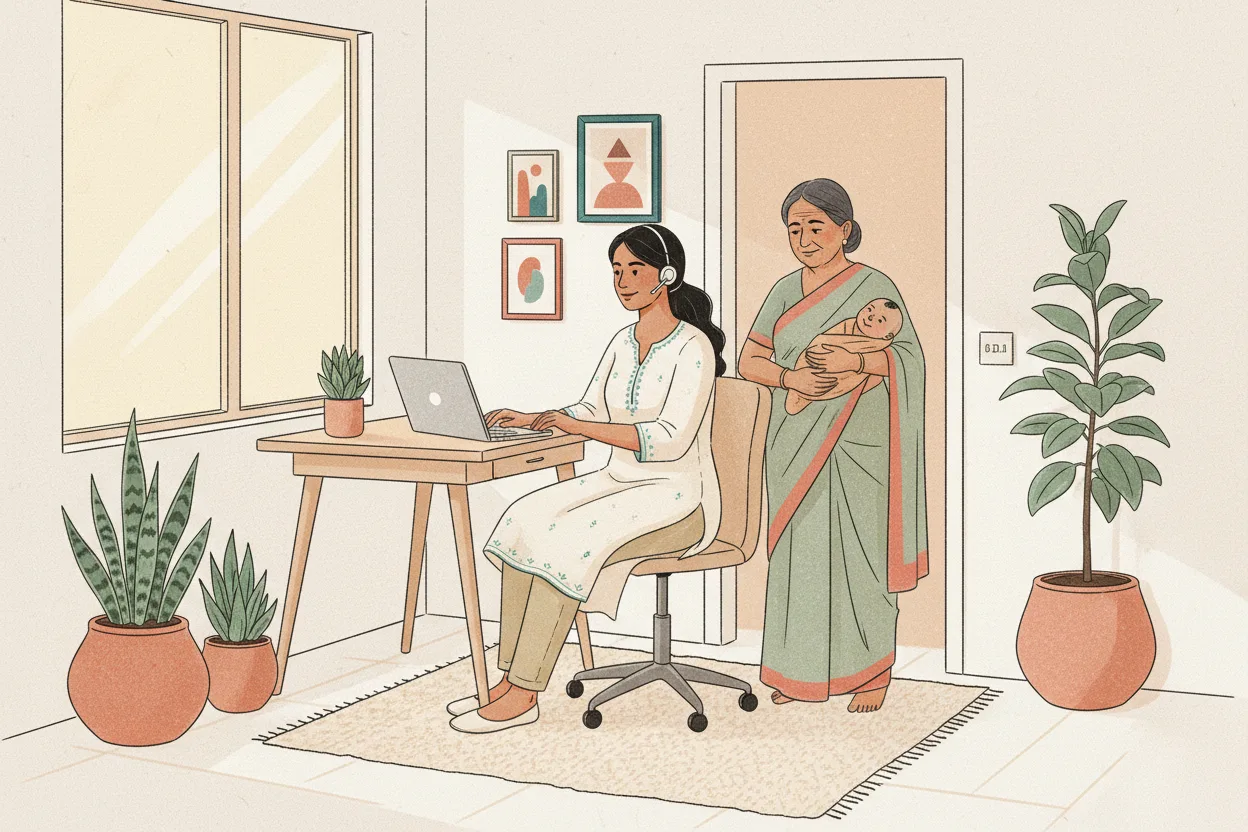
No one can tell you that three months is too soon, because there is no age at which rejoining becomes the correct choice — it depends on your recovery, your sleep, your support at home and what the job actually demands of you. What we can tell you is what you are giving up and what you are keeping. India's Maternity Benefit Act, as amended in 2017, provides 26 weeks of paid maternity leave, and Section 5(5) of the Act provides for work from home on terms the employer and the woman mutually agree — so at three months you may still have paid leave in hand, and "work from home" may be something you can formally ask for rather than quietly improvise.
The feeding side stays open to you. WHO and UNICEF recommend exclusive breastfeeding for the first 6 months of life, then continued breastfeeding up to 2 years of age or beyond, and rejoining work does not close that door — the NHS lists expressing milk and asking for flexible hours arranged around your breastfeeding needs among your options, and says to tell your employer before you go back.
Not medical advice — consult your pediatrician, gynaecologist or a lactation consultant (IBCLC) for guidance specific to you and your baby.
The part your plan is missing
This is our judgement rather than a finding, but it is what we would want said first: working from home with a baby in the house is two jobs in one room, and the hard part is not the logistics. It is that both sides read your presence as availability.
To your employer, being at home reads as flexible — a call can sit a little later, you are only in the next room anyway. To your family, being at home reads as present — you are right there, so surely you can hold her for ten minutes while lunch is served. Both readings are reasonable. Together they leave you physically present and professionally unavailable at the same moment, all day, with no line that anyone else can see. Building that invisible line is the real work of the first fortnight, and it gets built with words agreed in advance far more than with a better calendar.
Better questions than "is it too soon?"
Ask yourself these instead, and answer them in writing if you can:
- How is my physical recovery, by my own assessment rather than anyone else's?
- Across a normal week, how much sleep am I actually getting, and would I accept that figure from a colleague doing this job?
- Which meetings genuinely cannot move, and how many hours of the day do they really occupy?
- What does my employer need from me at 22:00 — my presence on a call, or my decisions by morning?
- Has anyone in the house yet held the baby for a 90-minute stretch without calling me?
None of those questions is about your baby's age. A three-month-old has no view on your calendar. The limiting factor is you, and how much of the day someone else can genuinely carry.
One honest flag worth weighing: a 2019 study in the Journal of Clinical Sleep Medicine of 45 women with mood disorders found that poor sleep quality at 1 month postpartum predicted depressive symptoms at 3 months postpartum. It is a small, high-risk sample, so read it as a reason to treat your own sleep as a work input rather than as a prediction about you.
Build the day around feeds, then drop the meetings into the gaps
The AAP's HealthyChildren explains that breastfed newborns nurse roughly every 2 hours from the start of one feeding to the next, that the feedings space out only slowly over time, and that crying is a late sign of hunger rather than the first one. At three months you are still planning around something that moves on its own schedule, which is exactly why scheduling to the minute fails.
Two practical moves, both judgement. Cluster the unmissable calls — ask for your fixed, camera-on, decision-making meetings to sit inside one block rather than scattered across nine hours, because a scattered day has no safe gap long enough to feed, pump or eat in. And keep one real buffer: not a gap you will fill the moment something slips, but a protected half hour you treat as booked. It absorbs a long feed or a meeting that runs over, and it is the first thing a packed calendar eats.
A shape that tends to hold for an afternoon-to-night remote shift:
| Time | What it is for | Who has the baby |
|---|---|---|
| 12:30–13:30 | Feed, eat your own lunch, handover | You, then your in-laws |
| 13:30–16:00 | Meeting block one — door closed, signal on | In-laws |
| 16:00–16:30 | Buffer: feed or pump, tea, move around | You |
| 16:30–19:00 | Meeting block two / focused work | In-laws |
| 19:00–19:45 | Feed and a genuine break from the screen | You |
| 19:45–22:30 | Late calls, camera off where possible | Partner |
| 22:30 onwards | Hard stop, then the night shift you share | You and your partner |
A door that closes, and a signal everyone reads. Agree what "in a meeting" looks like from outside: the closed door plus something visible, a red sticky note or a small sign on the handle. Agree too what overrides it — a baby that cannot be settled is a knock; a question about dinner is a message to the family group that you will see in the buffer. Settling this once is kinder to your in-laws than correcting them six times in week one.
Pumping: the session you skip today is a supply problem next month
This is the bit people treat as an inconvenience and then regret. The AAP's HealthyChildren notes that diminished milk supply is a common problem for employed parents and is most often the result of skipped pumping sessions or not pumping long enough, and that rebuilding it means pumping more frequently for at least 10 minutes per session, while offering the breast at least every two or three hours when you are at home with your baby.
Working from home makes skipping easier, not harder — the pump is twenty steps away, so it always feels postponable. Put each session in the calendar as a booked meeting with a name only you understand, and let it survive the day the way any other booked meeting would. We have covered the supply mechanics of a working day in depth for the office case in pumping at work with a long commute, and most of it transfers directly.
The storage side is simpler at home: AAP guidance on storing expressed milk says freshly expressed milk can stay at room temperature for up to 4 hours, is best kept at the back of the refrigerator and used within 4 days, and that microwaving breast milk is not safe because of the risk of scalding your baby. Label every bottle with the time, because the person feeding her at 15:00 is not the person who expressed it.
Your 22:30 finish, meeting the night shift
Here is where we would push back hardest, and again this is judgement. On paper your plan is covered: in-laws have the days, you and your partner have the nights. In practice your working day ends at the hour the night begins. There is no seam between the two, and a plan with no seam has nowhere to put a bad night. Three things worth trying before week one.
Ask whether 22:30 is actually fixed. Some of it may be one recurring call that could move 60 minutes earlier, or a standing meeting you could attend by written update twice a week. Ask plainly rather than assuming the answer.
Alternate whole nights instead of splitting each one. Two people each half-broken every night is worse than each of you getting one unbroken night in two. With expressed milk in the fridge, one parent can take the full stretch while the other sleeps.
Treat your partner's load as real too. A 2020 study in Frontiers in Psychiatry of 881 fathers found that greater time spent with the infant, parenting self-efficacy and material support were all significantly associated with lower paternal depressive symptoms during the first year — his nights are good for him as well as for you, but only if he is sleeping somewhere in the week.
Settle these before week one, not after
With your partner
Which nights are yours, how late your hard stop is and which of you answers the 03:00 wake on a night that is not theirs. Also: which of you protects the buffer when you are on camera and cannot speak.
With your in-laws
Start from gratitude, because their cover is what makes this plan possible. Then be specific: the hours they hold her, the signal that means a closed door, what counts as an interruption, and where the expressed milk sits and in what order to use it. If they have not yet had her for a long solo stretch, do a trial run on a working-shaped day before you rejoin. Becoming the daytime carer is an emotional shift for everyone — we have written about that side in when your mother-in-law becomes the daytime carer.
With your manager
Ask for two meeting-free blocks a day and say plainly what they are for. Ask what the camera expectation is on internal calls, because camera-off is the difference between a feed and a missed hour. Ask whether the late finish is negotiable for the first month. And tell them you are breastfeeding before your first day rather than after an awkward moment in week two.
You are also asking for less than you may think. A Press Information Bureau factsheet on the labour codes states that after resuming duty post-childbirth a woman is entitled to two breaks during her daily work for nursing the child until the child attains the age of 15 months, and that women receive added flexibility through work-from-home options after maternity leave, wherever feasible. Putting that in the written request alongside your meeting-free blocks moves the conversation from a favour to an arrangement.
When tiredness is something more
Exhaustion in this setup is expected. What is worth watching for is the shift from tired to something flatter. The NHS lists low mood, finding it hard to enjoy anything, feeling hopeless or that you cannot cope, anxiety or worrying all the time, difficulty sleeping even when you get time to rest, and difficulty concentrating or making decisions among the symptoms of postnatal depression, says that it is important to get help if it continues or gets worse, and notes that fathers and partners can also have depression after having a baby.
If you want to talk to someone tonight, the Ministry of Health and Family Welfare's Tele-MANAS service runs a toll-free, 24/7 helpline on 14416, with a choice of language, and is also reachable on 1-800-91-4416.
Frequently Asked Questions
Is three months too soon to rejoin a remote job?
There is no age that makes it right or wrong. The honest test is your recovery, your sleep and whether someone can carry long stretches of the day without you. If you have paid leave still in hand, taking a few more weeks is a legitimate choice rather than a failure of nerve.
Will working from home protect my milk supply automatically?
Being in the same house helps, because feeds at the breast are possible between calls. What catches people out is the opposite effect: skipped or too-short pumping sessions are the most common cause of reduced supply in employed parents, and a pump in the next room is the easiest thing to postpone.
Should I tell my manager I am breastfeeding?
Yes, and before your first day. The NHS advises telling your employer in advance precisely so that arrangements can be made. You are not asking a favour; you are giving them what they need to schedule you properly.
My in-laws keep bringing the baby in during calls. How do I handle it without a fight?
Treat it as a missing agreement rather than a boundary violation. From outside a closed door there is no difference between you typing and you presenting. Give them a signal they can read at a glance, name the one or two things that genuinely override it, and thank them loudly the first time they hold the line.
What if I am just not coping in the first few weeks?
Say so early, to your partner and to your doctor, rather than waiting for it to pass. Struggling in the first month of a remote rejoin with a young baby is a workload signal, not a character flaw — and the fixes, from moving a call to taking back a week of leave, are much easier to arrange before you are depleted.