
White noise can genuinely help some newborns fall asleep faster — but the machine itself is more likely to hurt your baby's hearing than the silence ever was, if you run it too loud or too close to the crib. Both things are true at once, and this guide is about getting the balance right rather than just picking a model off a bestseller list.
Not medical advice — consult your pediatrician for guidance specific to your child.
Why Indian Parents Reach for One
A sound machine solves a specific problem in a lot of Indian homes: unpredictable household noise. A joint-family home has doors, TVs, phone calls and relatives moving through common areas at all hours; even a nuclear-family flat has traffic, construction, or a building generator kicking in in the middle of a nap. A steady hum of white noise masks those sudden spikes so a sleeping baby is less likely to startle awake at a slammed door or a horn outside. It's also useful for parents dealing with load-shedding or scheduled power cuts in some cities — more on battery options below — since the point is a consistent background sound, not silence.
Does White Noise Actually Help Babies Sleep?
The evidence for the core idea is more promising than most parenting gadgets get. A randomised trial in Archives of Disease in Childhood found that 80% of newborns fell asleep within five minutes when exposed to white noise, compared with only 25% who fell asleep spontaneously in a silent control group. That's a real, measurable effect on sleep-onset time in the newborn weeks — not a marketing claim.
But treat that as a mild aid, not a proven remedy. A 2024 systematic review and meta-analysis concluded that the research base is still preliminary, built on small and lower-quality trials, and that future studies need larger samples and more rigorous methods before white noise's effect on overall infant sleep quality can be stated with confidence. In practice: it may help your baby fall asleep faster in the moment, but don't expect it to fix night wakings, short naps, or sleep regressions on its own.
A separate worry parents raise is whether running white noise every night, for months, could affect a baby's hearing or speech development down the line — not from volume damage, but from the constant sound itself. A 2024 scoping review in the journal Sleep Medicine found that continuous, moderate-intensity white noise exposure during sleep has shown harmful effects on early development in animal studies, while human data broadly agreed with those animal findings — though the same body of human evidence also suggests low-intensity noise during sleep may actually be beneficial. Read together with the volume research above, the sensible takeaway isn't "avoid white noise," it's "keep it low and don't treat it as mandatory background noise" — which is exactly the volume and placement guidance in the next section.
The Real Risk Isn't the Noise — It's the Volume
This is the part most product listings skip, and it's the one worth reading carefully before you buy anything.
A 2014 study published in Pediatrics, the American Academy of Pediatrics' journal, found that every infant sleep machine tested produced maximum sound levels above 50 A-weighted decibels at 30 cm — which is already the upper limit recommended for infants in hospital nurseries. A follow-up look at the category confirmed this isn't a one-off: a 2021 study on infant white-noise devices found that at maximum volume, nine of fourteen devices tested exceeded 85 dBA measured just 10 cm from the speaker — a level that would be considered hazardous for an adult in a workplace, let alone a newborn's ear held close to it all night. The same research recommended conservative use: avoid the maximum volume setting, and place the device well outside the crib, at least 30 cm away from the child.
Why the caution matters long-term: the US National Institutes of Health's NIDCD explains that damage from loud sound exposure is permanent, because unlike some other cells in the body, human inner-ear hair cells don't grow back once they're gone. There's no "it'll heal" with hearing damage, which is exactly why the volume knob deserves more attention than the design or the app features.
In practice, this means:
- Avoid the maximum volume setting entirely, regardless of how loud your home is.
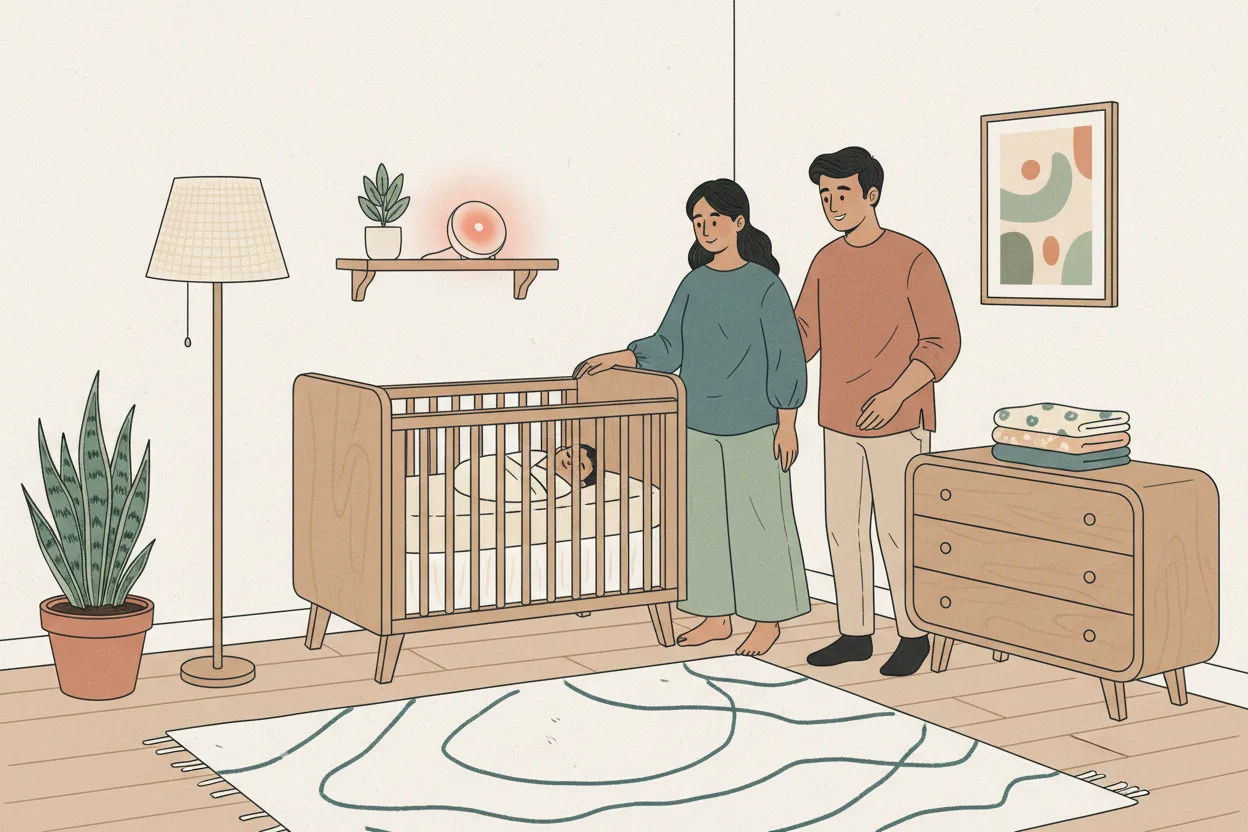
- Keep it on a dresser or shelf across the room — not clipped to the crib rail or tucked under the mattress.
- If you can comfortably hold a conversation next to it at the volume you've set, you're in a reasonable range; if you have to raise your voice over it, turn it down.
- Turn it off, or set a sleep-timer if the model has one, once baby is soundly asleep rather than running it at full blast all night by default.
A Sound Machine Doesn't Replace Safe Sleep Basics
However you use white noise, it sits on top of — never in place of — the fundamentals. The American Academy of Pediatrics recommends putting your baby on their back for every nap and every night's sleep, with or without a sound machine running nearby. And NICHD's Safe to Sleep program states that room-sharing — baby's own crib in the parents' room, not in the parents' bed — for at least the first six months lowers the risk of sleep-related death compared with bed-sharing. A white noise machine on the dresser works with either setup; it isn't a reason to change baby's own crib for anything else.
What to Look for When Buying One in India
Skip anything marketed purely on volume or a long feature list. The models worth your money share a few practical traits:
| Feature | Why it matters for an Indian home |
|---|---|
| Volume cap or low-max design | Some machines are built so their loudest setting still stays in a safer range — check reviews or the spec sheet for a stated maximum dB, not just "adjustable volume." |
| Battery + adapter combo | Runs through a power cut instead of going silent mid-nap, which matters in cities with scheduled outages. |
| Sleep timer | Lets you run it only while baby settles, rather than all night by default. |
| Simple sound library over app-dependent models | Fewer things that break when Wi-Fi drops; a basic machine with 3–5 sounds (fan, rain, static) does the job most families need. |
| Compact size | Easier to place a safe distance from the crib on a shelf or side table, rather than needing crib-rail placement to fit. |
Where to Buy
| Product type | Typical price (India) | Where to buy |
|---|---|---|
| Basic plug-in white noise machine | Rs. 800 – Rs. 1,800 | Amazon.in / FirstCry |
| Battery + adapter sound soother | Rs. 1,200 – Rs. 2,500 | Amazon.in / FirstCry |
| App-connected smart sound machine | Rs. 2,500 – Rs. 5,000 | Amazon.in |
A basic plug-in model covers most needs. Pay for the battery/app tiers only if a power cut mid-nap, or remote control from another room, genuinely solves a problem you actually have.
Frequently Asked Questions
Do white noise machines really help babies fall asleep? There's real evidence for this specifically at sleep onset — a randomised trial found 80% of newborns fell asleep within five minutes with white noise, versus 25% without. Whether it improves sleep quality across the whole night is much less settled, per a 2024 review of the research.
What's a safe volume for a baby sound machine? Keep it well below maximum. Research on these devices found most exceed hazardous sound levels at their loudest setting, so the safest approach is to avoid the max-volume setting entirely and keep the device at least 30 cm from the crib.
Where should I place the sound machine? Across the room on a shelf or dresser, not clipped to the crib or placed right next to baby's head. The same research recommends at least 30 cm of distance between the device and the child.
Can hearing damage from a loud sound machine be reversed? No. NIDCD explains that the inner-ear hair cells responsible for hearing don't regrow once damaged — this is exactly why volume and placement matter more than any other feature on the box.
Is it safe to run white noise all night, every night? There's no research suggesting occasional or nightly use at a safe, low volume and safe distance is harmful in itself — the documented risk is specifically from high-volume, close-placed devices. A sleep timer that switches off after baby is settled is a reasonable middle ground if you'd rather not run it continuously.
Could nightly white noise affect my baby's hearing or speech development long-term? This is about the sound itself, not volume damage, and the evidence is mixed. A 2024 scoping review found that continuous, moderate-intensity white noise exposure showed harmful effects on early development in animal studies, and that human data broadly agreed — but the same human evidence also suggested low-intensity noise during sleep may be beneficial. Keeping the volume low and the device across the room, rather than running it as loud, all-night background noise by default, is the practical way to stay on the safer side of that evidence.
Does a white noise machine replace safe sleep practices? No. The AAP still recommends back-sleeping for every nap and night, and NICHD recommends room-sharing without bed-sharing for at least six months — a sound machine is an add-on to these, never a substitute.