

Yes, you can give your baby your surname, combine both parents' surnames, or create a new one — there is no rule requiring an Indian child to carry only the father's name. The friction usually isn't legal. It's family.
Not medical advice — for legal documentation specific to your state or municipality, confirm current requirements with your local registrar or passport office.
Why This Question Even Comes Up in India
A father's surname passing automatically to the child feels like "the rule" in most Indian families, but a peer-reviewed review of naming and gender research notes that favoring the father's surname over the mother's is a social convention, not a biological necessity — and it's one that international bodies have flagged. The same review states that the practice of favoring men's surnames over women's has been recognized by both the United Nations (in 1979) and the Council of Europe (in 2008) as a matter of gender equality.
That framing matters because it reframes the decision: choosing your surname, or combining both, isn't a break from tradition that needs defending — it's simply one of several legitimate options.
The Legal Reality: What Documents Actually Require
Here's the part that surprises most parents: India's passport process does not require both parents' names. The Ministry of External Affairs' passport rules press release states that the online passport application form requires the applicant to provide the name of father or mother or legal guardian — only one parent, not both. In practice, that means a mother can get her child's passport issued using her own name, without naming the father at all.
Birth certificates and school records are governed by your state/municipal rules rather than a single national law, so the exact form fields vary by state — but the passport process is a useful data point: even a document as formal as a passport doesn't insist on the father's name specifically. Whatever surname combination you choose, keep it consistent across the birth certificate, passport, and school admission form from day one — mismatched surnames across documents create paperwork headaches later, even though that's a logistics issue rather than a legal barrier.
Who Actually Makes This Decision in Your Home
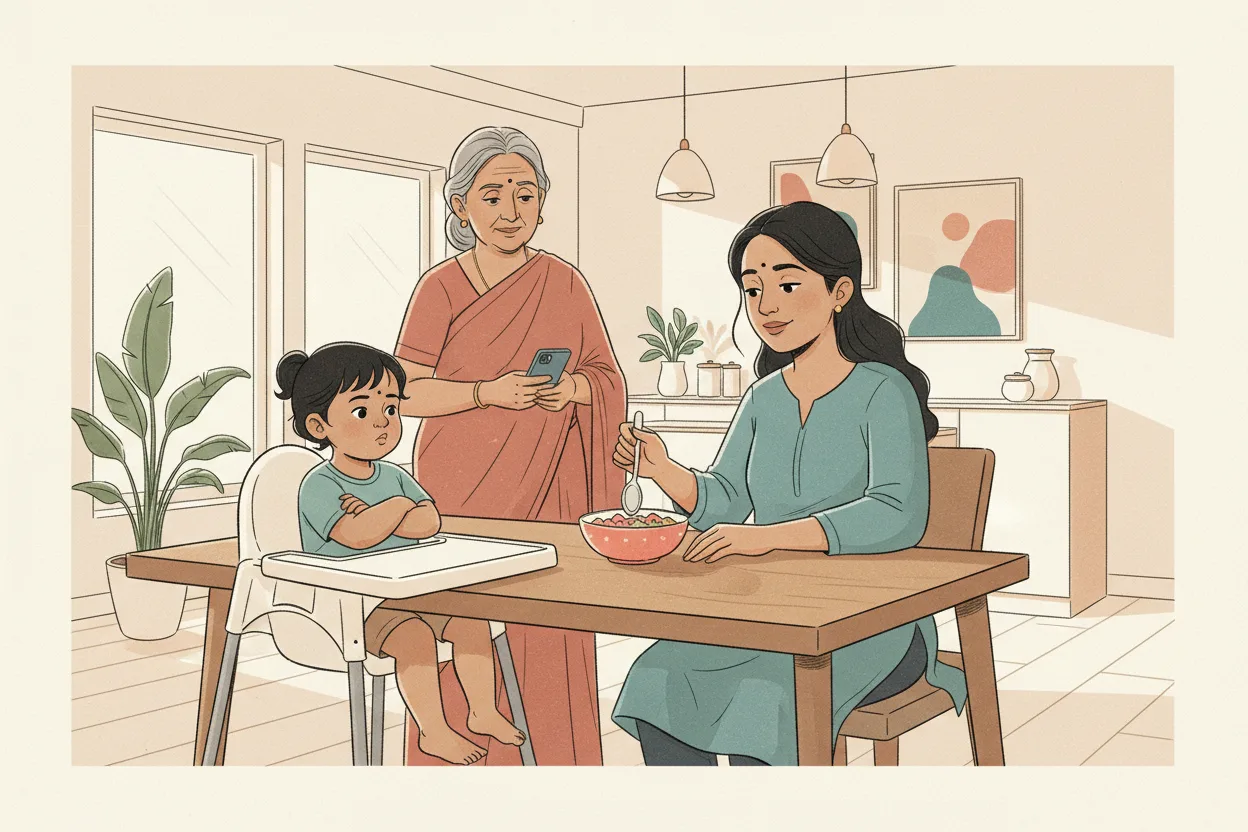
Here's a pattern worth knowing before the conversation happens: naming decisions in Indian households often aren't a joint call between the two parents. A peer-reviewed study of 551 mother-caregiver dyads across four Indian states found that decisions in the household are predominantly made by a single person — around 70 percent of the time — and that person is often not the birthing woman herself, but a caregiver such as the father, the maternal grandmother, or the paternal grandmother.
That's useful context if a surname discussion suddenly feels like it involves more relatives than just you and your partner. It's not unusual. It also means the two of you deciding together, as a couple, and then presenting that decision to the wider family, is itself already a deliberate departure from a common default — and worth naming as your plan going in.
Handling Pushback From In-Laws
If your in-laws push back, you're not imagining the emotional weight of it. A qualitative interview study of postpartum identity among urban mothers in Chennai found that mothers commonly describe feeling judged by a mother-in-law's expectations in the postpartum period — one mother described it as, "My mother-in-law would say, 'You should've done this or that.' No one appreciated what I was doing." A surname disagreement often lands on top of that same dynamic, not separate from it.
There's also a real well-being cost to keeping the peace at your own expense. The same PLOS ONE study found that a birthing woman's postpartum mental well-being is measurably lower when her primary caregiver is her mother-in-law, compared with a spouse or other caregiver filling that role. That doesn't mean every mother-in-law relationship is difficult — it means the postpartum period is already a vulnerable window, which is worth remembering when a surname conversation gets tense.
A few things that help in practice:
Bring your partner into the conversation with you, not as your advocate. Since surname convention is a social choice, not a biological rule, it lands differently as "we decided" than as "she wants."
Decide before the birth, not during the newborn haze. Sort out cradle-naming ceremonies, official documents, and what you'll say to relatives ahead of time, so you're not negotiating this while sleep-deprived.
Separate the ceremony from the paperwork. Many families do a traditional naming ceremony that uses one name informally, while the legal documents carry the name you've decided on as parents. You're allowed to let elders lead the ritual while you lead the registration form.
Keep your reasoning simple and steady. Surname convention is a social choice rather than a fixed rule, so there's no tradition-based argument to win — you can simply repeat, calmly, what the two of you have decided, and move on to updating the documents.
Frequently Asked Questions
Do both parents' surnames have to appear together, or can I use just my surname alone? Either is fine. Some parents give the child only the mother's surname, some hyphenate or combine both, and some create a new shared family surname. The choice is yours as parents — there's no requirement to include the father's surname.
Will using my surname cause problems getting a passport for my baby? No — the passport application only asks for one parent's name, father, mother, or legal guardian, so applying with your own name is a recognized path, not a workaround.
What if the birth certificate already has a different surname than what we want going forward? Correcting a birth certificate is possible but involves your local municipal registrar and can take time and follow-up. If you've moved past that stage and want the change formalized more broadly, the Department of Publication's guidelines for changing a minor's name state that either parent has to notify the change in a newspaper, then submit a signed undertaking and specimen form to have it published in the Gazette of India — a separate, formal process from the municipal correction, with its own paperwork and printing fee. It's far easier to settle on the final surname before you register the birth than to change it afterward.
My in-laws say a child must carry the father's surname by tradition. How do I respond without a fight? There's no need to debate tradition, since favoring the father's surname is a social convention rather than a fixed requirement. You can simply say this is what the two of you, as parents, have decided for your child, and that the decision is made — then redirect the conversation to something you'd genuinely like their involvement in, like the naming ceremony itself.
Does the school admission process care which surname we use? Schools go by whatever is on the birth certificate, so as long as your documents are consistent with each other, the surname itself isn't an issue for admission.
Is it normal to feel like this decision caused more family tension than expected? Yes — decisions like this often surface wider dynamics around who typically makes calls for the baby in the household and how postpartum family relationships feel day to day. Feeling friction here doesn't mean you've made the wrong call.