

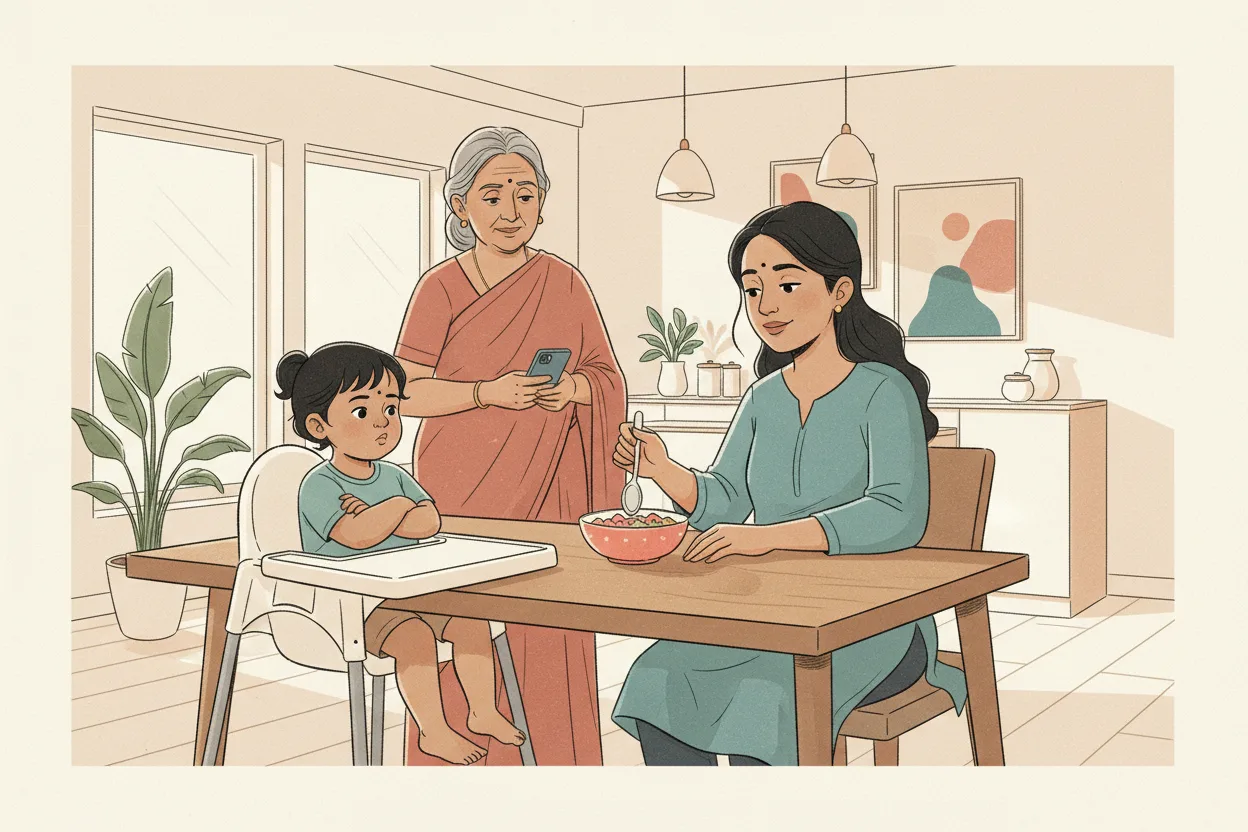
Your toddler pushing away food they used to eat happily doesn't mean something is wrong. And the phone or TV your in-laws hand over to sneak in "just one more bite" is a fix that actually works against you.
As the American Academy of Pediatrics (HealthyChildren.org) explains, "after the rapid growth of infancy, when babies usually triple in weight, a toddler's growth rate – and appetite – tends to slow down." That's why a child who ate everything at one can turn choosy between ages one and four — it's a stage, not a sign something is wrong.
Not medical advice — consult your pediatrician about your child's growth and feeding.
Why Your Toddler Suddenly Won't Eat
The appetite drop is the biggest reason mealtimes get tense in a joint household. Grandparents remember your child eating well as a baby, so a plate that comes back half-finished can look alarming — even though it's expected at this age.
Part of the pattern is also about exposure, not stubbornness. A systematic review found that "the evidence suggests that eight or more exposures will lead to an increase in at least one measure of food acceptability" — a toddler who spits out a new vegetable the first few times isn't refusing it for good, just not there yet.
Why "Just One More Bite" Backfires
The instinct in a joint family is to get food in, by whatever means works — cajoling, chasing the child around the room, or forcing a spoon in. It rarely works.
A peer-reviewed study in Appetite (PubMed) found that pressuring a child to eat was linked to lower food and energy intake, not more — the opposite of what the pressure aims for. And the Indian Academy of Pediatrics' parental feeding guideline states plainly: "Do not force to feed the child. This way the child starts disliking food and the process of feeding."
Why the Phone or TV "Helps" Right Now — But Costs More Later
This is the hardest part to push back on, because it visibly works in the moment: hand over a phone, and a distracted toddler opens their mouth for a few more spoonfuls. But it trades a short-term win for a longer-term problem.
A peer-reviewed study (PubMed Central) found that "screen use during meals in early childhood is related to overall screen time and the use of TV as a background, and also associated with more frequent consumption of junk foods." The American Academy of Pediatrics (HealthyChildren.org) warns that "distracted by the TV or the app, they'll often eat long beyond when they're full. The result? Weight gain." A distracted toddler isn't learning what "full" feels like — they're eating on autopilot.
It's also not the substitute for engagement it can feel like at a hectic joint-family dinner. The American Academy of Pediatrics states that "children younger than 2 learn best from exploring the world around them and playing with other children and adults" — not from passive viewing, at meals or otherwise.
What to Do Instead
The alternative isn't more pressure or a screen — it's stepping back and letting your toddler steer, within limits you set. A peer-reviewed study (PubMed Central) describes responsive feeding as "a feeding style characterized by child signaling of hunger and fullness cues and the appropriate responses from the caregiver to these cues." In practice: you decide what food goes on the table and when meals happen; your toddler decides how much of it they eat.
Combine that with repeated, pressure-free exposure — the same rejected vegetable served again a few days later, without commentary, works better than a mealtime battle. Keep portions small so "finishing the plate" isn't the daily goal.
Holding the Line With In-Laws Without a Fight
Knowing the research helps you stay calm — but you still have to say something at the table, in front of family, without it turning into a confrontation. A few ways to do that:
| Situation | What to try instead |
|---|---|
| Grandparent reaches for the phone to distract during a meal | "Let's try without it today — I want to see how much they eat on their own." Offer to sit with the child yourself for that meal. |
| Family says the child is "not eating enough" | Share what the pediatrician said at the last check-up (growth, weight) rather than debating opinions — a number is easier to agree on than a feeling. |
| Someone tries to spoon-feed past the point the child is pushing food away | "They're telling us they're full — let's stop and try again at the next meal." |
| Pressure to finish the plate before leaving the table | Serve a smaller portion to start with, so "finished" is realistic, and offer seconds only if asked. |
Frame it as "this is the approach our pediatrician suggested" rather than "you're doing it wrong" — it's often easier for grandparents to follow a doctor's approach than to change a habit on your say-so alone. Most families come around once they see the child eating calmly, without the drama the phone was papering over.
Frequently Asked Questions
Is it normal for my two-year-old to refuse foods they used to eat happily? Yes. As HealthyChildren.org explains, a toddler's appetite and growth rate slow down noticeably after the first year, so choosy and unpredictable eating between ages one and four is expected, not a red flag on its own.
My mother-in-law says a few episodes of TV during meals is harmless. Is she wrong? The concern isn't one meal — it's the pattern. Research links regular screen use during meals to more junk-food consumption, and the AAP notes a distracted child tends to eat past fullness. Occasional use is different from making it the daily routine.
How many times should I offer a food my toddler rejected before giving up? Keep going. A systematic review found that eight or more calm exposures typically increase acceptance of a new food. Offer it again in a few days without pressure or comment, rather than forcing the issue in one sitting.
Won't my toddler just not eat enough if I stop pushing them? Research on pressure to eat actually found the opposite of what most families fear — pressuring a child was linked to lower intake, not higher. Letting your toddler control how much they eat, while you control what's offered, tends to work better over time.
What do I say when family insists I'm underfeeding my toddler? Bring it back to your pediatrician's growth chart rather than arguing preferences — the IAP's own guidance to parents is explicit that force-feeding backfires, which can help reframe the conversation as "the doctor's approach," not just yours.
Is it okay to let my toddler eat the same three foods for weeks? Yes. A toddler's appetite and food choices naturally narrow at this stage, so repeating safe foods is fine. Keep offering new foods alongside the familiar ones without pressure — it typically takes eight or more calm exposures before a new food is accepted, so patience works better than a battle.