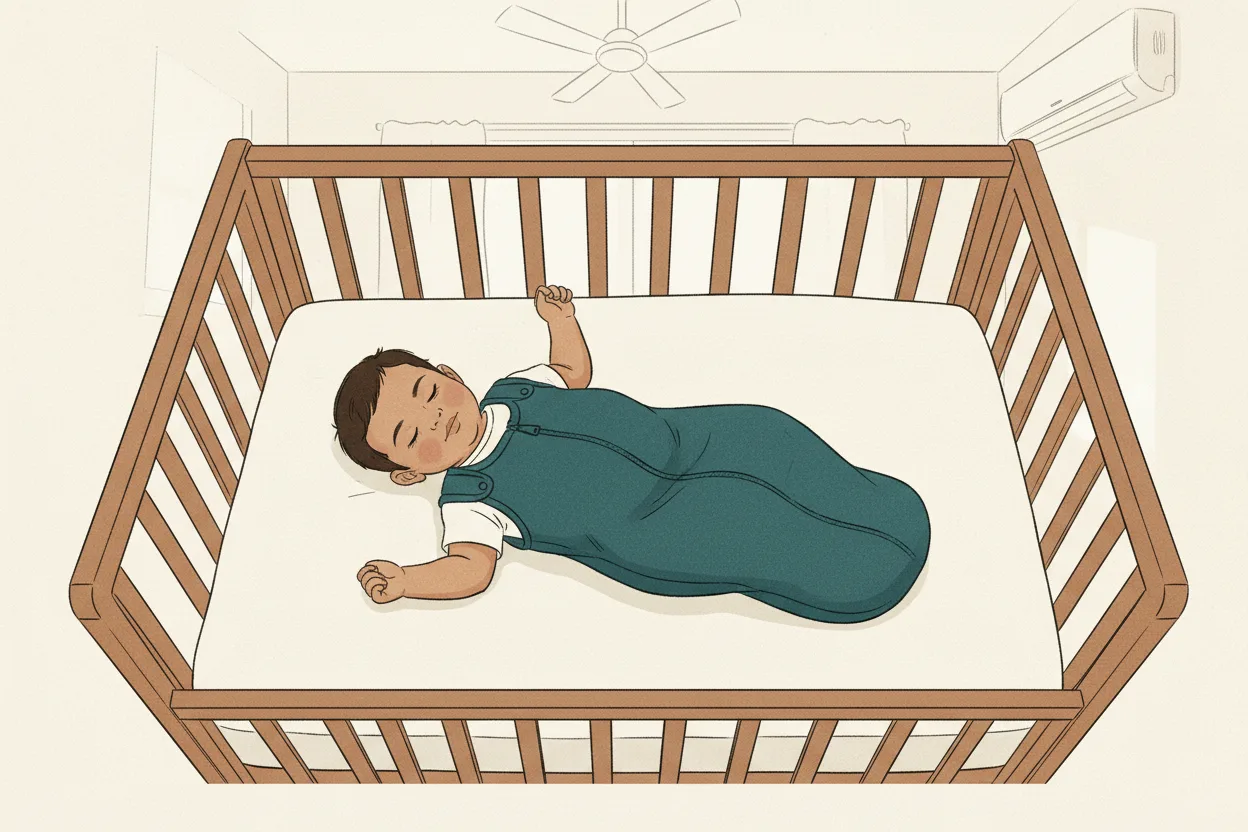
If your baby is up and crying by 5:30 or 6 AM every single day, you haven't done anything wrong — early morning waking is one of the most common baby sleep complaints, and it's genuinely fixable. The three most likely reasons are a room that's a little too warm, dawn light creeping in, and a nap schedule that's quietly shifting underneath your baby — all things you can check and adjust starting tonight.
Not medical advice — consult your pediatrician if the early waking is paired with illness, poor weight gain, or other symptoms that worry you.
Rule Out Heat First
Heat is the easiest thing to check and one of the most common, easily-fixed triggers behind a fussy, too-early wake. The AAP and other medical organizations recommend keeping baby's sleep space in the comfortable range of about 68-72°F (20-22°C) and avoiding overheating or covering baby's head — worth a second look if you run the AC on a timer or your baby sleeps in a closed room overnight, common in many Indian homes during summer. Before assuming your baby needs another layer at 5 AM, check for the opposite problem: NICHD's Safe to Sleep campaign advises checking your baby for signs of overheating — sweating, a hot chest, or flushed skin — before adding any warmth.
Check Light Next
Even a sliver of dawn light can be enough to wake a light-sleeping baby well before you're ready. Sleep Foundation notes that blackout curtains block the majority of external light, which makes them one of the most effective ways to prevent light-triggered early waking, since even small amounts of light exposure can disrupt sleep. Balance that with getting outside during the day: Sleep Foundation explains that exposure to natural light during daytime activities helps establish a day-night sleep-wake pattern, making it more likely your baby sleeps longer and more consolidated stretches at night — a short morning walk or time near a window does the job.
Consider Sound Too
If your baby's room backs onto a street, a milk cart, or an early-rising joint family, sound is worth checking alongside heat and light. Sleep Foundation notes that one theory for how white noise helps is that it masks background noises that can disrupt sleep — running a fan or white noise machine through the early morning hours can cover the honking, temple bells, or hallway footsteps that often start well before 6 AM in Indian apartments and buildings.
Is It Actually Hunger?
Hunger is worth ruling out, but it isn't always the reason for a dawn wake at this age. The NHS notes that for some babies aged 6 months to a year, night feeds may no longer be necessary, and some babies this age sleep around 15 hours in total, most of it at night — so a 5:30 AM cry isn't automatically about an empty stomach. If your baby settles quickly and goes back to sleep after a feed, that's a real signal to keep feeding for now; if the feed is more habit than hunger, it's a good thing to bring up at your next pediatrician visit.
Total Sleep Might Be the Real Issue
A baby who is genuinely short on sleep — day or night — will often wake early simply because their tank isn't full. Nemours KidsHealth states that most babies 8, 9, 10, 11 and 12 months old need 12-16 hours of sleep per day, including a stretch of 9-12 hours at night, so a baby waking at 5:30 AM after a late bedtime may simply be short on total sleep rather than settled into a permanent new pattern. If bedtime has crept later over the past couple of weeks, try moving it 15-20 minutes earlier for a few nights before assuming anything else is wrong.
The Nap-Transition Connection
There's also a schedule shift working against many families around this age. Nemours KidsHealth notes that from around 4 months of age, sleep rhythms start to become more set, with most babies sleeping longer at night and settling into 2-3 daytime naps — and that schedule keeps evolving for months afterward as naps consolidate further, which can temporarily unsettle wake times. Many babies move from 3 naps down to 2 somewhere between 7 and 10 months, and it's common for the morning wake time to get earlier and crankier for a few weeks while the new rhythm settles in. If your baby has recently dropped a nap, or is fighting the morning nap while still needing an early-afternoon one, that transition — not a new "permanent" habit — is often the real driver.
How to Shift the Wake Time, Gradually
Once you've checked heat, light and hunger, the fix is consistency, not a dramatic change overnight. The NCT (National Childbirth Trust) advises putting your baby to bed at the same time every night and waking them at the same time every morning, alongside daytime light exposure and dimming the lights before bed, to support their internal body clock. Pick a target wake time and hold the whole household to it — no earlier feeds, no bringing baby into a brightly lit room — for at least 1-2 weeks before deciding whether it's working, since body clocks shift gradually and one good or bad morning doesn't mean much on its own.
Products That Actually Help
| Product | What it does | Price Range | Where to Buy |
|---|---|---|---|
| Blackout curtains / window film | Blocks dawn and streetlight glow from waking baby early | Rs. 700 – Rs. 2,500 | Amazon.in |
| Digital room thermometer | Confirms the room is in the 68-72°F (20-22°C) range instead of guessing | Rs. 300 – Rs. 900 | Amazon.in |
| Toddler clock / "OK to wake" light | Gives a visual cue for the target wake time once baby is old enough to understand it | Rs. 1,000 – Rs. 2,500 | FirstCry |
A thermometer is the cheapest way to stop guessing about heat — many Indian bedrooms run warmer than expected once the AC cycles off overnight, and confirming the actual temperature takes the guesswork out of the first fix to try.
Frequently Asked Questions
My baby used to sleep till 7 AM. Why did this suddenly change? A sudden shift is often one of three things: a warmer room than before, more light coming in as the seasons change, or a nap transition happening underneath the surface. Work through heat, light, and nap timing in that order before deciding it's a permanent new pattern.
Is it OK to just let my baby cry it out until a later hour? That's a personal parenting choice outside what we cover here — talk to your pediatrician about an approach you're comfortable with. What's worth doing regardless of approach is ruling out heat, light and hunger first, since those are quick, low-effort fixes.
How long should I wait before going in when my baby wakes and cries at dawn? Nemours KidsHealth advises giving your baby a few fussy minutes before you respond — after confirming everything is OK, reassure without picking your baby up right away, since they may settle back down and fall back asleep on their own.
Should I move bedtime later so my baby wakes up later? Often the opposite works better. An overtired baby tends to wake earlier, not later, so a later bedtime can backfire. Try an earlier bedtime for a few nights first and see if the wake time improves before pushing bedtime back.
How long before I know if a change is working? Give any single change — earlier bedtime, blackout curtains, a consistent wake time — at least a week, ideally two, before judging it. Body clocks shift gradually, and one early morning doesn't undo progress.
Could this be the 3-to-2 nap transition? Often, yes. Nemours KidsHealth notes that babies' daytime nap schedules keep evolving for months after sleep rhythms first set around 4 months, and many babies move from three naps to two somewhere in the 7-10 month range — an unsettled nap schedule during that shift can show up as an earlier, crankier morning wake for a few weeks until the new rhythm settles.
When should I actually call the pediatrician about this? Poor weight gain, frequent illness, snoring, breathing pauses, or a generally unwell-seeming baby (rather than just a cranky one) are all good reasons to bring it up with your pediatrician sooner rather than later.