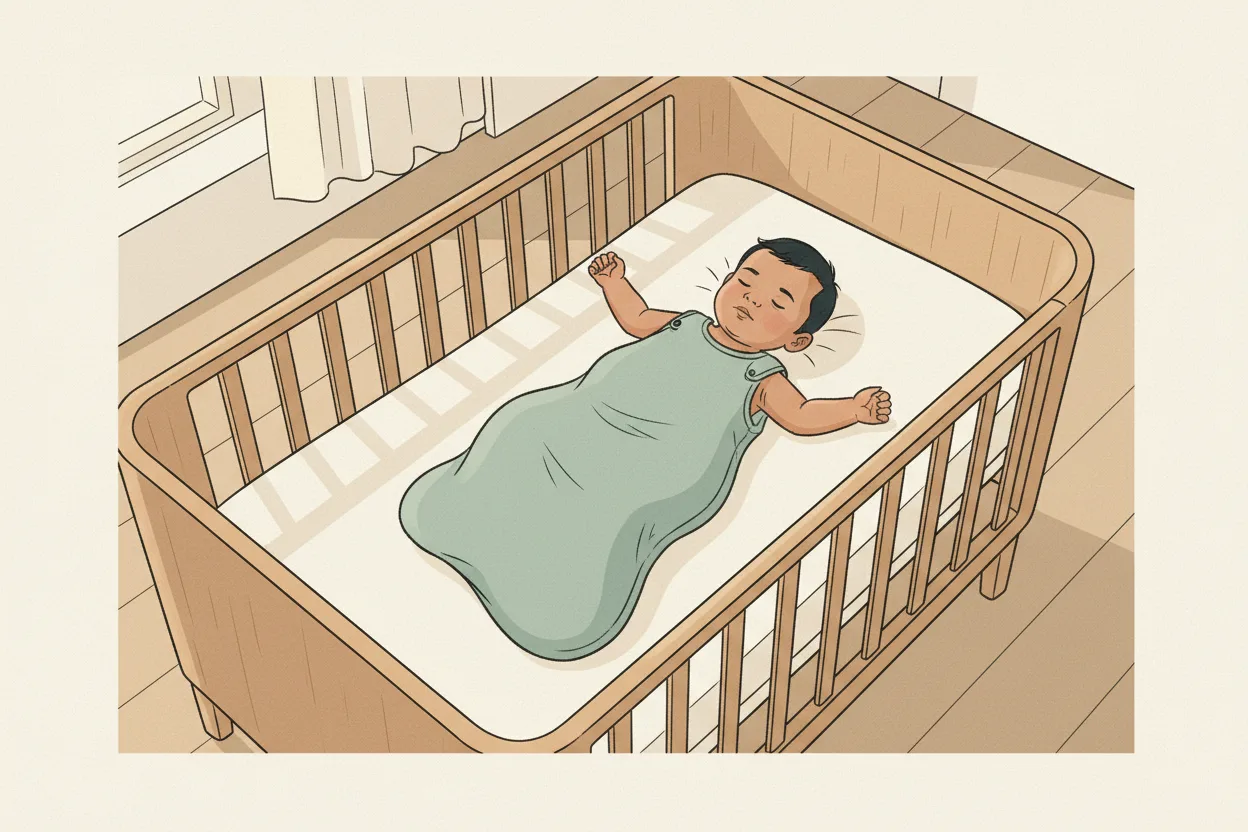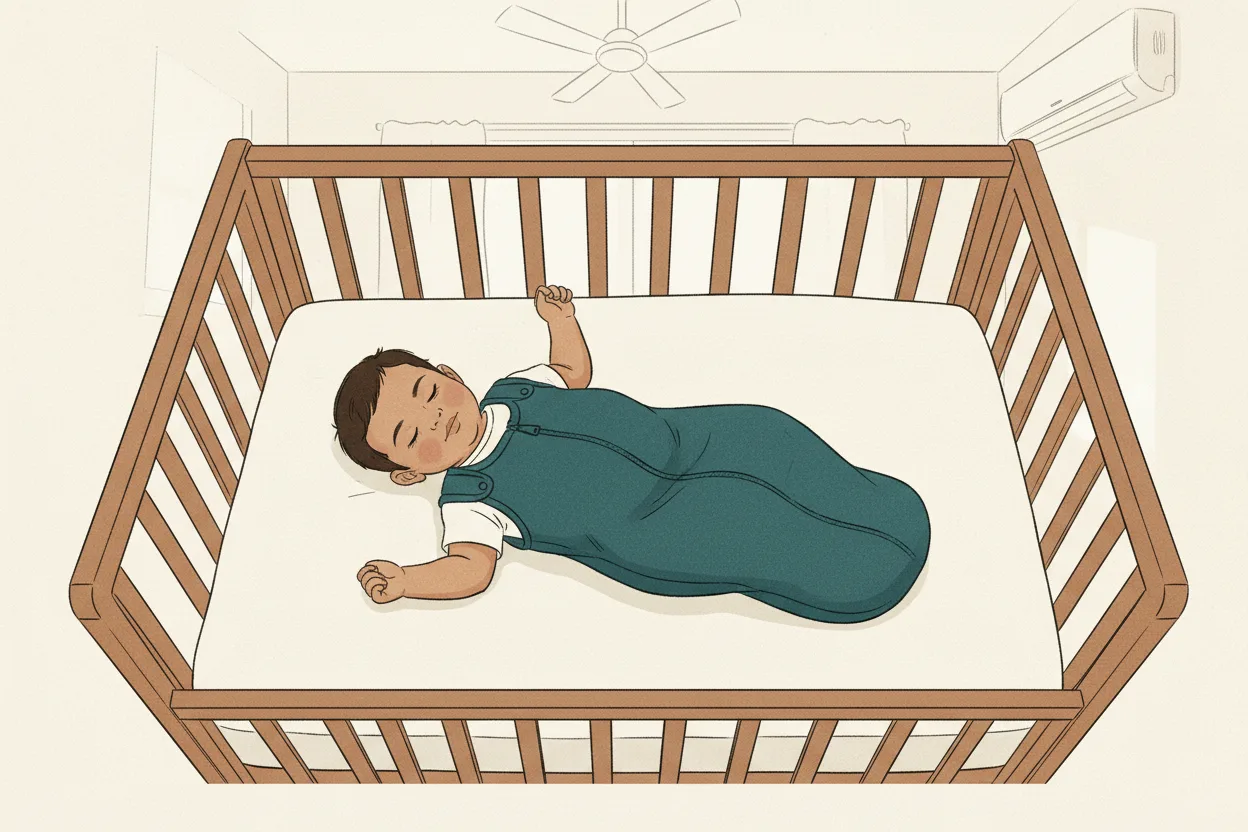
One light layer, not the footed full-sleeve suit. At twenty-five to twenty-six degrees, the Lullaby Trust's dressing guidance states that when the room is warmer than twenty degrees Celsius it is fine to have your baby in a lightweight layer such as a short-sleeve bodysuit, or even just a nappy. Your room sits above that all night. The sack has taken over the muslin's job, so the thing underneath it gets lighter, not stays the same.
Not medical advice — talk to your paediatrician about your own baby.
Why nobody will give you the chart you want
You have probably already found one: a neat grid on the sack's swing tag or the brand's site — twenty-six degrees, 0.5 TOG, bodysuit only. What you cannot find is the same grid from a safe-sleep authority — and that gap is on purpose, not an oversight.
The Lullaby Trust says plainly that families often look to it for a chart matching room temperature to clothing, layers and tog, and that it is unable to provide that specific advice: every product is made of different materials, so the thermal insulation differs for every product; the heat trapped between layers changes the insulation or warmth of the product significantly; and every baby is different. That is an authority telling you the precision you are looking for does not exist.
The trapped-air point is the one that answers your question directly. Dressing a baby in two one-tog sleep bags does not make two tog, because air becomes trapped between layers and increases the warmth. Layers are not additive. Neither are a suit and a sack.
So the grid on your swing tag is the manufacturer describing its own garment, and it is not nothing — the same guidance does tell parents to follow the manufacturer's tog guide for the sleep bag they have. Read it as the maker's instructions for one product, not as a public-health mapping of your baby, your layers and your room.
The rule you get instead
It is a comparison, not a number. The American Academy of Pediatrics advises that overheating can increase the risk of SIDS, and that your baby needs only one more layer than you would wear in the same environment to be comfortable. The NIH Safe to Sleep room guidance is the same sentence from the room's side: dress the baby in sleep clothing such as a wearable blanket, and keep the room at a temperature that is comfortable for you. Safe to Sleep adds the two details parents skip — dress the baby in clothes suitable for the temperature of the room, and take any hat off indoors, because wearing a hat indoors can make a baby too hot.
Which means the measurement you need is already in the room: you. Stand next to the cot at nine at night. At twenty-five or twenty-six with the fan turning, you are in one cotton layer and comfortable. His one extra layer is the sack. What goes under it is your layer, roughly — and a full-sleeve footed suit is more than you are wearing, before the sack is even zipped.
So, concretely, under the 0.5 TOG sack
A short-sleeve cotton bodysuit. The half-sleeve jhabla-style vest works, or a sleeveless one. Bare legs, bare feet inside the sack, no socks, no hat, and nothing laid over the top.
Keep the footed full-sleeve suit for a different night — a hill-station trip, or a December morning with the AC off.
Here is why that suit was fine under the muslin and is a different proposition under the sack. The muslin was one loose-woven cotton layer that breathed, draped and let air through the weave. A sleep sack is a closed, lined garment that holds still air against him by design — that is what a tog rating is measuring. Swap one for the other and you have not swapped like for like: the heat trapped between the layers changes the real insulation significantly, which is the exact reason the chart you wanted does not exist.
The fan is doing real work, just not this work
The Lullaby Trust's hot-weather advice suggests using a fan to cool the room but not aiming it directly towards the baby, together with lighter bedding and clothing and fewer layers. Setting four is helping the room. It moves air past his face and skin, which changes how twenty-six degrees feels; it has no effect on how much heat the sack and whatever is under it trap between them. The layers are decided by the room and by checking him. The fan speed is not a variable in the layering.
Where the honest answer is "start lower and check"
This is one of those places — not a hedge, but what every one of these authorities does instead of publishing a chart. Put him down tonight in the bodysuit and the sack. Then check him, twice: once about twenty minutes after he settles, and once when you go to bed yourself.
Checking is not watching his face or trusting the thermostat. It is two fingers on skin.
How to tell whether he is too hot
The NHS tells you exactly where to feel: his chest or the back of his neck — and not to worry if his hands or feet feel cool, because that is normal — and to remove one or more layers of clothing or bedding if his skin is hot or sweating. Hands and feet mislead in both directions: a perfectly comfortable baby has cool fingers and cool toes at three in the morning, which is how a parent ends up adding a layer that was never needed.
Safe to Sleep lists the signs to watch for: sweating, flushed, red or hot skin, or a chest that feels hot to the touch. Damp hair at the hairline and a clammy neck usually show up before any of it.
The same caution comes from closer to home. The Indian Academy of Pediatrics tells parents to keep soft bedding out of a baby's sleep area and, additionally, not to cover the baby's head or allow the baby to get too hot.
And the reason the authorities are so careful with this, rather than just telling you to keep him cosy: the NIH names temperature among the risk factors for SIDS, and says overbundling — dressing a baby in too many layers of clothing and bedding for the temperature of the room — can increase the risk. A 1992 case-control study in the BMJ measured the quantity involved: babies who died of SIDS had more excess thermal insulation for their given room temperature, 2.3 tog against 0.6 tog in matched controls, and the relative risk rose by about a quarter for each extra tog of insulation above what the room called for. Excess insulation relative to the room is the variable — which is precisely what a suit plus a sack plus a cool room makes hard to eyeball, and why the check beats the arithmetic.
The rest of the setup is unchanged: a firm, flat, level sleep surface covered only with a fitted sheet, with nothing soft or loose in the cot — laid out in our guide to sleep in the first three months.
Where to read next
The transition itself — the rolling deadline, the startle reflex, and how to run the arms-out steps you are halfway through — is in our guide to stopping the swaddle once your baby rolls. For the months when the answer under the sack gets heavier again, see dressing a baby in cooler weather. And if the night wakings start multiplying in the next few weeks, that is a separate story: the four-month sleep regression.
You have bought the right sack. Put one light layer under it, keep your hand free, and let his chest tell you the rest.