Start with what you may not have noticed: at ten weeks, a five-to-six hour stretch at night is what most parents are still waiting for, and yours is already happening. The fifteen-minute naps are real and the days are genuinely hard — but they are not a sign that something has gone wrong, and the total you are counting is not the alarm you think it is.
Not medical advice — consult your pediatrician about your own baby.
Your nights are the good news
A longitudinal sleep-diary study of seventy-five infants, published in Pediatrics, found that the most rapid consolidation in infant sleep regulation happens in the first four months, and that most infants are sleeping through the night by two and three months of age, whichever definition of "through the night" the researchers used. A long first stretch, a feed, then a shorter second stretch is exactly the shape that emerges here. The honest reading of your baby's night: on time, possibly a little ahead.
A short nap is one sleep cycle, not a failed long one
A 2011 review of sleep physiology in Nature and Science of Sleep describes the newborn cycle plainly: each cycle lasts fifty to sixty minutes, sleep onset occurs through active (REM) sleep rather than deep sleep, and each sleep period lasts only one or two cycles — so sleep periods are "shorter and more frequent than in an older child, resulting in easily interrupted sleep." Infants under six months spend about half their sleep time in REM, against a fifth in adults, and they drop into it immediately, where an adult takes roughly ninety minutes to get there.
Read your baby's nap against that. She is not failing partway through a long sleep: she goes straight into the light, arousable half of the cycle and surfaces at the seam at its end. One cycle is the unit her brain works in. Joining two together is a developmental step, not a skill she can be taught — which is why nothing you try at this age reliably lengthens a nap, and why any method that promises to is promising something her nervous system cannot yet do. If the charts have made this worse, that mismatch is ordinary too: see why wake windows rarely match a real baby, and the age-by-age totals table in our guide to newborn sleep from birth to three months.
Nights organise before days — that is the order
A baby's day–night rhythm is not switched on at birth, and it does not arrive all at once. An observational study of thirty-five healthy term infants, published in Archives of Disease in Childhood: Fetal and Neonatal Edition, tracked these rhythms from six to eighteen weeks of age and found a clear sequence: the day–night rhythm of cortisol appeared first at about eight weeks, the melatonin marker a week later, "at the same time that night-time sleep was established," and at ten weeks the deep body temperature fall arrived with the onset of night sleep.
That is a small, single-city sample, so hold it loosely — but it matches what you are living. Your baby is ten weeks old and her night sleep has consolidated, which is the rhythm arriving exactly where that study puts it. Daytime sleep comes online last, because it has to work against the daylight signal rather than with it. So your good nights and your scattered days are not a contradiction; they are the same event, seen from both ends — not day–night confusion, which is the opposite pattern, and not the six-week regression you may have read about.
Where "fourteen to seventeen hours" comes from
It is a real number with a traceable origin, and it is not a target.
It was set by an eighteen-member expert panel convened by the National Sleep Foundation, published in Sleep Health in 2015. The panel agreed that "the appropriate sleep duration for newborns is between 14 and 17 hours" — and said in the same paper that the figures are guidelines for healthy individuals and that "sleep durations outside the recommended range may be appropriate." It is a recommendation across a population, not a quota each baby must fill.
It reaches Indian parents largely by that route. The Indian Academy of Pediatrics' own parent guideline on sleep prints it for the nought-to-three-month band and credits it, in a footnote, to the Sleep Foundation. That same row carries what the popular versions drop: beside the recommended fourteen to seventeen, a minimum of eleven hours. Your eleven is the floor of that table, not a shortfall below it.
Two more things are worth knowing. The American Academy of Sleep Medicine, in its 2016 consensus statement, declined to issue any sleep-duration recommendation for babies under four months at all — because of "the wide range of normal variation in duration and patterns of sleep, and insufficient evidence for associations with health outcomes." For a baby your daughter's age, the most rigorous body in the field says it does not know enough to name a number.
And what babies actually sleep is not what the recommendations say they should. A systematic review of thirty-four observational studies in Sleep Medicine Reviews pooled measured infant sleep at a mean of about twelve and three-quarter hours a day, with a normal range from under ten hours to nearly sixteen — and found that, across childhood, studies from predominantly Asian countries recorded roughly an hour less sleep than non-Asian ones. Eleven hours sits inside that range, and the charts she is measured against were not drawn on babies here.
What actually tells you she is sleeping enough
Not the total. The signals are the ones you have already described without knowing it. The AAP's guidance on whether a baby is getting enough milk points to six or more wet nappies a day with pale urine, and a baby who seems "satisfied and happy" for a stretch between feeds. The NHS puts it more simply still: "Steady weight gain is one of the signs that your baby is healthy and feeding well." You have told us she is not always fussy and has plenty of happy, alert awake time. That is the evidence, and it outranks the arithmetic.
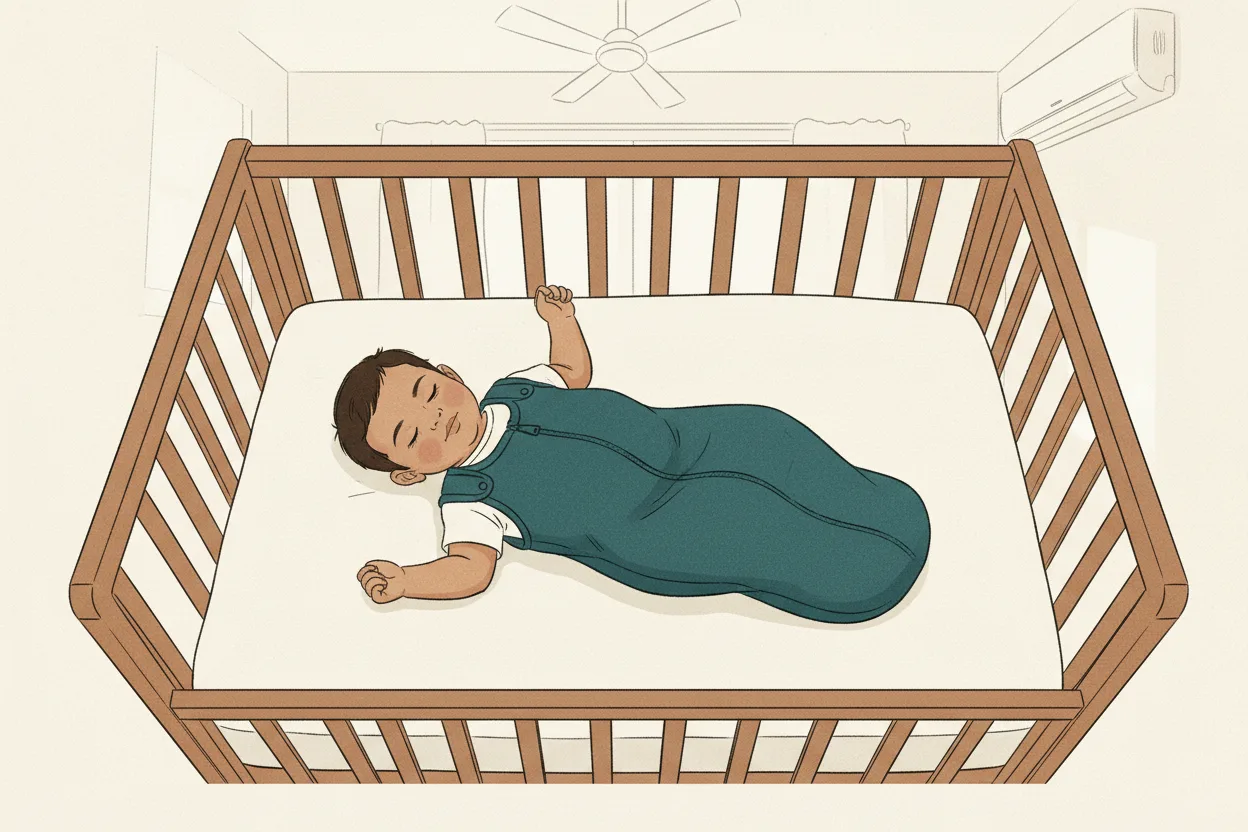
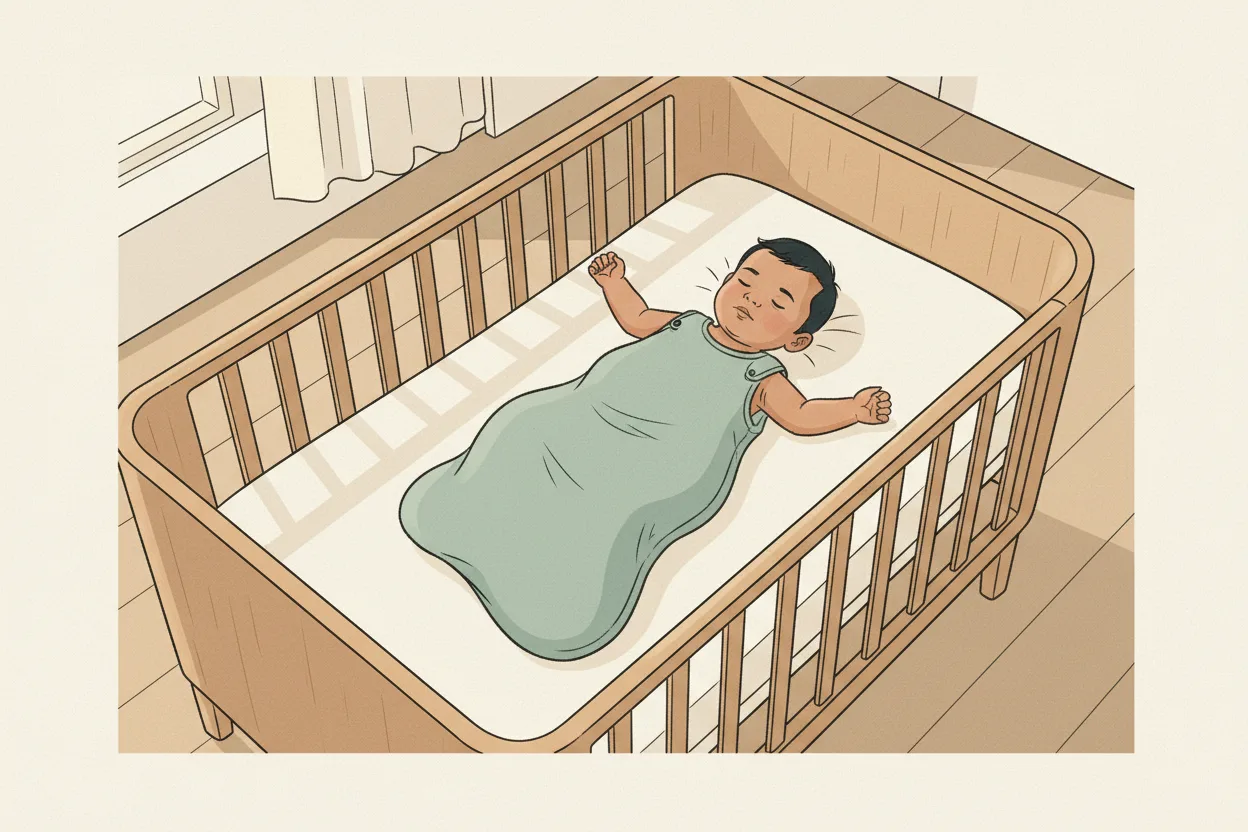
Carrying and walking her to settle is a reasonable answer to a short nap, not a habit you are building — see safe contact naps and how to rest while holding her, and getting through this with no help at home. When you do put her down, NHS safer-sleep advice applies to a daytime nap exactly as it does to the night — on her back, firm flat mattress, cot clear of pillows, bumpers, loose blankets and soft toys — because sudden infant death "can happen anytime a baby is asleep, day or night."
When scattered sleep is worth a medical look
Almost everything above is development, not illness. What moves it into your paediatrician's territory is not short naps. The AASM's statement is explicit that parents worried their child is sleeping too little or too much should consult their healthcare provider — so if the worry itself is not lifting, that is reason enough to ask.
More urgently, the NHS lists signs of serious illness in a baby: floppiness, being difficult to wake, no interest in surroundings, a weak, high-pitched or continuous cry, being unable to settle or very agitated, a baby who is not feeding, and no wet nappies for at least twelve hours. Those warrant urgent help whatever the sleep log says.
Everything else here is a ten-week-old assembling her own clock, roughly on schedule, in the order it is built.