Pick your baby up gently and calmly first — Cleveland Clinic advises being careful about how you move them, since "with head traumas, it's possible that they've also injured their neck or spine, and you don't want to possibly worsen the injury by moving them." Most bed falls end in nothing worse than a scare and a bruise, but a few warning signs mean the ER right away — covered below.
Not medical advice — consult your pediatrician if you have any concern after a fall.
What to Watch For After the Fall
Cleveland Clinic's guidance is to be deliberate about the pickup itself, since a possible neck or spine injury means you shouldn't yank or twist baby while lifting them. Check the fall height and surface (a low bed onto carpet is very different from tile or marble), then watch closely for the next 24 hours.
Call your pediatrician or head to the ER right away if you see any of these. HealthyChildren.org, published by the American Academy of Pediatrics, lists the emergency signs after a head bump as baby "looks very drowsy or cannot be awakened," has "one pupil... larger than the other," or has any "loss of consciousness (even a brief loss of consciousness should be taken seriously)." Repeated vomiting after the fall is another sign from the same list that needs same-day medical attention. If in doubt, get it checked — don't wait it out.
Why This Happens So Often on Trips
A fall off the bed rarely happens at home, where you've already baby-proofed the room. It happens at your native place, at your in-laws' house, in a hotel room — an unfamiliar bed, a different layout, a distracted moment while unpacking. None of this means you did anything wrong: falls are, in fact, the leading cause of nonfatal injury in young children overall, and travel simply strips away the baby-proofing you'd normally have at home.
Setting Up a Safe Sleep Space Away From Home
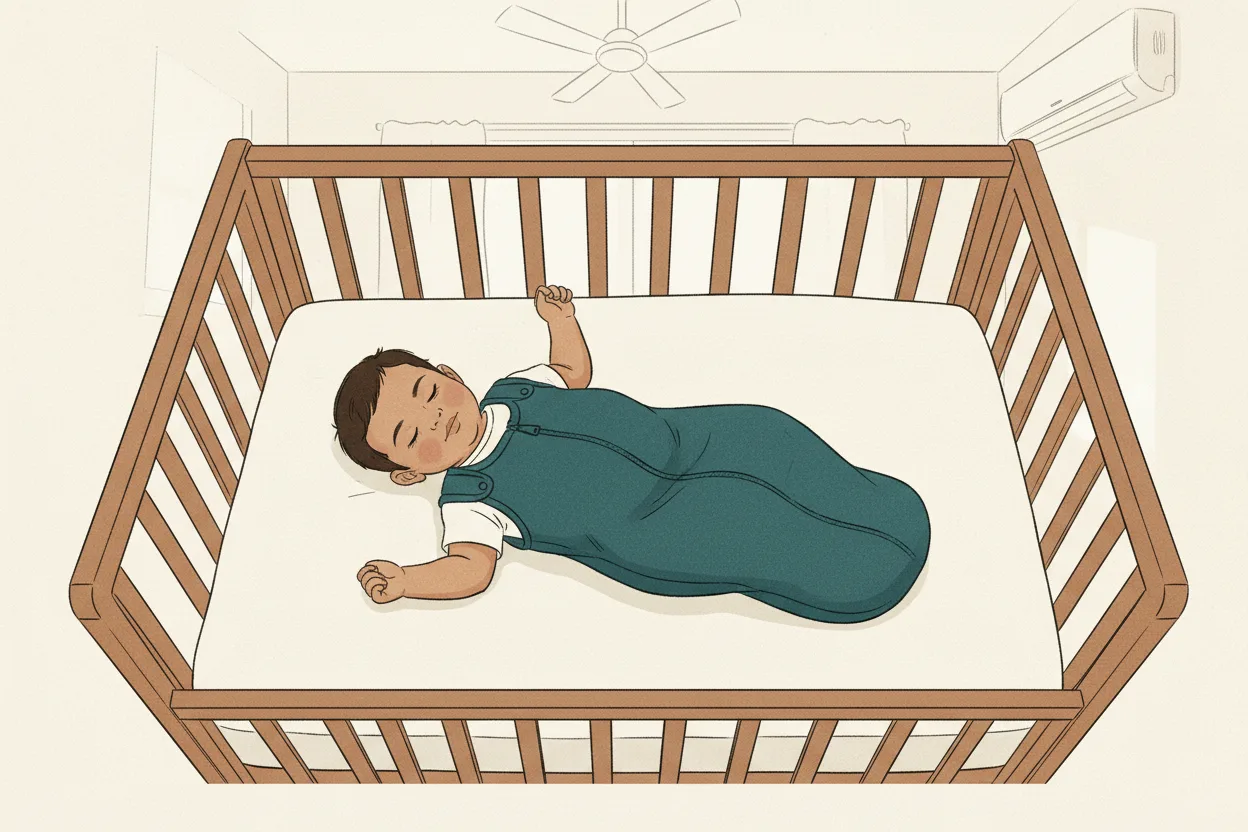
The safest fix isn't a barrier that keeps baby on an adult bed — it's giving baby their own proper sleep surface, every time, wherever you are. The AAP recommends that you "put your baby on their back for all naps & at night" on "a firm, flat sleep surface" — that rule doesn't pause because you're visiting family.
On where baby sleeps at night, the AAP states it "recommends that parents sleep in the same room – but not in the same bed as a baby, preferably for at least the first six months," and adds plainly that the "AAP cannot support bed-sharing under any circumstances." Room-sharing on a separate surface — not the open adult bed — is the guidance to carry with you when you're staying at your in-laws' or native place too.
That means the sleep surface itself matters just as much away from home as it does in your own nursery. NICHD's Safe to Sleep campaign states that "both the sleep surface (such as a mattress) and the sleep space (such as a crib, bassinet, or portable play yard) should meet the safety standards of the Consumer Product Safety Commission (CPSC)" — an open adult bed, however comfortable, isn't built or tested to that standard. And the mattress itself matters: NICHD warns that "soft surfaces, like couches, sofas, waterbeds, memory foam, air or pillow-top adult mattresses, quilts, blankets, and sheepskins are not safe for babies to sleep on" — a common setup at a relative's guest room, where the mattress is older and softer than what you'd choose at home.
The Pillow-Barricade Trap
Lining pillows around baby on the bed to stop them rolling off is one of the most common travel workarounds in Indian households — and it's worth knowing it isn't actually safe. A study in the Journal of Pediatrics, available via PMC, found that "although infrequent, infant deaths have occurred with infants placed on u-shaped pillows or with the u-shaped pillows around their heads," because "soft objects in the sleep environment can occlude an infant's airway leading to accidental suffocation." A pillow wall trades a fall risk for a suffocation risk — it doesn't remove the danger, it just changes what it is.
What Actually Works: Your Options Compared
| Option | How it works | Best for |
|---|---|---|
| Portable travel crib / play yard | Baby's own enclosed, firm, flat sleep space that meets safety standards, set up in your room | Any trip — native place, in-laws', hotels |
| Clip-on portable bed rail | A rigid barrier that attaches to the adult bed frame, keeping baby from rolling off | Toddlers already sleeping on a family bed who don't yet need a full crib |
| Floor-level mattress (baby's own, by choice) | Baby's mattress placed low so there's no fall height, in a room you've checked for hazards | Parents who prefer this setup as an option, with the room baby-proofed |
| Pillow barricade | Loose pillows stacked around baby | Not recommended — suffocation risk shown above |
A portable crib or play yard keeps the back-sleeping, firm-flat-surface setup the AAP recommends consistent, whether you're at home or three states away. A rigid, tested bed rail suits an older, mobile toddler for a short stay — not folded towels wedged under the mattress. Baby's own mattress set low to the ground, in a room checked for hazards, is a fine choice too — the point is baby's own firm, flat surface, not the height of the adult bed under them.
A bed rail isn't automatically the safer choice, either — it trades one risk for another if it's loose or gapped. A CPSC staff memorandum on portable bed rail incidents found that in the fatal cases it reviewed, "the child became entrapped in an area between the mattress on the bed and the attached bed rail, in one case the child slipped through the bars of the bed rail, in another a child was found hanging from a protrusion on the bed rail itself, and 2 children were entrapped in the space between the headboard/bedpost and the bed rail." If you do use a bed rail for an older toddler, push it flush against the mattress with no gap, check it hasn't loosened before every sleep, and skip it for a baby who isn't yet steady enough to get in and out of bed on their own.
Products Worth Packing
| Product | Price Range | Where to Buy |
|---|---|---|
| Portable travel crib / play yard | Rs. 4,500 – Rs. 12,000 | Amazon.in / FirstCry |
| Clip-on bed rail (toddler) | Rs. 1,200 – Rs. 3,500 | Amazon.in / FirstCry |
| Travel bassinet / co-sleeper (infant) | Rs. 2,500 – Rs. 7,000 | FirstCry |
Pack whichever fits your baby's age and the length of the trip. For a weekend visit, a compact play yard that folds into a bag is usually enough; for longer stays at your native place, a proper bed rail or bassinet you leave set up for the visit saves you re-assembling it every night.
Frequently Asked Questions
My baby fell off the bed and seems fine — do I still need to see a doctor? Not necessarily, but keep watching closely for the rest of the day. HealthyChildren.org (AAP) lists the signs that mean go straight to the ER: can't be woken or looks very drowsy, one pupil larger than the other, any loss of consciousness, or repeated vomiting. If none of those appear and baby is acting normally, you can monitor at home — but call your pediatrician if anything feels off.
Is it safe to just put pillows around my baby so they can't roll off? No — a study in the Journal of Pediatrics found soft objects like u-shaped pillows around a baby's head carry a real, documented suffocation risk. Use a portable crib, play yard, or a proper clip-on bed rail instead.
Can my baby sleep in bed with us just for the trip? The AAP does not support bed-sharing under any circumstances, even temporarily while traveling. Room-sharing — baby on their own firm, flat surface in your room — is the recommended setup, at home or away.
What if the guest room bed is the only option and I don't have a travel crib? Push the mattress onto the floor so there's no fall height, clear the floor space of hazards, and keep baby to the back-sleeping, firm-flat-surface basics the AAP outlines. It's not as good as baby's own crib, but it removes the fall risk for that one night while you arrange something better.
At what age is a bed rail enough, versus needing a full travel crib? Ask your pediatrician what's appropriate for your baby's stage — it depends on mobility and the specific bed, not a fixed age.
Should I feel guilty that this happened? No. Falls are the leading cause of nonfatal childhood injury overall, and an unfamiliar bed on a trip removes the safeguards you'd normally have at home. Focus on what you do next, not on blame.