
Baby massage itself is genuinely good for your baby — a Cochrane systematic review found it improves daily weight gain in preterm and low-birth-weight infants. What isn't backed by evidence is how many families in India do it: vigorously, until the baby cries, with mustard oil, and often with the mother sent out of the room. You can keep the massage and change the method.
Not medical advice — consult your pediatrician about your baby's specific health needs.
Why This Is a Family Decision, Not Just Yours
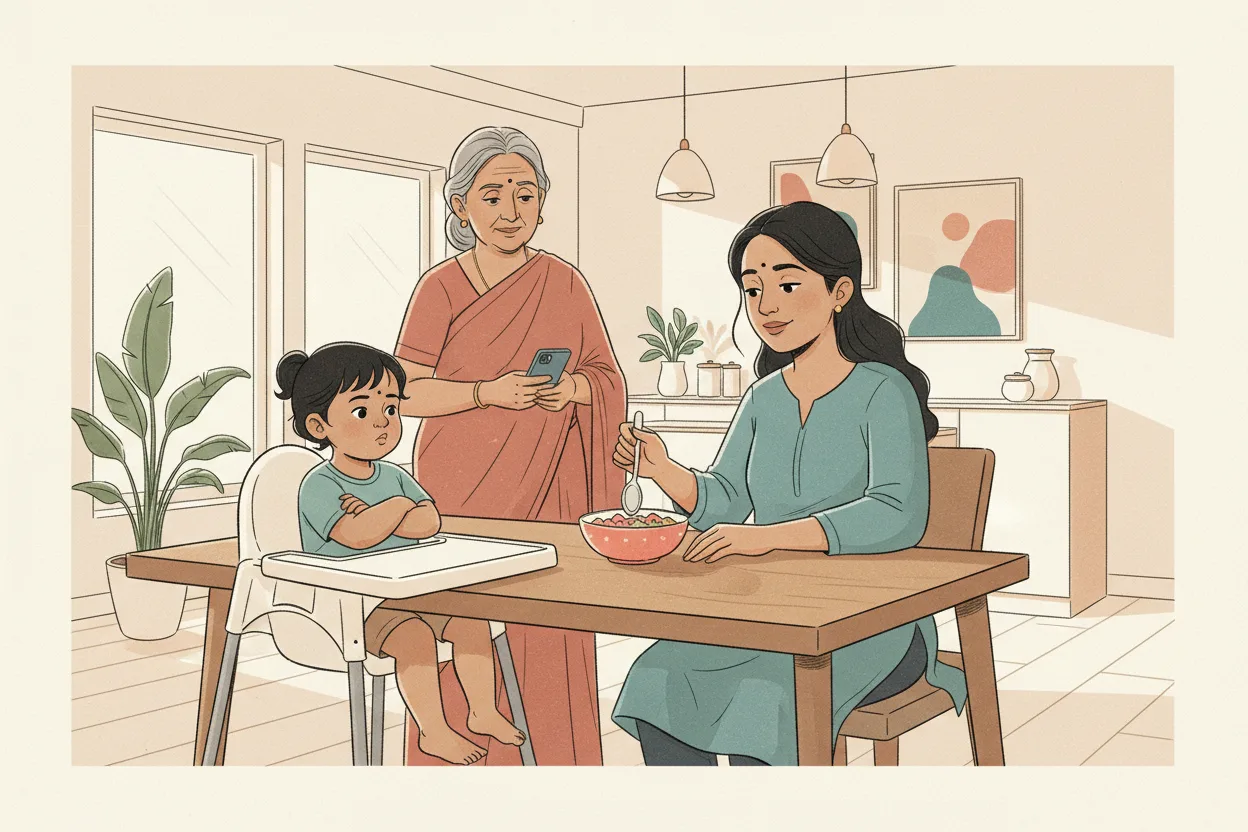
In most Indian homes, baby massage isn't optional or a personal parenting choice you get to make quietly — it's a daily ritual your mother or mother-in-law expects to lead, often with a trusted maalishwali (masseuse) doing the actual pressing and stretching. This isn't just your family: a PubMed-indexed cross-sectional study of Indian mothers' infant-massage practices found the practice prevalent among 93.8% of caretakers surveyed across two states. Saying no to massage entirely usually isn't realistic, and it isn't necessary either: the practice has real value. The goal is to keep what works and change what's risky, using evidence rather than "always done this way" as your argument.
What the Evidence Actually Supports
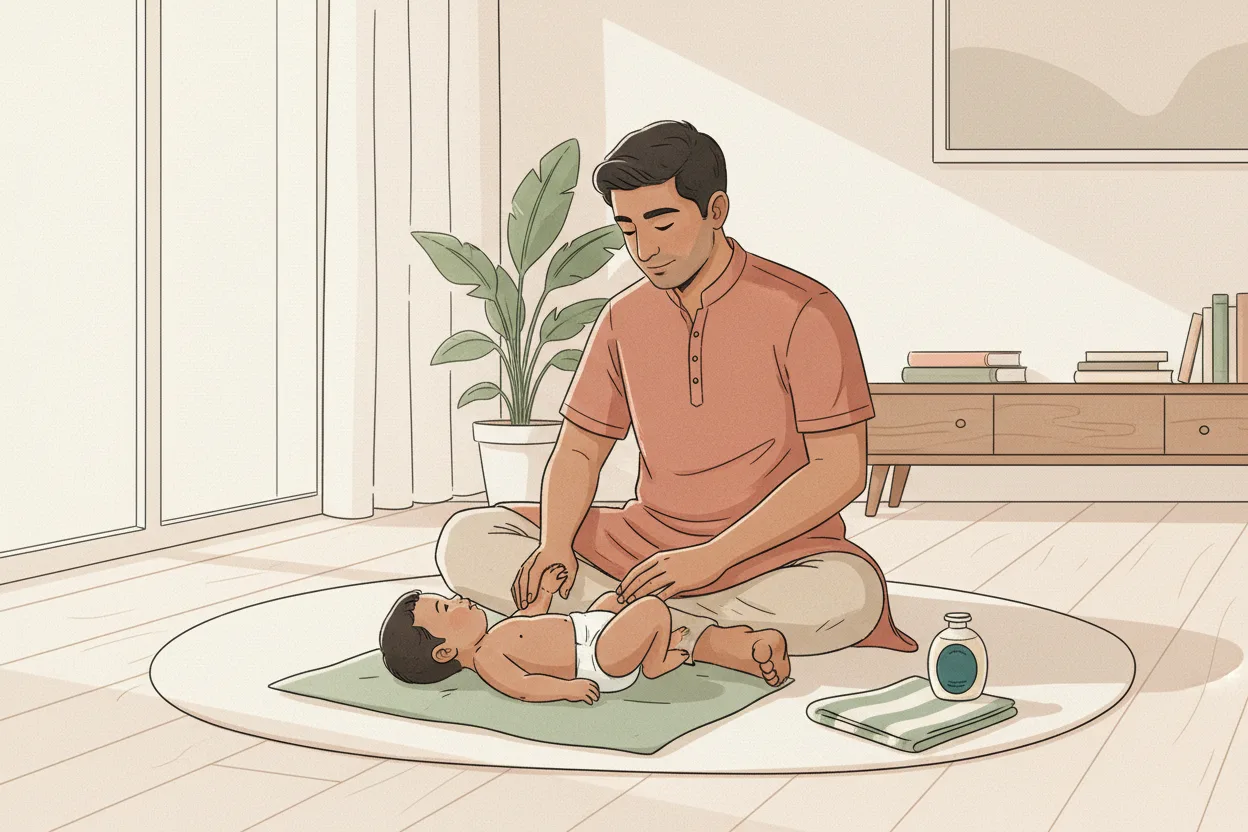
Massage is not just tradition for tradition's sake — it has a measurable benefit. A Cochrane systematic review found that massage interventions improved daily weight gain by about 5.1 grams a day in preterm and low-birth-weight infants compared with standard care. That's a real, useful reason to keep gentle daily massage in your baby's routine — it just needs to be gentle.
Where It Turns Risky: Vigorous Massage and "Until They Cry"
The most common version of the complaint — a grandmother or masseuse pressing hard, stretching the baby's arms and legs, and continuing even as the baby cries — is exactly the practice the evidence flags. A study of Indian mothers' infant-massage practices in BMC Pediatrics found that vigorous massage can be harmful to the skin barrier, especially in babies with thin, vulnerable skin. Crying isn't a milestone to push through — it's the baby telling you to stop.
The American Academy of Pediatrics' HealthyChildren.org states that you should always watch for signals that your baby enjoys what you're doing, and stop the massage if they seem to have any discomfort. That's the opposite of "massage until they cry" — discomfort is the stop signal, not something to push through to get a "proper" massage in.
This matters even more for handling in general. The American Academy of Pediatrics' HealthyChildren.org states that it is never safe to shake, throw, hit, slam, or jerk any child, and it never solves the problem — a useful line to keep in mind if massage ever tips into forceful jiggling or bouncing to quiet a crying baby.
The Oil Question: Mustard Oil vs. Sunflower Oil
Mustard oil (sarson ka tel) is the traditional massage oil in much of North India, often warmed and rubbed in vigorously because it's believed to "toughen" the skin. The research points the other way. A review of skin-care practices in Indian newborns (NIH/PMC) states that olive and mustard oils might have damaging effects on neonatal and infant skin and should be avoided.
A study that tracked this directly found the same thing. A study of newborns massaged with mustard oil in rural Nepal (NIH/PMC) found that skin-barrier function, measured by rising transepidermal water loss, worsened steadily over the newborns' first month of life, possibly worsened by the oil itself.
| Oil | What the evidence says |
|---|---|
| Mustard oil (sarson ka tel) | Linked to worsening skin-barrier function over the newborn period; avoid for infant massage |
| Olive oil | Also flagged as potentially damaging to newborn/infant skin |
| Sunflower (seed) oil | Shown to speed skin-barrier recovery rather than damage it — a reasonable, widely available substitute |
If the family is set on an oil-based massage, sunflower oil is the substitution to suggest — it keeps the ritual intact while changing only the ingredient. Whatever oil is used, an NHS baby massage guide advises always warming the oil up in your hands before you start, rather than applying it cold or heating it another way.
"Shaping" the Nose: Why This One Needs to Stop
Pinching or pressing a newborn's nose during massage, to try to make it narrower or straighter, is one of the riskier traditional practices — and it isn't supported by any real mechanism. Newborns breathe almost exclusively through their nose. A clinical review of neonatal nasal obstruction (NIH/PMC) states that because newborns are obligate nasal breathers, obstructing the nose can have consequences including breathing difficulty that can be life-threatening, feeding difficulty, and failure to thrive. Nose shape is set by genetics and cartilage growth, not by pinching in infancy — this is a practice with real downside and no upside, and worth being firm about.
The Soft Spot: A Myth Worth Correcting
A related fear that sometimes drives families to avoid the head altogether is that the fontanelle — the "soft spot" — is dangerously fragile. The American Academy of Pediatrics' HealthyChildren.org states that despite lacking a bony layer, the fontanelle is protected by a tough membrane and is well protected from typical day-to-day baby handling. Gentle touch isn't the danger; vigorous pressing anywhere on a small baby's body is.
Being Sent Out of the Room
Many mothers describe being told to leave while the massage happens — sometimes framed as "you'll get upset watching," sometimes just the masseuse's or grandmother's routine. This is a practical and relational issue, not a medical one: you're the parent, and it's reasonable to want to see what's being done and step in if the baby is distressed. Frame it as staying present, not as distrust — "I want to be there for his massage" lands better than "stop massaging him."
Setting the Boundary Without a Fight
The most effective approach is usually specific, not total. Rather than "no massage," try:
- Ask to be in the room. This alone lets you see grip pressure and stop things if baby is distressed.
- Set a clear stop signal. Agree upfront: if baby cries and doesn't settle within a few seconds, the massage pauses.
- Offer the oil swap, not a ban. Suggesting sunflower oil "because it's gentler on his skin" lands better than rejecting the oil the family has always used.
- Name the nose specifically. It's the one practice worth being unambiguous about — say clearly that pinching or pressing the nose is off the table, and explain it's about breathing, not appearance.
- Loop in your pediatrician. A one-line "our doctor said gentle only" from a professional often carries more weight in the moment than a parent's own explanation, fair or not.
What to Use Instead
| Product | Price Range | Where to Buy |
|---|---|---|
| Cold-pressed sunflower (seed) oil, baby-safe | Rs. 150 – Rs. 400 | Amazon.in / FirstCry |
| Soft cotton massage towel/mat | Rs. 300 – Rs. 800 | FirstCry |
Frequently Asked Questions
Is baby massage actually good for my baby, or is it just tradition? Both. A Cochrane systematic review found massage improves daily weight gain in preterm and low-birth-weight infants by about 5 grams a day compared with standard care.
Is mustard oil really bad, or is this overblown? The evidence leans against it. A review of newborn skin-care practices (NIH/PMC) states mustard oil might have damaging effects on infant skin, and a study in rural Nepal (NIH/PMC) found skin-barrier function worsened over the newborn period with its use.
My mother-in-law says the massage has to be firm to "build strength." Is there any truth to that? No — the AAP's HealthyChildren.org advises watching your baby's cues and stopping if they show any discomfort. There's no evidence firmer pressure builds strength, and vigorous massage can harm the skin barrier in babies with thin skin.
Is it safe to touch or massage near my baby's soft spot? Yes, for normal gentle handling. The AAP's HealthyChildren.org states the fontanelle is protected by a tough membrane and is well protected from typical day-to-day handling.
Why is nose pinching specifically dangerous, not just unproven? Because newborns rely on their nose to breathe. A clinical review of neonatal nasal obstruction (NIH/PMC) states that obstructing a newborn's nose can cause breathing difficulty that can be life-threatening, plus feeding difficulty and growth issues.
How do I stop the massage from turning into rough handling when the baby is fussy? Agree on a shared rule with whoever gives the massage: if the baby cries and doesn't settle, pause. The AAP's HealthyChildren.org is clear that it is never safe to shake, jerk, or handle a child roughly to try to solve crying.