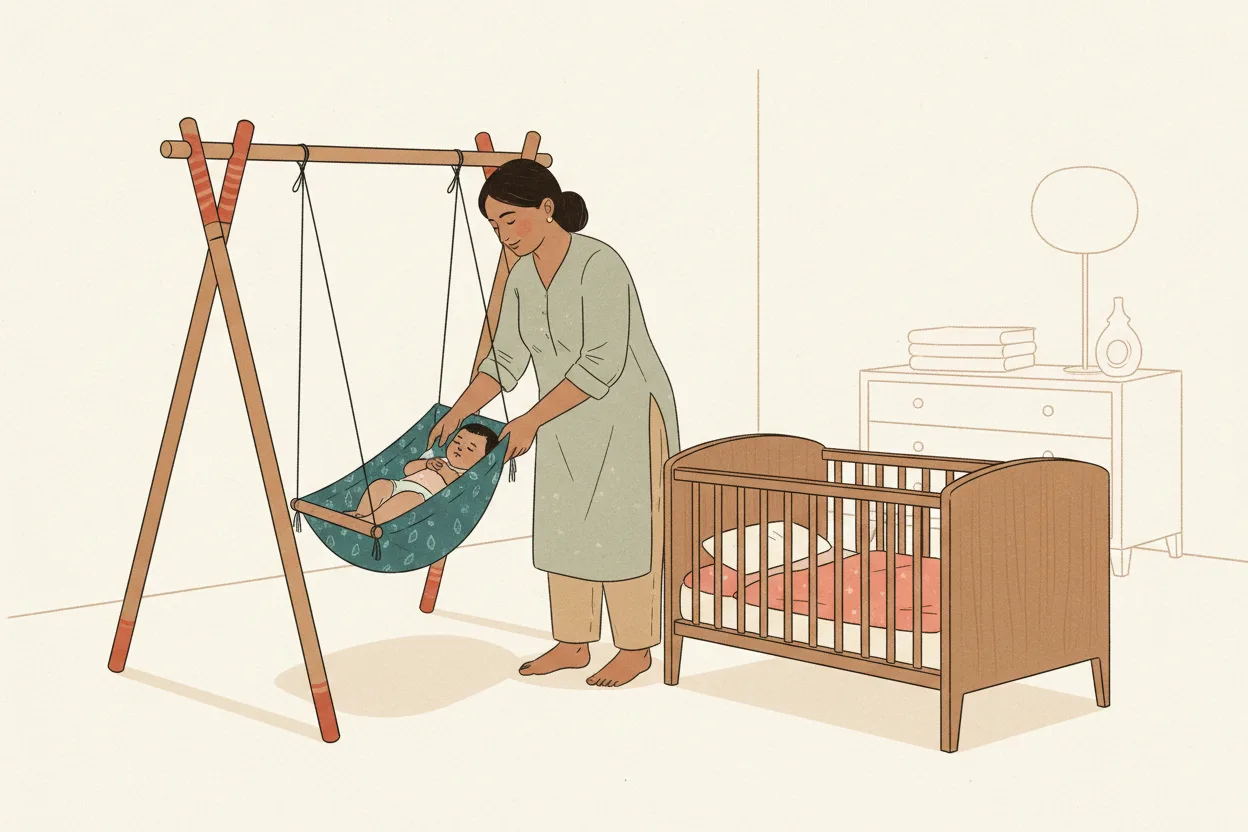


Most toddlers drop from two naps to one somewhere between 14 and 18 months. Nemours KidsHealth explains that "young toddlers may still take two naps, but most drop down to one nap a day by 18 months." If your child is still fighting sleep twice a day close to their first birthday, the one-nap schedule is probably closer than it feels — but rushing it before your baby is genuinely ready usually backfires.
Not medical advice — consult your pediatrician if you have concerns about your child's sleep or development.
Why the Switch Feels Bigger in an Indian Home
In a lot of urban Indian households, a grandparent or a nanny runs the daytime schedule while parents are at work. That's good for consistency — until the nap schedule needs to change. Whoever has run the same two-nap routine for months may reasonably assume it should keep working, so the cranky, resistant afternoons that mark a real transition can look like a discipline problem rather than a schedule to adjust.
This isn't just a global sleep-training trend, either. The Indian Academy of Pediatrics' own parent guidelines confirm that a single daily nap is the usual pattern for toddlers aged 1-2 years, alongside a recommended 11-14 hours of total daily sleep — so a caregiver who insists the "old" two-nap routine is still correct at this age is going against India's own pediatric guidance, not just a foreign one.
The fix: a short conversation about why the nap time is shifting, backed by what your child is actually showing you. Share it with the parent leaving for work in the morning, the grandparent or nanny managing the day, and whoever handles bedtime — that cuts down the tug-of-war where one caregiver keeps trying the old two-nap slot and another tries a single afternoon one.
Signs Your Toddler Is Actually Ready
The transition isn't tied to a single birthday — it's tied to behavior. Sleep Foundation identifies a toddler's difficulty falling asleep at nap time as one of the clearest readiness signs, especially when it happens at the same nap slot day after day rather than as a one-off bad afternoon.
A more specific pattern to watch for: Nemours KidsHealth states that "a toddler who fights the morning nap is probably ready for just an afternoon nap." That's the single most useful signal for Indian families juggling a caregiver handoff — if the morning nap has become a daily battle but the afternoon nap still goes smoothly, you're looking at a genuine one-nap-ready toddler, not just an off week.
| Sign | What it looks like | What it usually means |
|---|---|---|
| Resists the morning nap, sleeps fine in the afternoon | Crying, playing, or refusing to settle at the usual morning slot | Ready to consolidate to one afternoon nap |
| Takes longer to fall asleep at nap time generally | 20-30+ minutes of fussing before sleep, most days | Early readiness sign — watch for a pattern, not one day |
| Both naps are still smooth and full-length | No resistance at either slot | Not ready yet — keep the two-nap schedule |
| Nap refusal only happens occasionally | One-off skipped nap, then back to normal | Likely a growth spurt, teething, or travel disruption, not a transition |
Don't Switch Too Early — Here's What Actually Happens
It's tempting to move to one nap the moment scheduling gets inconvenient — a longer commute, a nanny with a simpler routine in mind, or a grandparent's own preference. But dropping a nap your toddler's body still needs comes with real, measurable downsides — here's what the research actually shows.
A peer-reviewed study (published via NIH's PMC) found that "when toddlers are deprived of a mid-day nap, they show significantly more negative behavior and less mature self-regulation skills." That's the science behind the meltdowns and short fuses so many parents describe during a badly-timed transition — it isn't just tiredness, it's a real dip in your toddler's ability to manage their own emotions.
There's a knock-on effect on the night too. A peer-reviewed study (published via NIH's PMC) found that toddlers who still nap "had 43 min later bedtimes...and fell asleep an average of 59 min later (sleep onset time) than non-nappers." So an early, forced transition to one nap doesn't necessarily buy you an earlier bedtime — if the timing or total sleep is off, it can do the opposite.
The bigger picture matters too. A CDC-authored analysis (published via NIH's PMC) found that children who don't get sufficient sleep face a higher risk of "injuries...attention and behavior problems, and poor cognitive development." The American Academy of Sleep Medicine's consensus statement recommends that "children 1 to 2 years of age should sleep 11 to 14 hours per 24 hours (including naps) on a regular basis to promote optimal health" — which is the real target to protect through the transition, however the hours get split between night sleep and a nap.
Managing the Cranky Adjustment Period
Once you and your child's other caregivers agree the signs point to one nap, expect a rough one to three weeks before the new rhythm settles. A few things make it easier:
Move the nap gradually. Shift the single nap 15-20 minutes later every few days rather than jumping straight to a 1pm nap from a 9:30am one. This gives your toddler's body clock time to catch up instead of forcing an afternoon nap on a body that's still expecting to sleep at 9:30am.
Watch the clock, not just the mood. The American Academy of Pediatrics (HealthyChildren.org) advises parents to "set regular nap times and stick to them," and specifically not to "wait for your child to start rubbing their eyes or yawning — that's probably too late." During the transition weeks especially, put your toddler down at the planned time rather than waiting for tired cues, which show up later and harder than usual while the schedule is shifting.
Pull bedtime earlier temporarily. Losing part of a nap's worth of daytime sleep during the adjustment period often means an overtired toddler by evening. A bedtime moved 30-45 minutes earlier for a couple of weeks helps make up the difference until the single nap lengthens to cover it.
Brief whoever is home during the day. If a grandparent or nanny manages the daytime routine, write down the new nap window and share it directly rather than relying on a verbal mention in passing — a sticky note on the fridge or a message in the family group chat works. Consistency between whoever is home each day is what actually shortens the adjustment period.
A Sample One-Nap Day (14-18 Months)
| Time | Activity |
|---|---|
| 6:30-7:30am | Wake, morning feed |
| 9:00am | Play, outdoor time if possible |
| 12:00-12:30pm | Lunch |
| 12:30-1:00pm | Wind-down routine |
| 1:00-3:00pm | Nap (1.5-2 hours) |
| 3:30pm | Snack, play |
| 6:00pm | Dinner |
| 7:00pm | Bath, wind-down |
| 7:30-8:00pm | Bedtime |
Treat this as a starting point, not a rule — adjust the nap window earlier or later based on when your toddler naturally gets sleepy, and keep bedtime flexible during the first couple of transition weeks.
Frequently Asked Questions
My 13-month-old suddenly refuses the morning nap but naps fine in the afternoon. Is this the transition already? Possibly. Nemours KidsHealth notes that a toddler who fights the morning nap specifically — while still settling well for an afternoon one — is usually ready for a single afternoon nap. Watch for at least a week of this pattern, since teething or a growth spurt can cause a short-lived version of the same thing.
Our nanny insists on keeping the old two-nap schedule. How do I get her on board? Show her the pattern directly instead of just asking her to change it — note the days your toddler resisted the morning nap but napped fine in the afternoon. Most experienced nannies and grandparents adjust quickly once they see the child is genuinely signaling a change.
How long does the adjustment period take? Most families see the rough patch settle within one to three weeks. Keeping nap and bedtime as consistent as possible during that window — even on weekends — shortens it.
Is a short single nap at first something to worry about? Not on its own. Many toddlers start with a shorter single nap (45 minutes to an hour) before it stretches to the fuller 1.5-2 hour nap most one-nap toddlers eventually settle into. If short naps continue past a few weeks alongside a consistently overtired, cranky toddler, mention it to your pediatrician.