

WHO recommends 14–17 hours of sleep per day for babies aged 0–3 months — but spread across short, irregular bursts, not one long stretch. There is no schedule in the first three months; what there is, is a predictable pattern of brief sleep windows and frequent feeds that you can learn to work with.
Not medical advice — consult your pediatrician if you have concerns about your baby's sleep or health.
What Newborn Sleep Actually Looks Like
Your baby has no concept of day or night yet, and their stomach is tiny. Breastfed newborns typically need to feed every 2 hours from the start of one feed to the next — around 10–12 sessions in 24 hours — which means no stretch of sleep lasts much more than two hours in the early weeks.
The NHS notes that total daily sleep in newborns varies widely: some babies sleep as little as 8 hours a day while others sleep up to 18 hours — both ends of that range can be normal. By 3–6 months, some babies begin to need fewer night feeds and may manage longer stretches — a milestone, not a guarantee.
Approximate patterns by age
| Age | Total sleep (day + night) | Feeds per 24 hours | Longer night stretch possible? |
|---|---|---|---|
| 0–4 weeks | 14–17 hours | 10–12 | Unlikely |
| 4–8 weeks | 14–16 hours | 8–10 | Occasionally 3–4 hours |
| 8–12 weeks | 13–15 hours | 6–8 | Some babies: 4–5 hours |
Based on WHO sleep-hour recommendations and AAP feeding guidance. Every baby varies.
The India-Specific Sleep Environment
Managing a newborn's sleep in India means dealing with three challenges most global guides don't address: heat, mosquitoes, and joint-family noise.
Heat
India's climate makes overheating a genuine sleep-safety concern. A 2022 review in Frontiers in Pediatrics found that hyperthermia is a recognised risk factor for sudden infant death syndrome (SIDS), and that excessive clothing and bedding insulation are the main causes. In a warm Indian home, layering the baby in multiple wraps or a thick blanket increases this risk.
The AAP recommends that your baby needs only one more layer than you would wear in the same environment. On a 28°C night in a home without AC, that means a single light cotton onesie or vest — not a heavy swaddle on top of a full bodysuit.
The CDC advises: "Do not cover your baby's head or allow your baby to get too hot. Signs your baby may be getting too hot include sweating or his or her chest feels hot." The back of the neck is the quickest check — if it feels hot and damp, remove a layer.
Practical steps:
- Run a ceiling fan on a low setting to improve air circulation — moving air helps without directly blowing on the baby
- Use a light muslin or cotton swaddle, not fleece or synthetic blankets
- If using AC, set it to a temperature that feels comfortable to an adult in a light shirt — the CDC confirms that allowing a baby to get too hot is a risk
Mosquitoes
A mosquito net over the cot is both safe and explicitly recommended. WHO advises placing babies under a bednet to protect against mosquito-borne diseases. Use a net with a rigid frame or hoop that keeps the fabric away from the baby's face — a loose net draped directly over the cot can fall and cover the face, which is a suffocation risk.
The AAP does not recommend insect repellents for children younger than two months. Consult your pediatrician before using any repellent product on or near a baby this age.
Joint-family noise
A baby in a multi-generation home quickly learns that the world is not a silent place — and that is fine. Newborns do not need absolute quiet to sleep; they spent nine months sleeping through the sounds of your body. You do not need to silence the household or turn away visitors.
What helps more than silence is a consistent difference between day and night. The NHS recommends keeping daytime naps in normal light with regular household sounds, and keeping nights dim, quiet, and low-stimulation — not talking much, not playing, and putting baby down as soon as they've been fed and changed. This is how babies gradually learn that night is for sleeping.
Safe Sleep Setup in Your Home
Whether you use a cot, a bassinet, or a portable crib, the safe sleep rules are the same. The NICHD specifies the sleep surface must be firm (it returns to its shape quickly when pressed), flat (no incline), and level, covered only with a fitted sheet.
- Always place your baby on their back for every sleep — every nap, every night
- Use a firm cot, bassinet, or portable crib — not a sofa, armchair, or adult bed
- Keep the sleep space clear: no loose pillows, thick quilts, stuffed toys, or cot bumpers
- Your baby needs only one more layer than you in the same environment
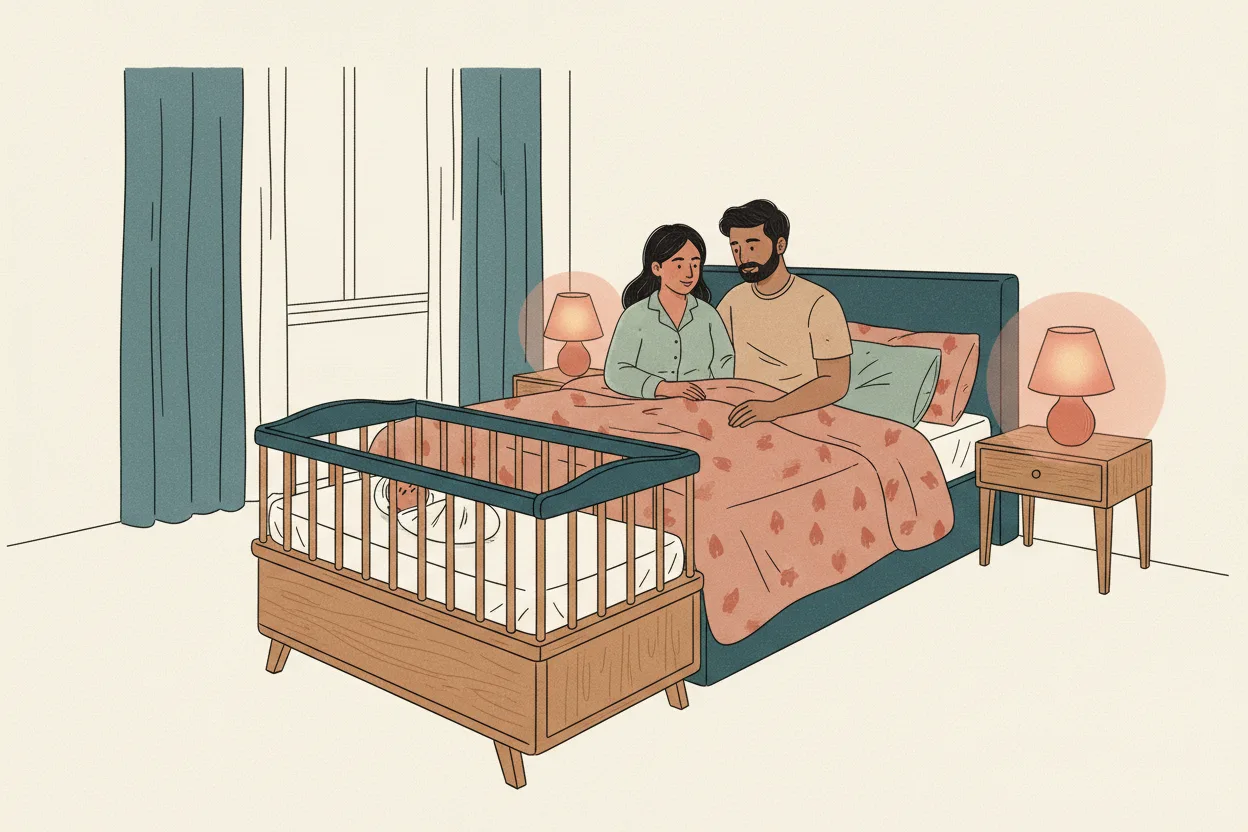
The CDC recommends keeping your baby's cot in the same room where you sleep for at least the first 6 months. Room sharing — baby in their own cot, in your room — is not the same as bed sharing, and it significantly reduces the risk of sudden infant death while making night feeds easier.
Building a Routine: Month by Month
Your baby is unlikely to follow a predictable schedule in the first three months. What you are doing is responding to cues, feeding on demand, and gently nudging day–night awareness.
Month 1: No pattern. Expect to feed every 2–3 hours around the clock. Both parents sharing night shifts makes this manageable — dad handling a feed with expressed milk while mum sleeps is a practical option.
Month 2: You may notice the first stretch of slightly longer sleep after the final evening feed. Protect that window: dim lights at night, feed calmly, and put baby back to sleep without play or stimulation.
Month 3: Some babies start to consolidate sleep a little — a longer first stretch at night, slightly more predictable nap timing. The NHS notes that by this age some babies can skip a night feed. Celebrate if it happens; don't worry if it doesn't. Most sleep consolidation comes after 4–6 months.
FAQ
My in-laws say a warm oil massage before bed helps the baby sleep — is that true? A pre-sleep massage is a well-established Indian tradition. The AAP notes that infant massage has a positive effect on a baby's physical health and can support development. It can be a good part of a calming bedtime routine. What matters most for safe sleep is where and how the baby sleeps afterward — firm, flat, on their back, in their own space.
Is it safe to use AC while the baby sleeps? Yes. The CDC cautions against allowing a baby to get too hot, and a 2022 Frontiers in Pediatrics review confirms hyperthermia is a recognised SIDS risk factor — a cool room is safer than an overheated one. Set the AC so the room feels comfortable to an adult in a light shirt, and dress your baby in a single layer accordingly. Don't point the vent directly at the baby. Check the back of the neck — if it feels cold, add a thin layer.
Can my baby sleep in a bouncer or swing? Not safely. The AAP states that any surface inclined more than 10 degrees is not safe for infant sleep. If your baby falls asleep in a bouncer or swing, move them to their firm, flat sleep surface.
When will my baby sleep through the night? "Sleeping through" often means a longer stretch at night. The NHS notes that by 3–6 months some babies may sleep 8 hours or longer at night — but many don't manage it consistently until later. Normal varies widely.
My baby is very noisy during sleep — grunting and squirming. Is that normal? Yes. Newborns spend a high proportion of their sleep in active (REM) sleep and frequently twitch, squirm, and make sounds without waking. Wait a few moments before intervening — they often settle on their own.
How do I handle nights in a joint-family home where relatives want to hold the baby at every wake-up? Consistent safe sleep matters more than who puts the baby down. Whoever is settling the baby should put them back on their firm sleep surface, on their back, after each feed or wake-up — regardless of what relatives prefer. You and your partner set the sleep environment; others can certainly help with daytime soothing.