
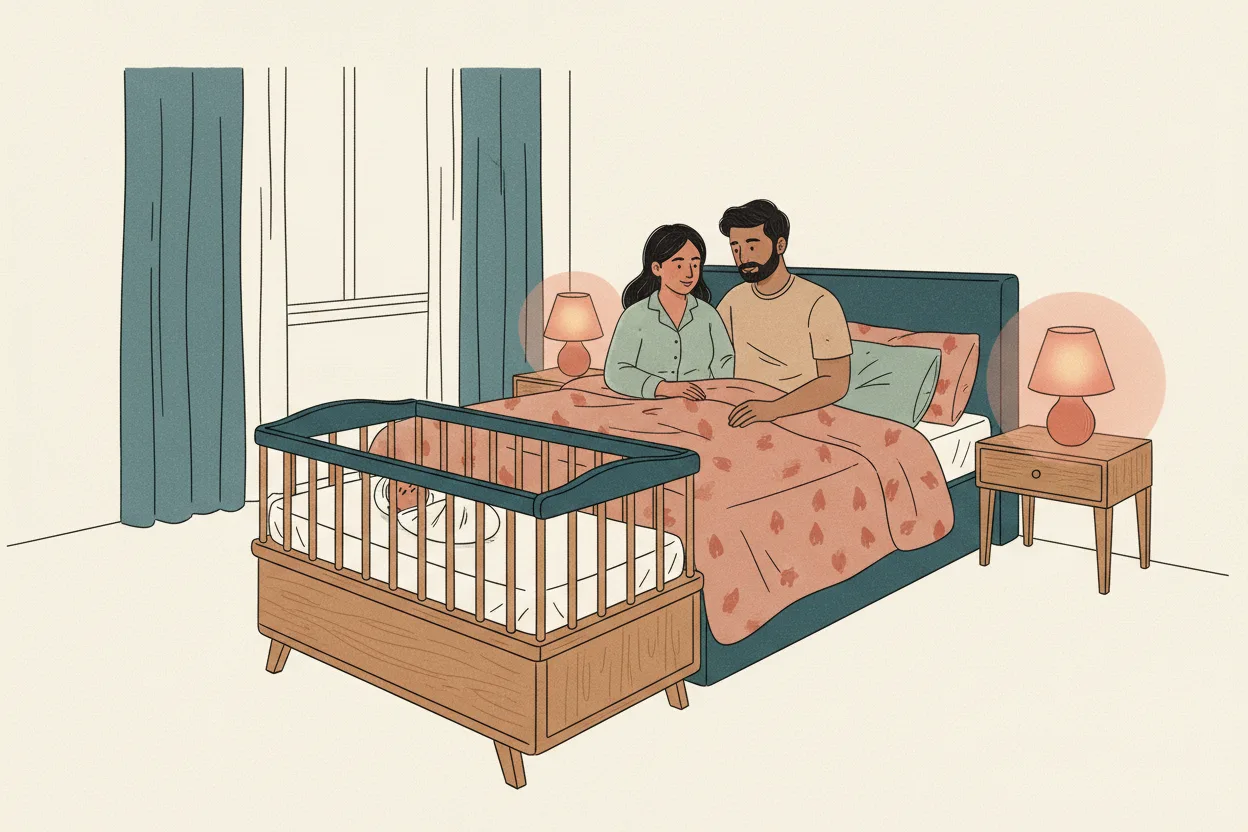
A bedside cot (a cot that attaches to or sits flush against your bed) is the setup the evidence best supports for a newborn. The American Academy of Pediatrics (AAP) states that keeping your baby's sleep area in the same room, but not in the same bed, for at least the first 6 months can decrease the risk of SIDS by as much as 50%. Bed-sharing and baby nests are both popular in India — here's how each actually compares once you look at the evidence.
Not medical advice — consult your pediatrician about what's right for your baby, especially if they were born preterm or with any health condition.
The India-Specific Context
Every new parent in India hears strong opinions on this — a relative slept with all her children in bed, a friend swears by a baby nest advertised as "hospital-safe." None of that is malicious; it's just how sleep advice passes down. But the setup that keeps a newborn safest doesn't depend on family tradition or how large your bedroom is — it depends on the surface, what's on it, and where it sits relative to you.
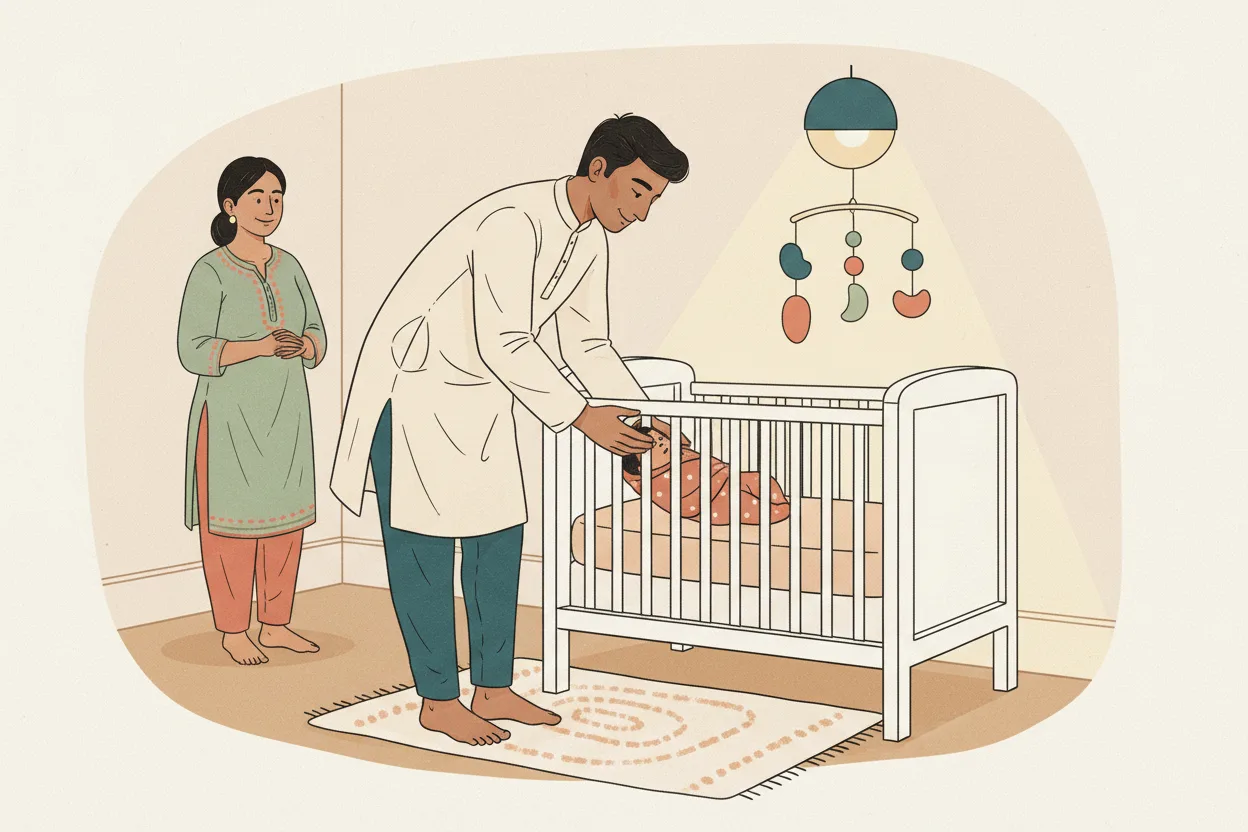
A separate nursery isn't required. A cot, bassinet, or bedside co-sleeper next to your bed, in your own room, works whether you're in a compact city apartment or a larger multi-generation home where you have your own space. Both parents can share in setting this up and in the night wake-ups that follow — it's not just the mother's job to manage.
The Three Options, Compared
| Setup | What it is | Where it stands on safety |
|---|---|---|
| Bedside cot / co-sleeper | A separate firm crib or bassinet placed right next to the parents' bed | Matches current safe-sleep guidance most closely |
| Bed-sharing | Baby sleeps in the same bed as a parent | Carries known risks; if chosen, needs specific precautions |
| Baby nest / pod | A padded, cushioned insert baby is placed inside, on a bed or elsewhere | Not recommended by safe-sleep authorities |
Bedside Cot: The Setup With the Strongest Backing
This is baby in their own cot, bassinet, or a bedside "side-car" crib that attaches to your bed, positioned in your room. The AAP states that keeping your baby's sleep area in the same room but not in the same bed for at least the first 6 months, ideally the first year, can decrease the risk of SIDS by as much as 50%. You get the closeness that makes night feeds easy, without baby sleeping on an adult mattress or under adult bedding.
Whatever cot or bassinet you use, the surface inside it matters as much as the cot itself. NICHD's Safe to Sleep campaign states that a baby's sleep surface should be firm, flat, level — never at an angle or incline — and covered only with a fitted sheet. Skip the "welcome home" bedding sets with padded bumpers, pillows, or quilted liners: NICHD also states that crib bumpers and any bedding beyond a fitted sheet are linked to serious injuries and deaths from SIDS, suffocation, entrapment, and strangulation.
Bed-Sharing: What the Evidence Actually Says
Bed-sharing — baby sleeping in the same bed as a parent — is a real choice some families make, often for night feeds or comfort. If that's what you choose, the Lullaby Trust's safer co-sleeping guidance states that you should keep pillows and adult bedding away from your baby and anything else that could cover their head or cause them to overheat, and not bring other children or pets into the bed with you.
One place bed-sharing should never happen is on a sofa. AAP safe-sleep recommendations state that you should never place your baby to sleep on a couch, sofa, or armchair, calling it an extremely dangerous place for a baby to sleep. This matters most at 3 a.m., when a parent doing a feed on the living-room sofa is at real risk of dozing off with baby still there — plan your night feeds for the bed or a chair you won't fall asleep in, not the sofa.
If your baby was born preterm, extra caution with all of this is worth it: a peer-reviewed study in Archives of Disease in Childhood found that preterm birth is a well-recognised risk factor for SIDS, with the risk increasing as gestational age at birth decreases. Talk to your pediatrician about your baby's specific sleep setup if they arrived early.
Baby Nests and Pods: Why We Don't Recommend Them
Baby nests and pod-style inserts are widely sold in India and marketed as a soft, secure-feeling space for a newborn. The evidence doesn't support them. NICHD's Safe to Sleep FAQ states that many wedges, positioners, or other products claiming to keep babies in one position or reduce the risk of SIDS, suffocation, or reflux do not meet federal guidelines for sleep safety, and that these products — including inclined sleepers — are linked to injury and death, especially when used in a baby's sleep area. A cot or bassinet with nothing but a fitted sheet does the job a nest claims to do, without the padding risk.
Getting the Room Right
Temperature is the other piece people overlook. NHS guidance uses 16–20°C as the standard room-temperature range for a baby's sleep space when sizing a sleep bag's warmth. Indian bedrooms often run warmer than that, especially outside winter, so a fan or AC set to keep the room comfortable, along with lightweight cotton sleepwear, matters more here than it would in a cooler climate. A simple room thermometer takes the guesswork out of it. Running a fan for air circulation is worth doing beyond comfort, too: a case-control study published in Archives of Pediatrics & Adolescent Medicine found that fan use during sleep was associated with a 72% reduction in SIDS risk, an effect that was strongest in warmer rooms — exactly the conditions common in Indian homes for much of the year.
What's Actually Worth Buying
| Product | Price Range | Where to Buy |
|---|---|---|
| Bedside co-sleeper cot | Rs. 4,000 – Rs. 12,000 | Amazon.in / FirstCry |
| Firm cot mattress + fitted sheets (no bumpers) | Rs. 1,200 – Rs. 3,500 | FirstCry |
| Room thermometer/hygrometer | Rs. 300 – Rs. 900 | Amazon.in |
| Lightweight cotton sleep bag | Rs. 600 – Rs. 1,800 | FirstCry |
Skip bumper sets, nests, positioners, and pillow-topped mattresses regardless of how they're marketed — none of them add safety, and the padding they add is what the guidance above warns against.
Frequently Asked Questions
Is room-sharing the same as bed-sharing? No. Room-sharing means baby's own cot or bassinet is in your room; bed-sharing means baby is on the same mattress as a parent. The AAP recommends room-sharing for at least the first 6 months because it can cut SIDS risk by up to half, while keeping baby on their own firm, separate surface.
Are baby nests safe if I only use them for supervised daytime naps? The safe-sleep guidance doesn't carve out an exception by time of day. NICHD states that these products don't meet federal sleep-safety guidelines and are linked to injury and death when used in a baby's sleep area, so it's simplest not to use one at all, day or night.
What if I fall asleep while feeding on the sofa? Try to plan for it in advance rather than let it happen by accident. AAP guidance is direct that a sofa, couch, or armchair is an extremely dangerous place for a baby to sleep, so if you feel yourself getting drowsy during a night feed, move to your bed or call your partner to take over.
Can I use a cot bumper if it's a thin, breathable mesh one? No brand of bumper is exempt from the concern. NICHD's guidance is clear that crib bumpers and any bedding beyond a fitted sheet are linked to serious injuries and deaths from SIDS, suffocation, entrapment, and strangulation — a bare cot with a fitted sheet is safest.
My baby was born a few weeks early. Does that change the sleep setup? It's worth discussing with your pediatrician. Research shows that preterm birth is a recognised SIDS risk factor, with risk rising as gestational age at birth decreases, so preterm babies benefit from especially strict adherence to a firm, bare, room-shared sleep setup.
How warm should the baby's room be? NHS guidance treats 16–20°C as the standard room-temperature range when choosing sleepwear warmth. In most of India that means using a fan or AC to keep the room from running hot, paired with lightweight cotton clothing rather than heavy layers.