
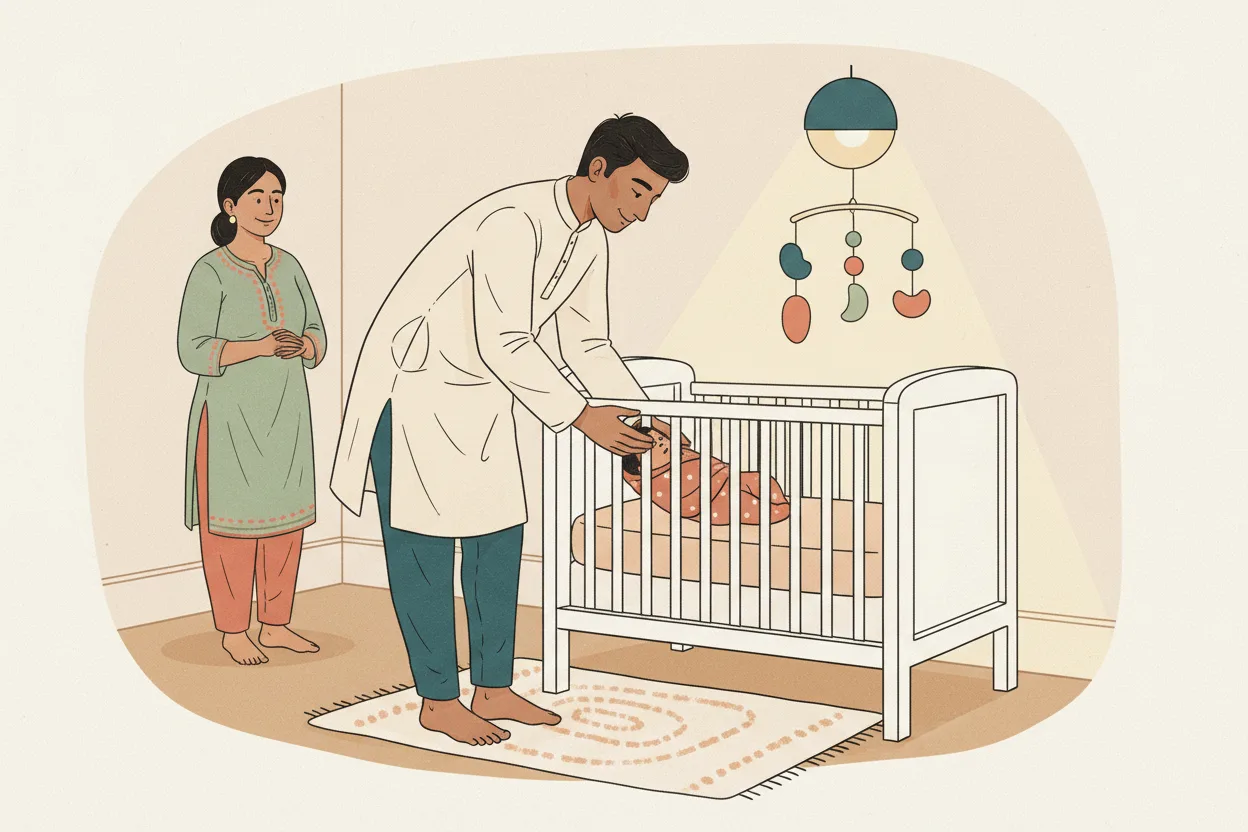
The trick isn't a special hold — it's timing. Wait until baby is genuinely limp and in deep sleep before you move toward the crib, keep a hand on their chest or back as you lower them, and keep that contact a little longer instead of pulling your hands away the instant they touch the mattress. Most "wakes the second I put them down" failures happen because the parent moves too early or breaks contact too fast, not because anything is wrong with the baby.
Not medical advice — consult your pediatrician for concerns about your baby's sleep.
Why the Transfer Keeps Failing
NIH's StatPearls physiology reference states that a newborn's full sleep cycle runs only about 50 minutes, against roughly 90 minutes for an adult. That short cycle means baby drifts from deep sleep into a lighter, easily-disturbed stage within minutes of nodding off — and if you lower them into the crib during that light phase, exactly what happens when you move the moment their eyes close, they often notice the change in temperature, position, and contact all at once.
The fix: wait a bit longer than feels necessary. Look for slack, heavy limbs, a slower and more even breathing rate, and a hand that flops rather than grips when you lift it — your cue that baby has moved into deeper sleep and the transfer is far more likely to succeed.
There's a second reason speed matters as much as timing. NIH's StatPearls reference on the Moro reflex states that this startle reflex "is triggered by the suddenness of the stimulus and not the distance of the drop" — so a fast, jerky lowering can set it off even from a height of a few inches, while a slow, steady lowering from the same height often doesn't.
The India Context: Why Contact Napping Is So Common Here
Many babies are bounced, walked, or rocked to sleep by a parent, a grandparent, or whichever family member is holding them — completely normal in Indian households, and visiting grandparents in particular often want to keep holding baby "just a little longer" once they've dozed off. That's lovely bonding time, but it also makes the transfer the daily bottleneck. Treat it as a shared job: either parent can do the actual lowering into the crib, and it's worth asking family members to hand baby back once they're drowsy rather than fully out, so you can finish settling them yourself.
Room temperature is worth a check before every transfer, not just once at bedtime — fans, air conditioning, and monsoon power cuts can all shift how warm the room feels through the evening.
The Step-by-Step Technique
- Bounce or rock until baby is limp, not just still. A baby that has merely stopped fussing can still be in light sleep. Wait for the heavy-limb, slow-breathing signs above.
- Move toward the crib slowly, keeping baby curled against your chest. Sudden postural changes — going from upright to flat too quickly — are a common reason babies startle awake, since the startle (Moro) reflex is triggered by how suddenly baby moves, not by how far.
- Lower baby feet-first, keeping your body in contact for as long as possible. Bend at the knees rather than the waist, so there's no sudden drop in height.
- Keep one hand on baby's chest or back for 10–20 seconds after they're down. Ease off the pressure gradually rather than lifting your hand away all at once.
- Once they settle, complete the transfer to a safe sleep position. The AAP recommends placing baby on their back for every nap and every night, and AAP guidance quoted on HealthyChildren.org is that the crib should have a firm, flat surface with no soft toys, pillows, blankets, or other loose bedding — so have the crib set up and empty before you start the transfer, not something you're still arranging with one hand.
Swaddling: A Genuine Transfer Aid, With a Hard Stop
A snug swaddle is one of the more useful tools for a smoother transfer. A systematic review in the AAP journal Pediatrics found that swaddled infants arouse less and sleep for longer stretches — which translates directly into a baby who is less likely to startle awake the moment you let go.
That benefit has a firm expiry date. The AAP advises that swaddling should stop as soon as baby shows any sign of trying to roll over, because of the suffocation risk of a swaddled baby who rolls onto their stomach. Once you see those first attempts, switch to a sleep sack that leaves the arms and hips free instead of a wrap that pins them.
Room-Sharing Without Bed-Sharing
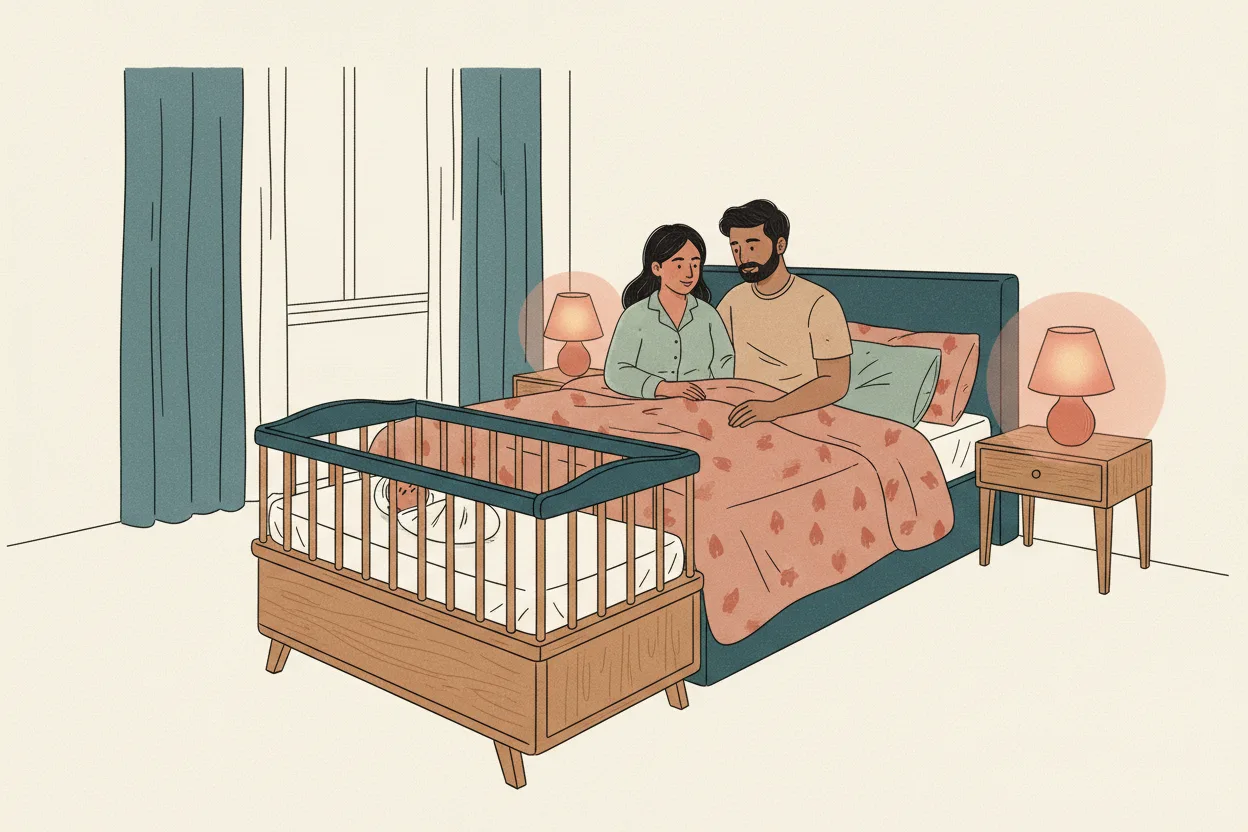
Plenty of Indian families keep baby's crib in the parents' room for the early months, which is a genuinely good setup: NICHD's Safe to Sleep campaign states that room-sharing — baby on their own separate surface, not sharing the adult bed — reduces the risk of SIDS and is safer than either bed-sharing or sleeping alone in another room. It also shortens the transfer itself to a few steps rather than a walk down a hallway, cutting the jostling that tends to wake a lightly-sleeping baby.
Don't Overbundle for the Transfer
It's tempting to wrap baby a little warmer for the crib than they were in your arms, especially with a fan or AC running. Resist that. NICHD's Safe to Sleep guidance states that baby can overheat if dressed in too many layers for the room's actual temperature — commonly called overbundling — and overheating during sleep raises SIDS risk. Dress baby for the room as it is, and check the back of their neck rather than their hands to judge if they're too warm.
White Noise: Useful for the Transfer, But Watch the Volume
A steady white-noise sound can mask the click of a door or a creaky floorboard during the transfer. Be careful with placement and volume, though: a study on infant sleep-machine sound output found that at maximum volume, most devices tested exceeded safe sound-output levels for infant hearing when measured close to the crib. Keep the machine across the room rather than clipped to the crib rail, at a lower volume than maximum.
Products That Actually Help
| Product | What it does | Price Range | Where to Buy |
|---|---|---|---|
| Swaddle wrap (0–3 months) | Snug wrap that helps baby stay asleep through the transfer | Rs. 400 – Rs. 1,200 | Amazon.in / FirstCry |
| Arms-free sleep sack (3+ months) | Replaces the swaddle once baby starts rolling | Rs. 600 – Rs. 1,800 | FirstCry |
| Glider or rocking chair | Lets you bounce/rock baby closer to the crib, shortening the walk | Rs. 4,000 – Rs. 15,000 | Amazon.in |
| White noise / sound machine | Masks household noise during the transfer and settling | Rs. 800 – Rs. 3,000 | Amazon.in |
A glider or rocking chair placed near the crib — rather than in another room — is one of the highest-value buys here, simply because it shortens the distance (and therefore the jostling) between "asleep in arms" and "down in the crib."
Frequently Asked Questions
Why does my baby wake up the second I put them in the crib, every single time? The most common reason is transferring too early, while baby is still in a light sleep stage. A newborn's sleep cycle runs only about 50 minutes, cycling in and out of lighter stages quickly, so waiting for the heavy-limb, slow-breathing signs of deep sleep before you move makes a real difference — it's fine, and usually helpful, to keep bouncing a little longer than feels necessary.
Does swaddling actually help with the transfer, or is that just a myth? It genuinely helps. A systematic review in Pediatrics found that swaddled infants arouse less and sleep longer, which supports a calmer transfer. Just remember to stop swaddling as soon as baby shows any sign of trying to roll over.
Is it safe to keep the crib in our room instead of a separate nursery? Yes — NICHD notes that room-sharing on a separate sleep surface actually reduces SIDS risk compared with baby sleeping alone in another room, and it also shortens the physical distance of every transfer.
Can my partner or a grandparent do the transfer instead of me? Absolutely — the technique (wait for deep sleep, move slowly, keep contact, lower gradually) works for whoever is holding baby. Sharing the job also means you're not the only one losing sleep to it.
Should I turn up the white noise machine to help baby sleep through the transfer? Keep it moderate rather than maxed out. Research on infant sleep-machine sound output found many devices exceed safe volume levels for infant hearing at their highest setting, so place the machine across the room and use a lower volume rather than turning it up close to the crib.