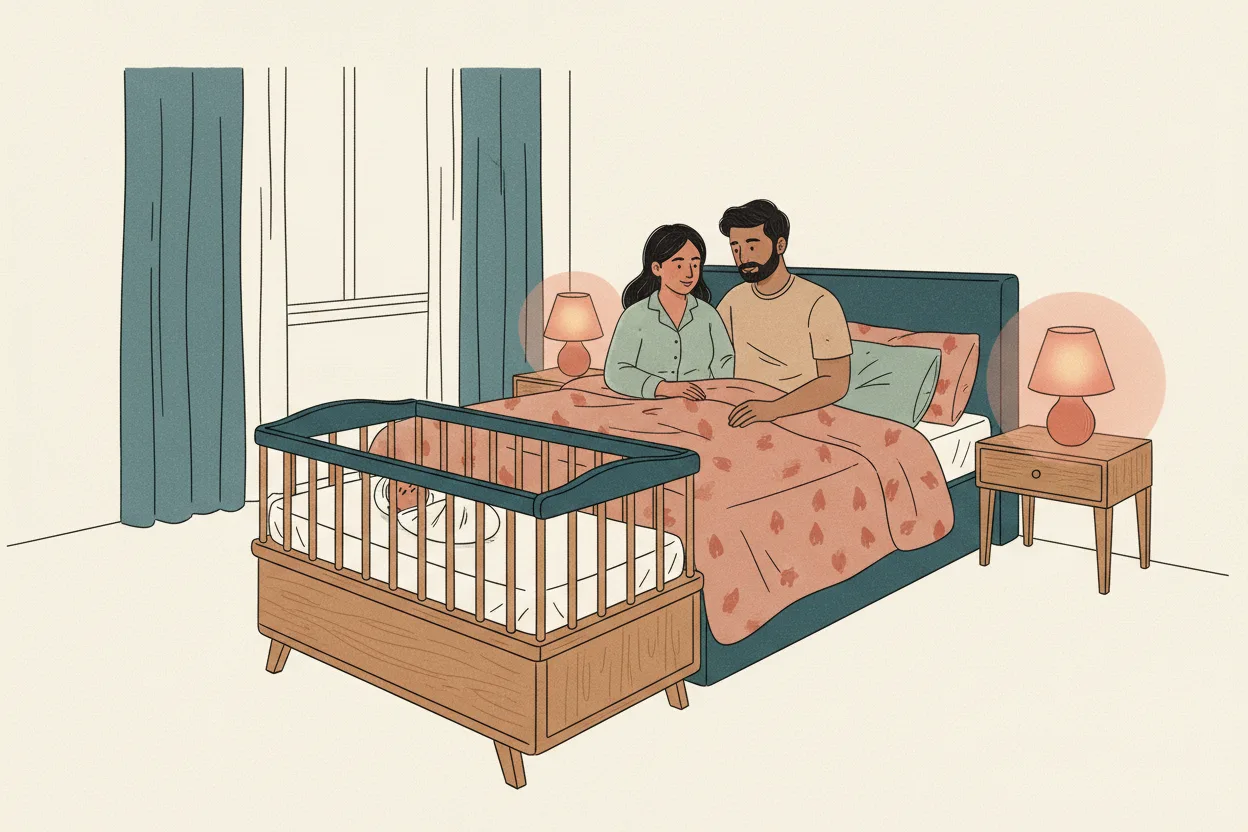

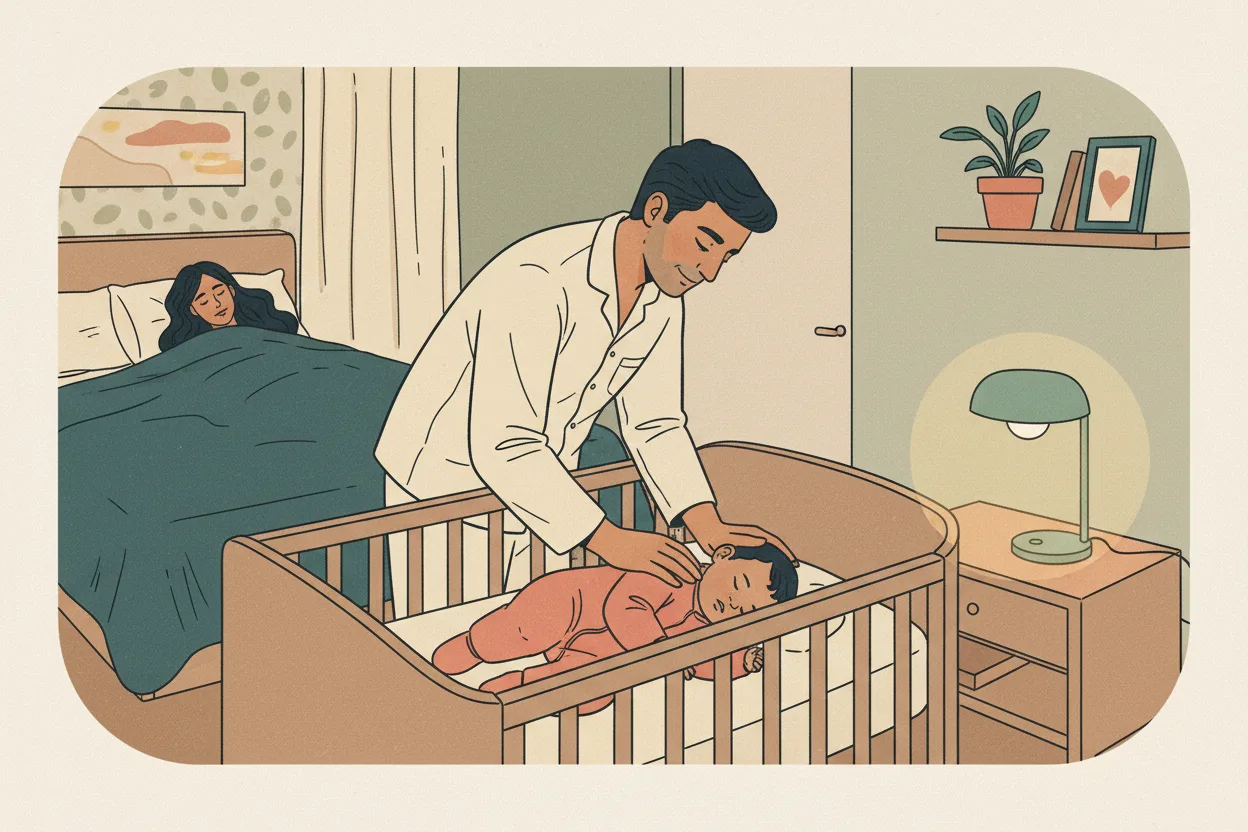
A baby who wakes every hour or so and only resettles by nursing usually isn't hungry that often — Pregnancy, Birth and Baby (Australian Government health service) notes that "sometimes babies will only settle when they feed — this is known as a sleep association," and HealthyChildren.org (AAP) explains that "if you hold babies or rock them to sleep, they may struggle to go back to sleep if they wake up during the night." The fix isn't cry-it-out — it's loosening the link between feeding and falling asleep, gradually, once solids are underway.
Not medical advice — consult your pediatrician if night waking affects your baby's growth or your own wellbeing.
Why This Happens With Exclusively Breastfed Babies
Every baby wakes briefly between sleep cycles at night. What matters is whether they can resettle on their own or need the same thing that put them to sleep the first time. For an exclusively breastfed (EBF) baby who has always nursed to sleep, that "same thing" is the breast, so feeding becomes the sleep association rather than a response to hunger. Waking every 60–90 minutes purely to nurse back down, not to actually eat a full feed, is the classic pattern of a sleep association — not a parenting mistake. It's also unlikely to be a growth spurt: KellyMom (IBCLC-authored breastfeeding resource) explains that "growth spurts usually last 2-3 days, but sometimes last a week or so," so a pattern that continues night after night for weeks points to a learned association rather than a temporary jump in feeding needs.
The India-Specific Context: Solids, Advice, and "Just Feed Her"
By around 6 months, WHO's guideline for complementary feeding of infants and young children states that "complementary feeding, defined as the process of providing foods in addition to milk when breast milk or milk formula alone are no longer adequate to meet nutritional requirements, generally starts at age 6 months and continues until 23 months of age, although breastfeeding may continue beyond this period." In practice, this means once your baby is reliably eating solids alongside breastfeeding, milk is no longer the only thing keeping them fed overnight — which is exactly the window where it becomes reasonable to start loosening the nurse-to-sleep habit, rather than earlier. Getting enough iron from those solids is worth prioritising for sleep, not just growth: a 2010 study in Sleep Medicine (via PMC) found that "6-month-old IDA infants napped longer during the day and were more restless during sleep, with increased time awake and decreased time in QS at night."
In many Indian households, the easiest advice to get from grandparents and relatives is simply "feed her, she'll go back to sleep" — and it works in the moment, which is exactly why the habit is so sticky. Well-meaning family may also push a bottle of expressed milk as the fix. But La Leche League International notes that "it's common for breastfed babies to refuse a bottle initially when their mother returns to work or study, while they adjust to major changes such as a new daycare environment and caregivers" — so a baby refusing a bottle is not a sign that anything is wrong with your feeding or your baby's development. It just means the change needs a gentler approach than swapping the breast for a bottle at 2 a.m.
Is It Teething? How to Tell the Difference
Teething gets blamed for almost every sleep disruption between 4 and 12 months, but it's worth separating out. Cleveland Clinic explains that "the discomfort of teething is pretty mild. It shouldn't affect sleep" — so weeks of waking every hour, every single night, is unlikely to be teething alone. A tooth breaking through can cause one or two rough nights, not a sustained multi-week pattern.
Fever is another common mix-up. HealthyChildren.org (AAP) explains that "though many parents expect a fever when baby teeth start to break through, extensive studies show this is a false symptom of teething." If your baby actually has a fever, treat it as a separate issue and call your pediatrician rather than waiting it out as "just teething."
| Pattern | Likely teething? | What it points to instead |
|---|---|---|
| One or two rough nights, then settles | Possibly | A new tooth breaking through |
| Multiple wake-ups a night, for weeks | Unlikely on its own | A feed-to-sleep association |
| Wakes but resettles without feeding | Unlikely | Normal cycle waking, not a problem |
| Wakes only when picked up and nursed | No | Sleep association |
| Genuine fever alongside waking | No — see your pediatrician | Something else going on |
Gentle Ways to Loosen the Habit
None of these require leaving your baby to cry. They work by changing what happens at the wake-up, a little at a time, over a couple of weeks.
Let the other parent handle some night wake-ups. KellyMom (IBCLC-authored breastfeeding resource) recommends that "if your baby appears to be waking only for comfort during the night, she may accept Dad as the comforter (and won't expect Dad to nurse her). Dad can comfort baby in other ways, such as offering a drink, just lying next to her, holding her, etc." Because the baby can't smell milk on the other parent, this is often the single most effective change, and it puts the father in an active, hands-on role at night. Pair it with more daytime nursing and cuddling, per the same KellyMom guidance, so total closeness doesn't drop.
Shorten the feed before you resettle instead of stopping it outright. Over several nights, cut back how long or how vigorously your baby nurses at each wake-up before you switch to patting, shushing, or simply holding them until they drift off without the breast.
Build a short wind-down routine that doesn't end in nursing. A dim room, a few minutes of rocking or singing, then into the cot still drowsy but not fully asleep — so falling asleep independently becomes a practiced skill, not something that only happens at the breast.
If you nurse in bed at night, move baby back afterward. HealthyChildren.org (AAP) advises that "if you bring your baby into your bed to feed or comfort them, place them in their own sleep space when you're ready to go to sleep." This keeps the change safe even on nights when you're too tired to leave the bed for a feed.
Expect this to take one to three weeks of consistency, with the occasional off night — that's expected, not a sign it isn't working. Go back to your usual comfort measures on nights your baby is unwell; this is a habit change, not a rigid rule.
Tools That Can Help
None of these replace the changes above — they just make the wind-down routine easier to keep consistent, night after night.
| Product | Price Range | Where to Buy |
|---|---|---|
| White noise / sleep sound machine | Rs. 900 – Rs. 2,500 | Amazon.in |
| Blackout curtains or window film | Rs. 500 – Rs. 1,800 | Amazon.in |
| Soft comfort toy / muslin lovey | Rs. 300 – Rs. 800 | FirstCry |
| Room thermometer/hygrometer | Rs. 400 – Rs. 1,200 | Amazon.in |
A consistent, dim, quiet room at the same comfortable temperature every night helps your baby associate the space itself — not just nursing — with falling asleep.
Frequently Asked Questions
My baby point-blank refuses a bottle when my husband tries a night feed. Is that a problem? No. La Leche League International notes that bottle refusal is common in breastfed babies adjusting to a new routine or caregiver. Skip the bottle for now and let the other parent comfort your baby without offering milk at all, as described above — many babies accept that faster than they accept a bottle.
Could the constant waking be teething instead? It's worth ruling out, but teething discomfort is typically mild and shouldn't disrupt sleep on its own, and it doesn't cause fever. Weeks of hourly waking that resolves as soon as you stop nursing back to sleep points to a sleep association, not a tooth.
Will this affect my milk supply? Daytime nursing and cuddling, kept steady per the KellyMom guidance above, is the way to protect supply as night feeds taper off. Cut back a little at a time rather than all at once, and check with your pediatrician if you're unsure your baby is still feeding and growing well.
How long before we see a change? Most families see a shift within one to three weeks of consistently applying the same response at each wake-up. The other-parent-comforts step tends to work fastest, since the baby can't smell milk on them and stops expecting a feed sooner.