You can move her into her own bed whenever you decide you are ready. Wanting your bed back after nearly three years is a good enough reason, and the method that works at this age is not one brave night — it is a staged handover, where you move a little further away every few nights until she falls asleep without you in reach.
Three is actually an easy age to do this at. She can understand a plan, hold a conversation about it, and be genuinely pleased about a bed of her own. She can also argue, stall and negotiate, which is why the staging matters more than the willpower.
Not medical advice — consult your pediatrician for personal guidance.
Nothing is wrong, and nothing is late
Almost nobody you know has done this unless a second baby forced the issue, and that is not your imagination. In a 37-country study of preschoolers, South Asia had the highest proportion of co-sleeping arrangements of any region, above 97%. Here, sleeping with your child until school age is the ordinary path, not a deviation from one — so there is no local script for moving out, and no aunt with a tested method to hand you.
That cuts both ways. There is no deadline and no developmental box she is failing to tick, and her nights are already uninterrupted, so you are not fixing a problem. This is a preference you are entitled to act on — that is a judgement about your family, not a finding from a study.
What is worth knowing is what good sleep looks like at this age, so you can tell a real setback from a noisy week. NHS guidance for three- to five-year-olds lists a three-year-old's needs as 11 hours 30 minutes to 12 hours at night, plus nothing to 45 minutes in the day. If she is landing in that range after the move, it is working, even if bedtime is taking longer than it used to.
Why a staged change beats one big night
A single-night switch asks her to give up every part of the arrangement at once — your body, your room, the sound of you breathing. Staging gives up one part at a time, so each step is small enough to accept and you only ever have one thing to hold firm on.
The published versions of this are explicit about the pace. An NHS gradual-retreat leaflet instructs parents to move to the next degree of separation every fourth night, resisting pleas from the child to go back to the previous position. An NHS-published camping-out guide says you move your bed or chair gradually towards the doorway and out of the room, over a period of one to three weeks.
So budget two to four weeks, not a weekend. The other half of the work is boring and unglamorous: an NHS children's sleep service recommends staying consistent with bedtimes and naptimes, and keeping her bed for sleeping only. Pick your sequence, then run it the same way on the bad nights as on the good ones.
The routes parents actually use
Pick one and commit. Mixing two is what turns three weeks into three months.
Mattress on your floor, then out of the room
Put a mattress on the floor beside your bed and let her sleep on it — same room, same darkness, same voices, her own surface. This is the gentlest first step and the only one that costs nothing: AAP's HealthyChildren.org suggests placing a mattress on the floor while you wait for a new bed, so a floor mattress is a legitimate sleeping place and not a stopgap you need to apologise for.
Once she is settled there, start walking it out. Move it to the far side of the room, then just inside her doorway, then into her room properly. Give each position three or four nights before the next move.
Her bed in your room first
If you would rather buy the bed now, put it in your room and let her use it there for two or three weeks before it travels. The furniture, the sheets and the bedtime all stay the same when the room finally changes, which leaves her one new thing to absorb instead of four.
Stay until she is asleep, then leave
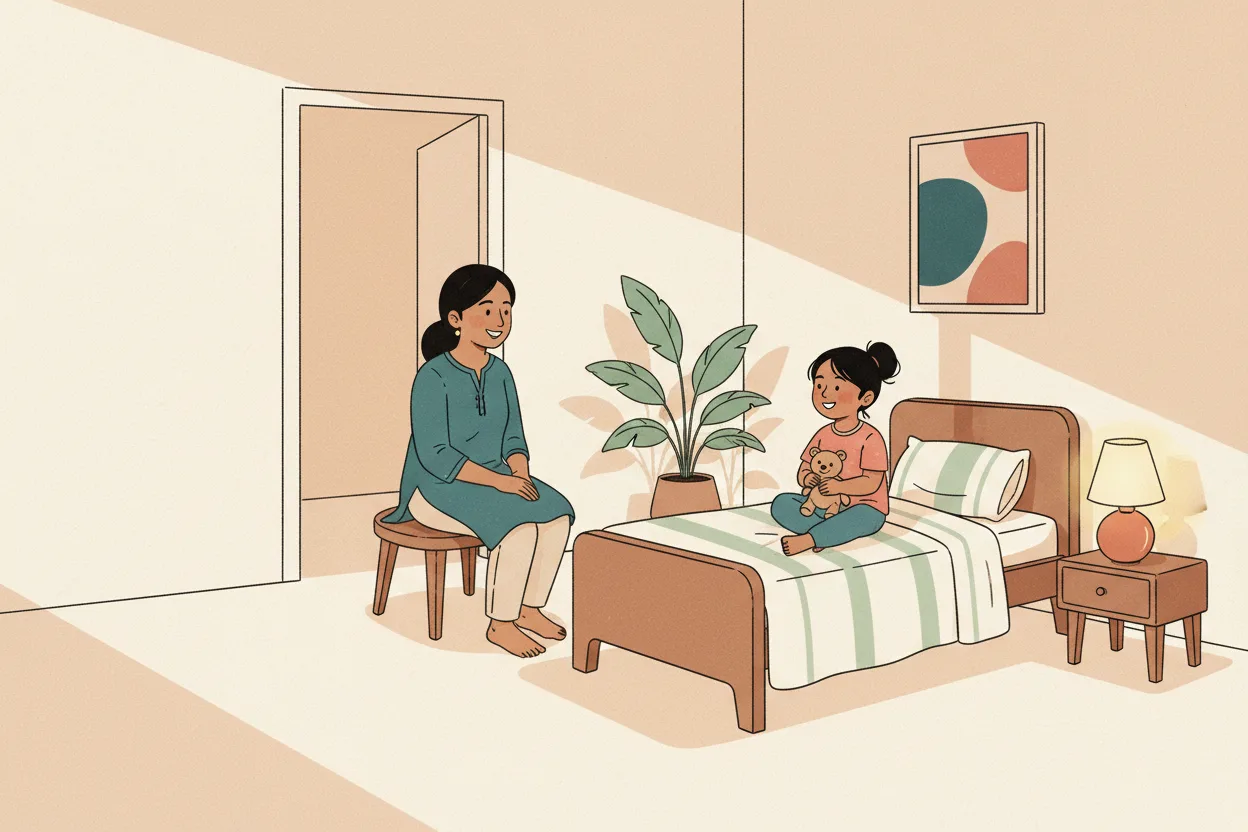
This is the classic gradual retreat, and the one to use if she goes into her own room easily but panics at being left. Sit on her bed at first, then on the edge, then on a stool beside it, then at the door, then just outside. Keep it dull — no talking, no eye contact, no negotiating.
The step you will be tempted to skip is the last one, where you leave before she is asleep. Do it on a night you are not already exhausted, and expect to repeat it.
The calm walk-back
However you get her in, she will come back to your bed, and this is the part that decides whether the whole thing holds. The NHS advises that if your child gets up, you keep taking them back to bed again with as little fuss as possible. Newcastle Hospitals' children's sleep service notes that this may need repeating several times each night, and that you should try to give the same response each time.
In practice: no lights, no conversation, no scolding, no lifting her into your bed "just for tonight." Walk her back, tuck her in, leave. The first two nights are the worst and the count drops fast after that — but only if the response is identical every time, including when your partner is the one doing it at 3 am.
If there is no separate room
A separate room is not the goal; a separate bed is. In a two-bedroom flat with grandparents in the second room, or a home where her room is also the study, the whole plan works inside your room — her own bed in the corner, as far from yours as the layout allows, with its own lamp and its own bedding she picked.
Run the same staging: your hand on her, then your chair beside her, then your chair across the room, then you in your own bed with the lights off. She is sleeping independently in a shared room, which is a complete outcome, not half of one.
For the relative who thinks this is harsh
Someone will say it. A grandparent, a sister-in-law, or a neighbour will tell you that a three-year-old belongs with her mother and that this is an imported idea you have picked up. Winning that argument is optional.
What helps is a short, flat line, repeated: "She is ready, we are doing it slowly, and she is fine." Then show them the plan — the mattress moving a foot at a time, you sitting beside her — because the thing they are picturing is a locked door and a crying child, and that is not what they will see. If the commentary is constant, give the person a job inside the plan: let them do the bedtime story in her new bed.
Her bed, briefly
Keep her bed low, with a firm mattress, so the drop to the floor is short. Rails are a separate decision with their own rules — our bed rail guide for India covers 3-side versus 4-side and fitting. Worth knowing before you shop: the US Consumer Product Safety Commission states that portable bed rails are intended for children who can get in and out of bed unassisted, typically from 2 to 5 years of age — so they are a product for her age, not for an infant.