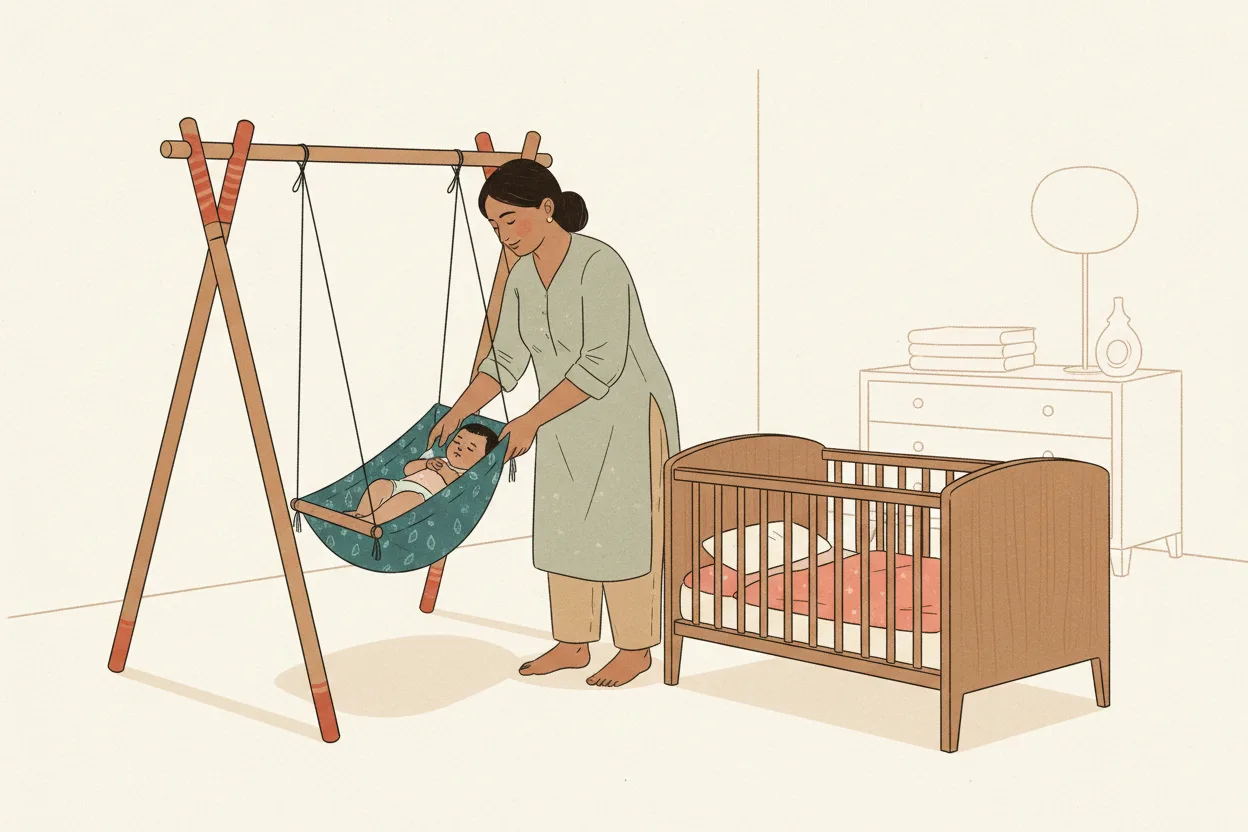


Your baby was sleeping in solid stretches — and then, right around four months, it fell apart. You didn't do anything wrong. Sleep Foundation states that at this age a baby's brain and nervous system are developing fast, and that process itself can create real instability in sleep. Add a brand-new skill — rolling — and a growing habit of nursing to settle, and you get a baby who fights the crib, wants to feed all night, and squirms constantly wherever they sleep.
Not medical advice — consult your pediatrician if you're worried about your baby's sleep, feeding, or development.
Why This Regression Looks a Bit Different in an Indian Home
Many Indian families already have a baby room-sharing with parents, and nursing to settle has always been treated as completely ordinary here. That's a genuinely good starting position. What actually changes this month isn't your setup — it's that rolling means a few of your existing habits, especially around swaddling and night repositioning, need an active update, whether baby sleeps in a cot beside your bed, a bedside co-sleeper, or (for some families) in your bed.
What's Actually Happening Inside Baby's Sleep
A peer-reviewed review of early childhood sleep architecture (PubMed Central) found that by around two months, a baby's sleep starts maturing from the simple newborn pattern of active and quiet sleep into the same REM and NREM cycling adults have, with the deeper-sleep "spindle" activity of NREM stage 2 typically present by three months. That maturing is exactly what's colliding with your baby's calendar right now — more organized, adult-like sleep cycles mean more, lighter transitions between cycles, and a baby who used to drift straight back off now wakes fully at each one. Sleep Foundation states plainly that this instability comes from rapid brain and nervous-system development — not from an illness, and not from a habit you created.
Rolling Changes the Safe-Sleep Rules — Read This Twice
Somewhere in this same window, most babies learn to roll. HealthyChildren.org (AAP) states that rolling over in both directions — tummy-to-back and back-to-tummy — typically emerges in the 4-to-7-month window. The moment your baby starts even attempting this, three things change:
Stop repositioning baby onto their back overnight. HealthyChildren.org's AAP-reviewed safe sleep guide states that once your baby is comfortable rolling both ways on their own, you don't need to keep turning them back to their back during the night. Still always put them down on their back to start.
Stop swaddling — even a partial one. HealthyChildren.org (AAP) recommends stopping swaddling as soon as your baby shows any sign of trying to roll over, because a swaddled baby who rolls onto their stomach cannot free their arms to clear their airway. Don't wait until they've "mastered" the roll — the first attempt is the cue.
Keep baby on their own firm, flat surface, in your room. NIH's Safe to Sleep campaign states that room-sharing — baby on their own sleep surface, in the parents' room — lowers the risk of SIDS by as much as 50% compared with sharing an adult bed or sleeping in a separate room. If your baby currently sleeps in your bed, moving them to a firm surface of their own right next to you — a bedside co-sleeper crib works well for this — is the single highest-impact change you can make this month. If a full switch isn't realistic for your family tonight, room-sharing on baby's own surface is still the safer middle step, and it's worth working toward.
Comfort Nursing at Night Isn't a Bad Habit
If your baby wants to nurse every time they stir, that isn't something you caused by "giving in" too often. WHO's infant and young child feeding guidance states that breastfeeding on demand — as often as the child wants, day and night — is itself part of recommended practice at this age, not a stopgap you should be weaning off. KellyMom, an IBCLC-authored breastfeeding resource, states that nursing a baby to sleep or purely for comfort, not only for hunger, is normal, healthy, and developmentally appropriate breastfeeding behaviour — not a habit that needs correcting. If comfort nursing is what's getting your family through this regression, that's a legitimate tool, not a problem.
Should You Start Sleep Training Now?
Once the nights get hard, it's natural to wonder if it's time for a structured sleep-training approach. Sleep Foundation states that babies generally aren't developmentally ready for sleep training until 4 to 6 months of age, because younger infants haven't yet developed the circadian rhythms that support longer sleep stretches. If your baby only just turned four months, you're at the very early edge of that window. There's no rush — making the rolling-related safe-sleep changes above and riding out the regression is a reasonable choice on its own, for as long as it takes your family.
What Actually Helps This Month
None of the gear below is required — the safe-sleep changes above are the only true "musts." These just make the transition easier for tired parents.
| Need | What helps | Price (India) | Where to buy |
|---|---|---|---|
| Baby's own firm surface, right by your bed | Bedside co-sleeper crib | Rs. 4,000 – Rs. 9,000 | Amazon.in / FirstCry |
| Moving off the swaddle | Arms-free sleeveless sleep sack | Rs. 700 – Rs. 1,800 | FirstCry |
| Softer night wake-ups for feeds | Warm, dim nightlight (not overhead) | Rs. 300 – Rs. 900 | Amazon.in |
Whichever surface your baby sleeps on, keep it clear — no loose bedding, cushions, or toys near their face, especially now that they can move around on it.
Frequently Asked Questions
Is the 4-month sleep regression real, or is it a myth new parents get told? It's real, even though "regression" undersells it. Sleep Foundation states it comes from rapid brain and nervous-system development around this age, which temporarily unsettles sleep — a sign your baby is developing on track, not a setback.
My baby has only just started attempting to roll — do I really need to stop swaddling right away? Yes. HealthyChildren.org (AAP) recommends stopping swaddling at the very first sign your baby is trying to roll, not after they've fully learned it.
Baby keeps rolling onto their stomach overnight — do I need to flip them back every time? No, not once they can roll both ways on their own. HealthyChildren.org's AAP-reviewed safe sleep guide states that you don't need to keep repositioning a baby who is comfortable rolling back-to-tummy and tummy-to-back. Keep starting them on their back at the beginning of the night.
Is it safe for baby to sleep in our bed while all this settles down? NIH's Safe to Sleep campaign states that room-sharing on baby's own sleep surface, rather than sharing an adult bed, cuts the risk of SIDS by as much as 50%. A bedside co-sleeper crib gives you the closeness of having baby right next to you without that added risk.
Should I stop nursing baby to sleep so they learn to self-soothe? Not necessarily, and not urgently. KellyMom notes that nursing to sleep is normal, healthy, developmentally appropriate behaviour, not a habit that needs fixing. Sleep Foundation also notes that babies aren't developmentally ready for structured sleep training this early anyway, so there's no rush to change what's already working for your family.
How long does this regression last? Healthline states that sleep regressions typically last around 2 to 4 weeks, though not every baby goes through one. Some families settle down faster, especially once the rolling and swaddle changes above are in place; others take a bit longer. Use that 2-to-4-week window as a rough ballpark, not a guarantee — how quickly it passes isn't a reflection of anything you're doing right or wrong.
How many times a night is it normal for baby to wake up right now? More than before — that's expected. A peer-reviewed cross-sectional study of 4-month-old infants (PubMed Central) found that on average, babies this age wake around 1.2 times a night, with roughly a quarter sleeping straight through until morning. If your baby is waking more often than that during this regression, it's still within the range of normal for this age and stage — it just means more of those wake-ups are the "fully awake and needing help resettling" kind rather than the quick, unnoticed kind.
Do we need special gear, or is this just a phase to get through? Mostly the latter. The rolling-related safe-sleep changes above are the only real "musts" this month. Everything else — a co-sleeper crib, a dim nightlight, splitting night shifts with your partner — is about making a hard few weeks easier, not fixing something broken.