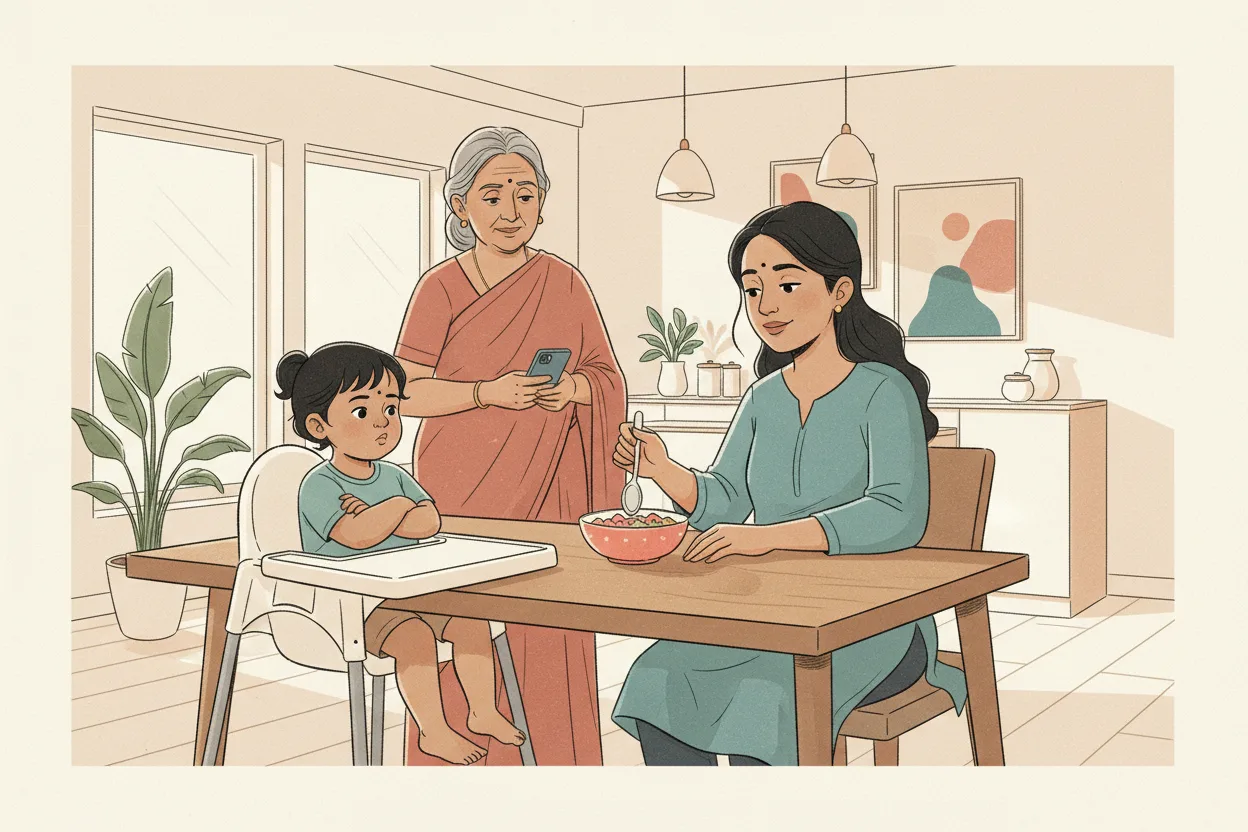


Hold him more — he needs the stimulation. Stop picking him up so much, you will spoil him. If you have heard both of those in the same week, you are in good company. In-law baby advice in India is plentiful, confident, and often contradictory — and navigating it without losing your confidence, or your relationship, is one of the quieter challenges of early parenthood.
The answer is simpler than it feels: know what the evidence says, act on that, and hold your ground calmly.
Not medical advice — consult your paediatrician for personal guidance.
Why In-Law Advice Feels So Overwhelming
In a joint family or multi-generational home, you are managing more than a newborn. You are managing opinions, expectations, and decades of family practice — and everyone is certain they know best.
A 2021 systematic review in BMC Pregnancy and Childbirth found that unsolicited advice from family members is a specific documented source of stress for new mothers — women described being told what to do by their family as one of their most stressful postpartum experiences.
The problem with contradictory advice runs deeper than irritation. A 2025 longitudinal study in BMC Pregnancy and Childbirth found that too much unwanted advice can make parents feel less confident in their ability to parent successfully. Each time two relatives give you opposite instructions, your self-belief takes a small hit — even when neither of them is right.
In joint families specifically, this dynamic is well-documented. A cross-sectional study in Southern Odisha found that women in joint families showed a significantly higher prevalence of postpartum depression than those in nuclear families. And qualitative research in a South Asian context found that comments from family members about a new mother's capabilities caused her to question herself and feel anxious about her own parenting.
This is not a character flaw. It is a documented pattern — and one that gets better when you know what you believe and why.
What the Evidence Says About Holding Your Baby
The most common in-law contradiction new mums in India report: "hold him more" versus "put him down or you will spoil him." Here is what the evidence actually says.
Healthline, medically reviewed by paediatrician Karen Gill MD, is clear: the idea that responding to a baby's cries causes spoiling is a myth. In the newborn stage, every cry is a genuine need — and meeting those needs is exactly the right response.
Formally, WHO and UNICEF's Care for Child Development package is built around two evidence-based recommendations: that caregivers play and communicate with their young children in a responsive manner. Responsive parenting — promptly meeting your baby's cues — is not a soft parenting opinion; it is what global health bodies formally advise.
When your mother-in-law questions this, you have a simple, honest response: "My paediatrician said responsive care is important at this age." Then pick up your baby.
Other Traditional Practices Worth Discussing with Your Paediatrician
Beyond the "spoiling" debate, several common Indian newborn practices have been revised by current medical evidence — and knowing the facts helps you respond to in-law advice with confidence rather than awkwardness.
Kajal on newborn eyes. Applying kajal to a baby's eyes is one of the oldest Indian traditions, but a peer-reviewed study in the Oman Journal of Ophthalmology documents the risks clearly: "prolonged application may cause excessive lead storage in the body, affecting the brain and bone marrow, causing convulsions and anemia" — and physical injury from unclean fingers is a separate concern. This is worth raising with your paediatrician as a routine question, not a confrontation with your family.
Water before six months. Many grandmothers instinctively offer a few drops of water to a crying baby, especially in summer. Research on exclusive breastfeeding in Indian infants is explicit: WHO's definition of exclusive breastfeeding means "the infant is only on breast milk with no other liquids or solids, not even water" for the first six months. Extra water displaces breast milk at feeds and can lead to underfeeding.
Mustard oil massage. Full-body mustard oil massage for newborns is deeply embedded in Indian family practice, but a cluster-randomised trial in BMC Pediatrics found that "mustard oil causes further barrier damage" to infant skin, unlike sunflower oil which supports skin barrier recovery. Sunflower oil is what most paediatricians now recommend for newborn massage — a small swap that is easy to make without turning it into a larger family argument.
In each case, the same phrase works: "I asked our paediatrician and they suggested we switch to [current recommendation]." That ends most debates.
How Your Confidence Directly Affects Your Baby
Here is why your confidence matters beyond your own comfort.
A PMC study on maternal parenting self-efficacy found that a mother's belief in her own parenting ability is positively associated with attentive, sensitive interactions with her infant and with her toddler's cognitive development. When you are second-guessing every decision, that effect ripples forward.
Research in the International Journal of Environmental Research and Public Health found that low parenting confidence in the early postnatal period is a risk factor for postpartum depression and anxiety. Building self-efficacy — your conviction that you can parent well — is protective for your mental health, not self-indulgent.
This is why it matters to have a clear, evidence-based position rather than deferring to whoever spoke last.
When Involvement Tips Into Interference
Most in-law involvement is well-meaning. But there is a clinical distinction between genuine support and interference that consistently overrides your judgment.
A 2022 study in Frontiers in Psychiatry found that conflicts over baby care details and excessive interference from a mother-in-law were documented causes of negative moods in postpartum women, and that living with in-laws can be a risk factor for postpartum depression.
An Indian Journal of Medical Research study found that women with postpartum depression perceived significantly less support from parents-in-law than they expected — and that this gap was linked to higher rates of postpartum depression and anxiety among Indian mothers.
The absence of support, or its replacement with persistent criticism, carries real consequences. This is a conversation your partner needs to be part of as well — navigating family dynamics is a shared responsibility.
Practical Responses to Common Situations
A few calm, clear phrases handle most contradictory-advice situations without escalating:
- "My paediatrician said..." Almost every in-law defers to a doctor even when they question your choices. Use this phrase honestly and often — it moves the discussion from opinion to authority.
- "I know that worked for you. I am going to try this first." Acknowledges their experience. Reserves your decision. No argument needed.
- "We have decided to follow current practice on this one." Useful for areas where parenting practice has shifted since your in-laws were raising children — sleep position, screen exposure, feeding cues.
- Put your partner in the room. When your partner says "we have decided to do it this way," it lands differently from you saying it alone. Align your positions in advance and present a united front.
- Timing matters. Disagreements in the middle of a night feed or a crying episode go nowhere productive. Save any real conversation about limits for a calm, neutral moment — ideally with your partner beside you.
Frequently Asked Questions
Is it normal to feel anxious and second-guessed from family advice?
Yes, and it is well-documented. Research in a South Asian context found that comments from family members about a new mother's capabilities caused anxiety and self-doubt in participants. What you are feeling is not an overreaction.
What do I say when my mother-in-law and mother give opposite advice?
There is no need to adjudicate between them. A simple response: "You are both coming from experience and I appreciate that — I am going to follow what my paediatrician has said." Then redirect the conversation.
How do I get my partner to back me up with in-law advice?
Be specific rather than general. "I need you to say 'we have decided' when your mother questions how I am handling the baby" is something your partner can actually do. "I need more support" is too vague to act on. Have this conversation at a quiet moment, not in the heat of a conflict.
Does it actually matter if I lose confidence? Can I just push through?
It matters clinically. A 2022 PMC study found that low parenting confidence in the early postnatal period is a risk factor for postpartum depression. Protecting your self-efficacy is not about pride — it is protective for your mental health.
When should I be more concerned about in-law interference?
If interference is constant, if it is affecting your mood or your relationship with your baby, or if you are experiencing persistent sadness or withdrawal — speak to your OB-GYN or a mental health professional. A Frontiers in Psychiatry study found that excessive mother-in-law interference is associated with postpartum depression. These are clinical concerns, not personal failures.
One thing worth knowing: postpartum depression in India is frequently undiagnosed and untreated — dedicated maternal mental health services are limited in many facilities, and a 2024 scoping review in the Indian Journal of Psychological Medicine found that only 7.5% of women diagnosed with PPD had actually sought professional help. If your OB-GYN is not the right entry point, iCall (run by TISS: 9152987821, Monday–Saturday 10 AM–8 PM) offers free, confidential counselling in Hindi, English, and several regional languages. The Vandrevala Foundation helpline (+91 9999 666 555) is available 24/7. Reaching out is not an overreaction — it is the right response.