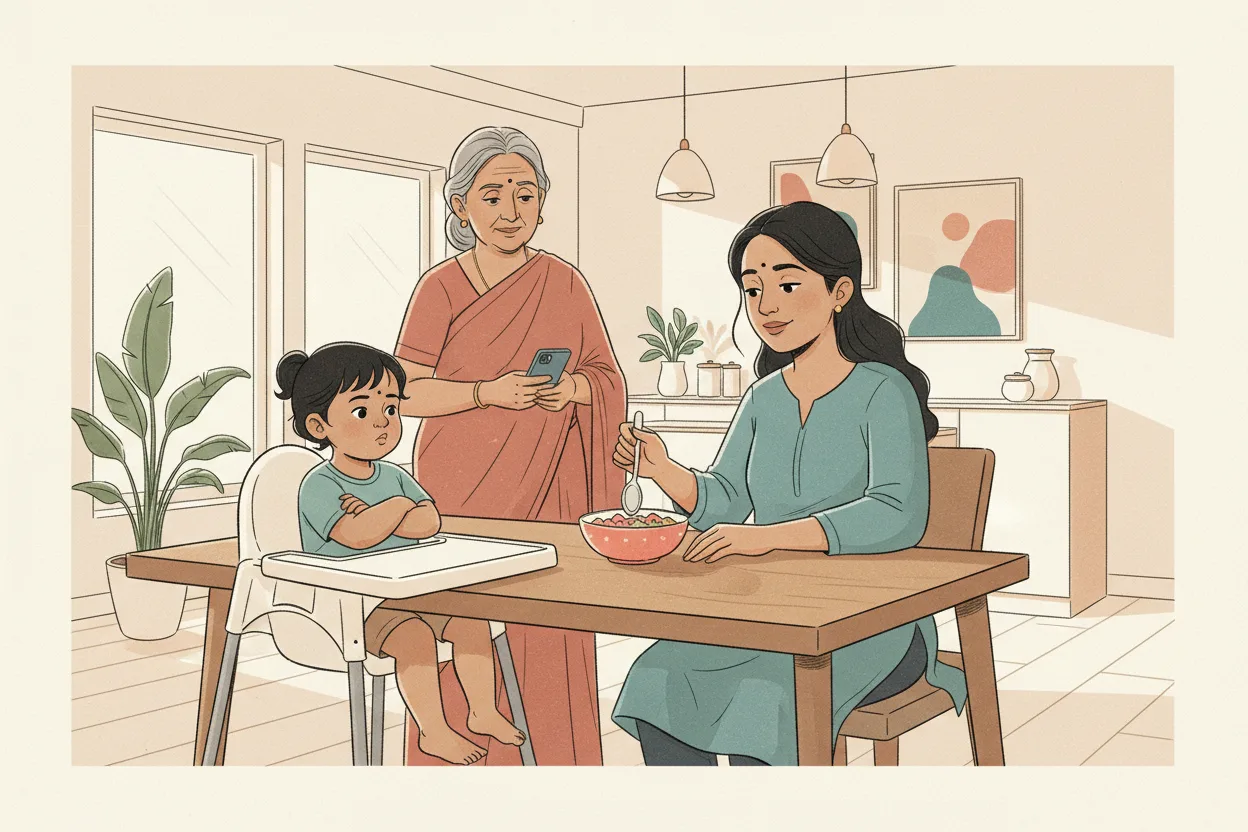


Your mother-in-law wants to know the new nanny's medical history, approve her clothes, and keep her own copy of her phone number — all before the nanny's first day. Some of that is a reasonable ask about the person spending unsupervised time with your baby. Some of it isn't hers to decide. The line is simple: safety and hygiene checks are a fair, shared concern; everything else — clothing, personal habits, whoever holds the phone number — is the parents' call.
Not medical advice — consult your pediatrician for guidance specific to your baby.
Why This Fight Shows Up Right Now
Hiring a nanny is one of the first big caregiving decisions a new family makes, and it lands at exactly the moment grandparents feel most entitled to weigh in. A meta-analysis of 11 studies published in Human Nature found that involved grandparents are "an important source of practical and emotional support for mothers" and a protective factor for postpartum mental health. That's the case for welcoming grandparent input. But a review in Frontiers in Psychology found the flip side: living with parents-in-law "may even increase risk of PPD for mothers" when the dynamic tips from support into conflict. Both are true — the difference is whether the involvement feels collaborative or imposed.
There's a marriage angle too. A 2021 study in Research in Human Development found that when spouses disagree about how close one partner is with their own parents, that disagreement "significantly predicted divorce," even after accounting for how close each partner actually felt. So the nanny-hiring disagreement is rarely really about the nanny — it's about whether both parents agree on the boundary with their own parents. Get that alignment first, before talking to grandparents at all.
There's a name for what happens when that alignment is missing. A 2025 study in Behavioral Sciences describes a "multiple heads of parenting" dilemma: "when grandparents and parents lack alignment in their parenting philosophies, the family may face a 'multiple heads of parenting' dilemma, which can lead to intergenerational conflict." A nanny hire — with its checkups, contact details, and daily instructions — is exactly the kind of decision where two "heads of parenting" can quietly start issuing conflicting instructions unless one household is clearly in charge.
What's a Fair Ask: Health and Hygiene
Anyone spending regular time holding or caring for your newborn is worth holding to a basic health bar — this applies whether it's a grandparent, an aunt, or a hired nanny, and it's worth treating it that way rather than singling the nanny out.
HealthyChildren.org, published by the American Academy of Pediatrics, advises that everyone in close contact with a newborn should be "up to date with immunizations and practice good hygiene, like hand washing." This "cocooning" approach exists because a newborn is too young to be fully vaccinated. A CDC-affiliated study on the strategy explains that cocooning "targets mothers, fathers, and other infant caregivers for vaccination to create a protective 'cocoon' around vulnerable infants, with the goal of interrupting pertussis transmission from infected adults." Asking a new nanny whether she's up to date on vaccinations, and asking her to be consistent about handwashing, is squarely inside this evidence-based practice — not overreach.
Where it gets murkier is hand hygiene specifics: a Cochrane review found "we are not sure which type of hand hygiene is best for preventing infection in newborn babies." So handwashing before contact is well supported; a grandmother insisting on one particular ritual or product as medically necessary goes beyond what the evidence actually says.
TB screening is similar. If a grandparent pushes for a formal tuberculosis test before the nanny starts, it's worth knowing the country's own baseline: a 2023 paper on India's National TB Elimination Programme, in PLOS One, states that "current National TB Elimination Programme (NTEP) guidelines only require verbal screening for contacts under 6 years old at TB treatment initiation." A verbal symptom check plus a general fitness check is a reasonable ask; demanding invasive testing beyond that isn't grounded in current Indian public health guidance, even from a place of genuine worry.
| Request | Where it lands |
|---|---|
| Nanny is up to date on vaccinations | Fair ask — matches AAP cocooning guidance |
| Nanny washes hands before touching baby | Fair ask — a core hygiene practice, even though the "best method" isn't settled science |
| Verbal TB/general symptom screening | Fair ask — matches India's own NTEP baseline for under-6 contacts |
| Insisting on one specific hand-hygiene ritual as "the only safe way" | Overreach — not what the evidence actually supports |
| Choosing the nanny's daily clothing or personal habits | Overreach — not a health or safety matter |
| Holding a separate copy of the nanny's contact details "just in case" | Parents' call, not a shared decision |
What's the Parents' Call: Clothing, Contact Details, Personal Choices
Once health and hygiene are covered, the rest — what the nanny wears, how she styles her hair, whether she eats in the kitchen or the dining room, whoever has her phone number — rests with the parents actually employing her. A grandmother's discomfort with a nanny's clothing choice, for instance, isn't a safety question; it's a taste question, and it's not hers to settle.
Contact details deserve a specific mention because it comes up so often: the nanny is your employee, and you're accountable for her hours, pay, and wellbeing. A grandparent keeping an independent line of contact "in case something happens" quietly shifts the working relationship out of the parents' hands and can put the nanny in the position of taking instructions from two households at once. Keep the employment relationship — and its communication — with the parents.
Worth knowing while you set those terms: there's no single Indian law spelling out what a nanny's contract, hours, or wages must look like. A Ministry of Labour & Employment release, via India's Press Information Bureau, states that "the Central Government has not enacted any separate law to protect the interest of domestic workers," though a National Policy for Domestic Workers — proposing rights like formal registration, minimum wages, and protection from abuse — has been in draft stage. In practice, that means it's on the parents, not a statute, to put the employment terms in writing and hold to them.
Getting the Paperwork Right (This Part Is Genuinely Shared Work)
One place where extra caution is entirely warranted is formal registration. In many Indian cities, registering a live-in or regular domestic worker with local police is a real legal step, not a formality to skip. Mumbai Police's domestic servant intimation form states that the person providing the information "certif[ies] that the information provided... is accurate and correct," and that "withholding of information or giving false information is a criminal offense." This isn't a Mumbai-only requirement, either — Delhi Police's official downloadable-forms page also lists a "Domestic Help Verification Form" among its citizen services. If a grandparent's concern translates into making sure she's properly registered and documented, that's worth doing together — check your local police station's process, since requirements vary by city.
A Script for the Conversation
Agree with your partner first on where health/hygiene ends and personal preference begins — that alignment matters more than the exact words. Then keep it simple: "We're doing the vaccination and hygiene checks you'd want for any caregiver, and we're getting her properly registered with the police. Her clothes, her schedule with us, and her contact details are between us and her." Framing it as "we're already covering the real safety concerns" lands better than "stay out of it," because it acknowledges the underlying worry is legitimate while still drawing the line clearly.
Frequently Asked Questions
Is it reasonable for my mother-in-law to ask if the nanny is vaccinated? Yes. The AAP's cocooning guidance recommends everyone in close contact with a newborn be up to date on immunizations. This applies to any regular caregiver, not just the nanny.
Should we insist on a TB test before the nanny starts? India's NTEP guidelines only require verbal symptom screening for contacts under six — that's the national baseline. A general health check and symptom conversation is reasonable; a mandatory invasive test isn't backed by current guidance.
My in-laws want to hold a copy of the nanny's phone number and ID. Is that reasonable? It's more useful to think of this as an employment relationship: you're the employer, so the primary contact and records sit with you. Sharing basic details for everyone's peace of mind is fine, but the working relationship — instructions, hours, and communication — runs through the parents, not a second household.
Does having involved grandparents actually help, or is it mostly conflict? Both are documented. A meta-analysis of 11 studies found involved grandparents are a protective factor for maternal postpartum mental health, while a separate review found conflict-heavy co-residence with in-laws can raise postpartum depression risk. The deciding factor is usually whether the involvement feels collaborative or imposed.
What should we actually register with the police when we hire a nanny? Requirements vary by city, so check with your local police station, but Mumbai's domestic servant intimation form is a useful example: it requires accurate personal details and treats false information as a criminal offense.
How do we stop this from becoming a fight between our own parents? Agree with your partner privately first on exactly where the line sits. Research on spousal alignment around in-laws found disagreement between partners about closeness with in-laws — not the closeness itself — predicts real relationship strain. A united front matters more than any individual boundary you set.