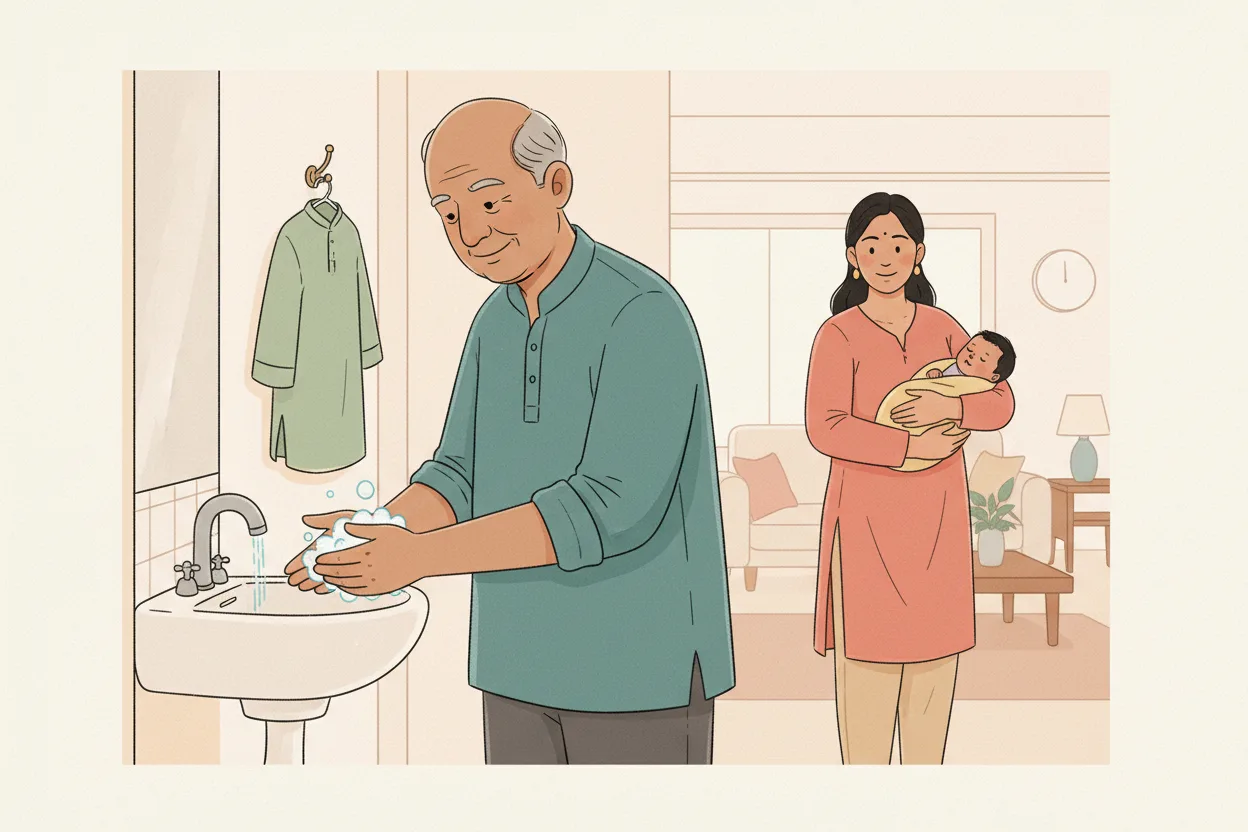

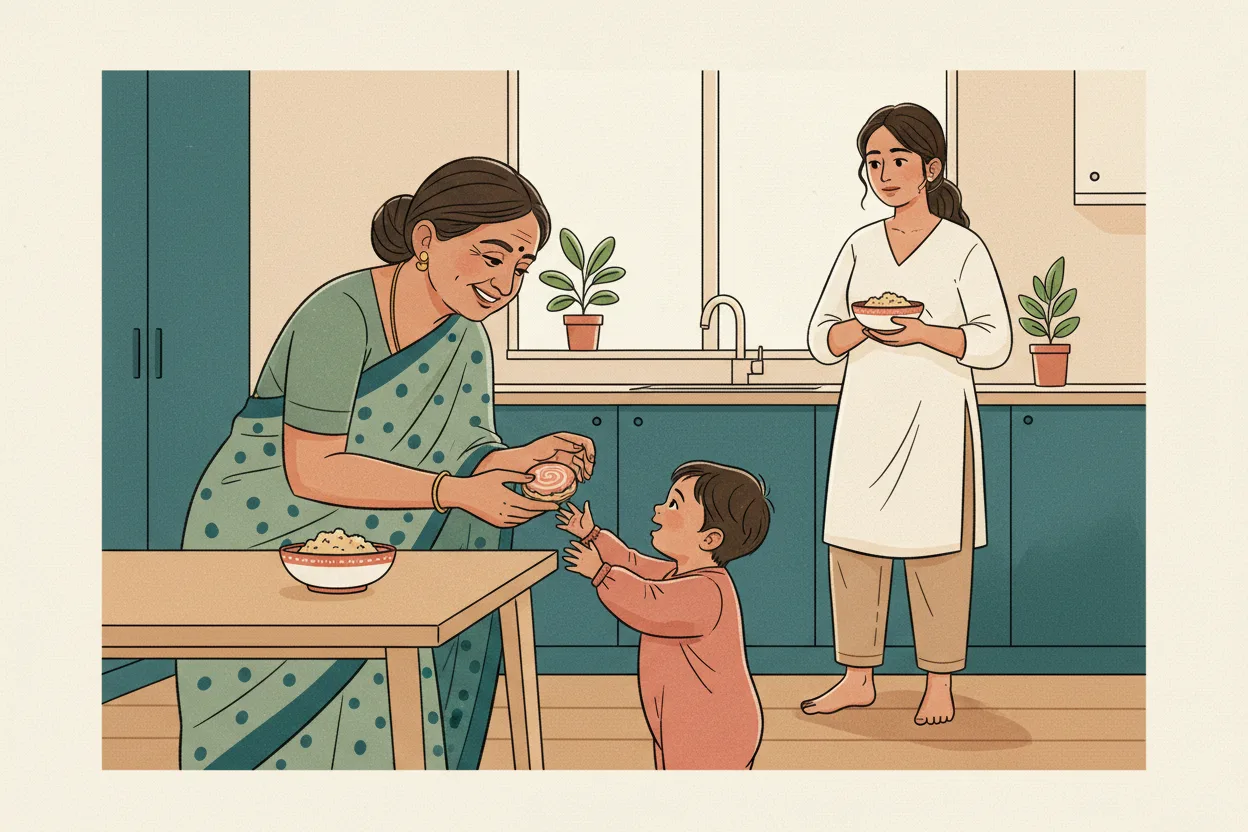
You cook from scratch, skip the added sugar, and it gets waved off as "too bland" — then your toddler is handed a store-bought cake within the hour. You're not imagining the double standard, and you're not wrong to want it to stop. The good news: the science backs your instinct, and there's a way to hold the line that doesn't turn every visit into a fight.
Not medical advice — consult your pediatrician for guidance specific to your child.
Why This Stings More Than It Should
It's rarely really about the cake. You've put real effort into learning what a toddler needs, cooking separately, planning meals around it — and then watching that effort get quietly overridden feels like your judgment as a parent doesn't count. In a joint or multi-generation Indian household, food is also how grandparents show love and claim their role with a grandchild. Treats feel generous to them; to you, they feel like sabotage of weeks of careful feeding.
Both things can be true at once: your in-laws likely mean well, and the sugar itself is a legitimate health concern, not just a preference. Knowing the actual evidence makes it easier to hold your ground calmly instead of getting pulled into "it's just one biscuit" arguments.
What the Evidence Actually Says About Toddler Sugar
This isn't a matter of taste or tradition — major health bodies are specific about it.
The American Academy of Pediatrics (AAP) recommends avoiding foods and drinks with added sugar entirely for children under 2 years of age. For a toddler just past that mark, the American Heart Association's guidance, as reported by Cleveland Clinic, states less than 25 grams — about 6 teaspoons — of added sugar per day for children aged 2 to 18. A single slice of a store-bought cake or a couple of packaged biscuits can use up that entire daily allowance on its own.
WHO recommends that both adults and children keep free (added) sugars below 10% of total daily energy intake, and WHO's Guideline: Sugars Intake for Adults and Children states that a further reduction below 5% of total energy intake brings additional health benefits. This isn't only a Western recommendation, either — a peer-reviewed comparison of national dietary guidelines, published in PMC, found that India's Dietary Guidelines for Indians (DGI 2024) recommend limiting added sugar to 5–10% of total daily calories, or roughly 23–30 grams a day, the same range as WHO's.
Here's what that sugar is actually doing, according to the research:
| Effect | What the evidence shows |
|---|---|
| Cavities | A peer-reviewed analysis of U.S. NHANES data, published in PMC, found a positive and statistically significant relationship between added sugar intake and dental caries in children |
| Early cavity risk | A prospective study of Scottish children, published in PMC, found that introducing sugar-sweetened drinks during a baby's first year can put them on a trajectory toward high levels of dental caries |
| Weight | A peer-reviewed study on dietary sugar and childhood obesity, published in PMC, found that children getting 10% or more of their energy from added sugars were 2.57 times more likely to be overweight or obese than those under 10% |
| Taste preferences | A study on infant sweetness exposure, published in PMC, reports prior research found that a higher intake of added sugars in a baby's first year was related to a stronger preference for sweet-tasting foods at age 4 to 7 |
That last row matters for the "it's just one treat" argument: the concern isn't only the sugar in that one piece of cake, it's that early, frequent sweet exposure appears to shape what your child wants to eat for years afterward — making the healthy food you're carefully building a habit around a harder sell later.
Why Grandparents Do This — It's Not Just Your In-Laws
If it feels like every grandparent does this, that's because it's genuinely common, not a reflection of your specific in-laws being difficult. A narrative review of grandparent feeding research, published in PMC, found that grandparents' indulgent feeding behaviours are widely seen by parents as a barrier to healthy eating and a real source of conflict and frustration in families. You're dealing with a well-documented pattern, not a personal slight — which can make it easier to address without it becoming a referendum on the relationship.
For many grandparents, offering sweets is inherited from how they raised their own children, when nutrition guidance looked very different. It's also often quicker and easier than negotiating with a toddler over a home-cooked plate, and it gets an instant smile — which reads to them as success.
Holding the Line Without a Fight Every Visit
A confrontation at every visit isn’t the goal — a few agreements that hold, so you’re not re-litigating them each time, do the job.
Talk to your partner first, not just your in-laws. If it's your spouse's parents, the conversation about limits should come from them as much as from you — a united front gets heard as a family decision, not as "the daughter-in-law being difficult."
Lead with the specific rule, not a lecture. The AAP’s own wording — avoid added sugar entirely under age 2 — is easier to hold to than a long explanation of dental caries and obesity odds. Save the detail for if they push back, and keep the specific numbers handy, since a concrete figure lands better than general worry.
Offer an alternative in the same gesture. If grandparents want to be the ones handing over something special, give them something to say yes to — fruit cut and plated nicely, a homemade ladoo with less sugar, or a small treat you've pre-approved for special occasions. It preserves their role as the generous one without the daily override.
Set the boundary as a health rule, not a taste preference. "We're not doing sugar yet" invites debate about your child's palate. "The pediatrician has us avoiding added sugar until 2" is harder to argue with, because it isn't really about your judgment — it's about a widely shared clinical recommendation.
Pick your moments. A birthday sweet at a family function is a different call from a daily biscuit slipped in "just this once." Reserve firm pushback for the recurring pattern, not every single occasion — constant vigilance exhausts everyone and makes you the difficult one instead of the sugar being the issue.
Frequently Asked Questions
Is a small amount of jaggery or traditional Indian sweets any better than packaged cake? Jaggery and traditional sweets are still added sugar as far as a toddler's body is concerned — WHO's guidance on free sugars applies regardless of the source. They may carry small amounts of minerals that refined sugar doesn't, but that doesn't change the recommendation to avoid added sugar under age 2, or to keep it well within the daily cap after that.
My mother-in-law says a little sugar never hurt anyone growing up. How do I respond? You can acknowledge that guidance has genuinely changed — the AAP's current recommendation is to avoid added sugar entirely under age 2, which wasn't standard advice a generation ago. Framing it as updated science rather than a criticism of how she raised her own kids usually lowers the defensiveness.
What if my toddler is already used to getting sweets from grandparents? Start by reducing frequency rather than eliminating treats overnight — agree on specific occasions (a festival, a birthday) rather than "sometimes." The 25-gram daily cap for children over 2 gives you a concrete number to work with when negotiating what "a little" actually means.
Does this apply the same way once my child is past 2? The under-2 guidance is the strictest, but the concern doesn't disappear afterward — added sugar above 10% of daily energy is still linked to higher obesity and cavity risk in older toddlers and children, so the daily cap, not a total ban, becomes the practical rule.
How do I stop this from becoming a source of ongoing conflict? Treat it as a shared parenting decision you communicate once clearly, rather than a rule you re-defend every visit. Grandparent indulgence is a common source of family friction precisely because it isn't addressed directly — naming the rule plainly, offering an approved alternative, and picking your battles for the pattern rather than every instance tends to reduce the tension over time.