
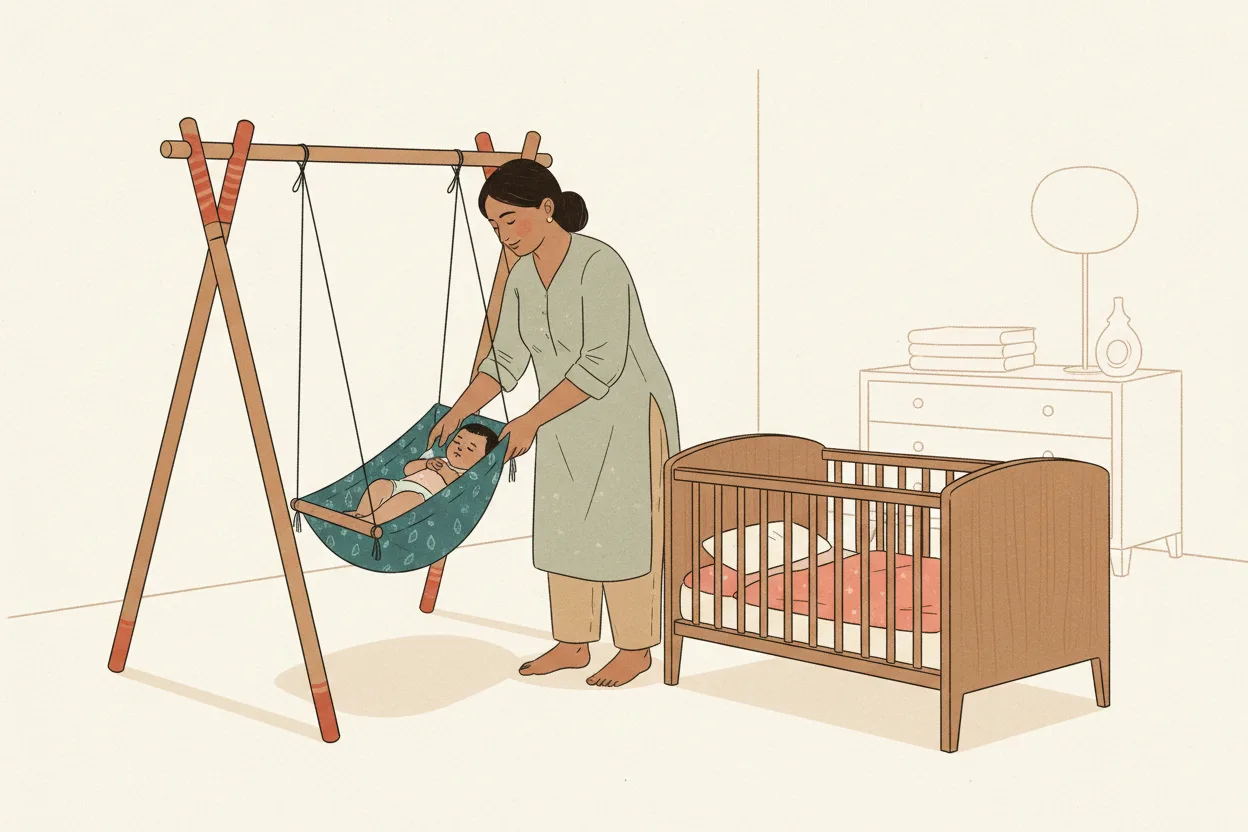
There's no single fixed age when a baby "outgrows" the jhula, but two windows make the switch far easier than trying to force it cold. Sleep Foundation notes that "at around 4 months, a baby's brain and body are developing rapidly, and the process of forming and linking different areas of the brain and nervous system may create instability in sleep" anyway, which makes it a natural point to start. And once your baby can roll from tummy to back, a skill most babies reach by around 6 months, continuing swing naps as the main way baby sleeps stops being a safe long-term plan. Aim to start the shift somewhere in that four-to-six-month stretch, rather than waiting until baby refuses everything else.
Not medical advice — consult your pediatrician for guidance specific to your baby.
Why the Jhula Works So Well (Until It Doesn't)
The jhula isn't just comforting — it's doing something specific for baby's nervous system. HealthyChildren.org (AAP) advises that you "walk your baby in a body carrier or rock them," because "calming motions remind babies of movements they felt in the womb." A jhula's steady swing does exactly that, more consistently than an arm can manage over a long nap.
There's also a nap-mechanics reason it works so well specifically at sleep time. A 2012 review in Advances in Neonatal Care (NIH/PMC) found that infant sleep cycles run far shorter than an adult's roughly 90-minute cycle: "the average duration of the sleep cycle is 47 minutes for healthy term infants and 50 minutes for 12-week and 24-week-old term infants." Baby stirs and half-wakes every 45–50 minutes through a nap, and the ongoing motion of a jhula helps carry them through that stir and back into the next cycle instead of a full wake-up — often why a jhula nap runs long while a cot nap ends the moment the swing stops.
When Helpful Becomes Dependent
The same motion that helps link sleep cycles can also become the only way baby knows how to fall asleep, and that's where dependency starts. Sleep Foundation explains that "if a child with strong sleep associations wakes up during the night, they may be unable to self-soothe and fall back to sleep unassisted." In a jhula routine, that plays out as: baby stirs mid-nap, the swing has stopped moving, and instead of drifting back off they're fully awake and crying until someone restarts it.
This isn't a flaw in your baby, or in your parenting. HealthyChildren.org (AAP) explains that self-soothing "involves a learning curve for you as well as your baby" — it's a skill that develops gradually, not something a baby simply has or lacks. A baby who has only ever fallen asleep swinging hasn't had the chance to practice it yet, which is exactly what the transition below gives them.
The Safety Line You Shouldn't Cross
There's also a hard safety reason not to let jhula naps run indefinitely as baby's only sleep setup. HealthyChildren.org (AAP) warns that swings and other inclined or upright sleep products "hold babies at an upright or inclined position. This causes your baby's head to fall forward or sideways if they fall asleep, making it hard (or even impossible) for them to breathe" — which is why they aren't recommended for routine, unsupervised sleep. HealthyChildren.org's AAP-based safe sleep guide adds that "if your baby falls asleep in a car seat, stroller, swing, infant carrier or sling, you should move them to a firm sleep surface on their back as soon as possible." Treat the jhula as a way to get baby to sleep, not the surface they sleep on for an entire nap.
There's no single agreed cutoff for one supervised stretch, but the daily total matters more than parents expect. Cleveland Clinic advises that "container time should be limited to necessary car travel plus one additional hour (or less) each day" — and that's the combined total across swings, bouncers, car seats, and strollers, not per device. If the jhula is where most naps happen, it's easy to blow past that without noticing.
This gets more urgent as baby becomes mobile. The CDC's Learn the Signs. Act Early. milestones list rolling from tummy to back as a marker most babies reach by around 6 months — and a baby who can roll can also work themselves into an unsafe position inside a moving swing unnoticed. That mobility milestone is a practical deadline: by the time it arrives, unsupervised swing naps should already be behind you.
How to Switch Without a Full Sleep-Training Overhaul
There's no need to sleep-train from scratch to get off the jhula. Most families manage it gradually, over one to two weeks:
- Cut swing time in half for a few days. Rock baby until drowsy, not fully asleep, then transfer them to the cot for the final stretch of settling.
- Keep the pre-nap routine identical. Same room, same sleep sack or swaddle, same white noise — change only the surface baby falls asleep on, nothing else at once.
- Start with one nap a day. Pick the nap where baby is least overtired (often the first nap of the day), switch that one first, and keep the jhula for the rest until the new nap sticks.
- Split the naps between both parents. There's nothing about this transition that needs to fall on one parent — trade off which parent handles the cot settling each day so baby gets used to it working with either of you.
- Expect a rougher few days, not a rougher few weeks. Self-soothing is a learning curve for both of you — a few noisy or shorter naps while baby practices settling without motion is normal, not a sign the approach is wrong. If it isn't clicking after two weeks, pause and try again in a few weeks rather than pushing through a miserable week for everyone.
Gear That Helps the Switch
| Item | Why it helps | Price Range | Where to Buy |
|---|---|---|---|
| Firm-fitted cot mattress | A flat, firm surface baby can safely settle on unassisted | Rs. 1,500 – Rs. 4,000 | Amazon.in / FirstCry |
| Breathable sleep sack | Keeps the pre-nap routine (and the swaddle-like snugness) consistent once the swing is gone | Rs. 700 – Rs. 1,800 | FirstCry |
| White noise machine | One less variable to change when baby is already adjusting to a new surface | Rs. 900 – Rs. 2,500 | Amazon.in |
| Blackout curtains or cloth | Helps daytime cot naps go as long as jhula naps used to | Rs. 500 – Rs. 1,500 | Amazon.in |
Frequently Asked Questions
My baby only naps in the jhula and screams the moment I put them down flat. Is this a "sleep problem"? No — it's a very common sleep association, not a problem with your baby or your parenting. Sleep Foundation describes exactly this pattern: a baby who is used to falling asleep one specific way struggles to resettle without it. The gradual transition above addresses it directly.
Is it actually unsafe to let a newborn nap in the jhula for hours unsupervised? Yes, treat it as a supervised-only setup. HealthyChildren.org (AAP) warns that the inclined position can cause a sleeping baby's head to fall forward or sideways, making it hard to breathe. If baby falls asleep in it, move them to a firm, flat surface as soon as you can.
What age should I stop using the jhula for naps completely? By around 6 months at the latest, once baby can roll from tummy to back and can work themselves into an unsafe position in a moving swing. Many families start the gradual switch earlier, around the 4-month mark, when sleep is naturally more unsettled anyway.
Will switching to the cot mean full cry-it-out sleep training? No. The step-down approach above — shorter swing time, identical routine otherwise, one nap at a time, split between both parents — is a gradual wean, not a cry-it-out method. Self-soothing develops gradually, and most babies adjust within one to two weeks without needing a formal sleep-training program.
Is it fine for an older baby to still enjoy jhula time while awake? Yes. The safety and dependency concerns here are specifically about unsupervised sleep in the swing, not about jhula time in general. A supervised, awake jhula session is a different situation from leaving a sleeping baby in it for a full nap.