
Yes — singing to your baby genuinely helps them settle. A 2017 study in the journal Child Development found that infants listened significantly longer to sung stimuli than spoken stimuli, meaning babies are wired to pay closer, calmer attention to a tune than to plain talk. You don't need a special app or a "proven" playlist — your own voice, whatever song you choose, is the tool that works.
Not medical advice — consult your pediatrician for concerns about your baby's sleep or hearing.
Why Music Works on Babies at All
This isn't a new preference that shows up after birth. A near-term fetal response study, published via NIH's PMC, found that cochlear biomechanics — the inner-ear machinery that lets us hear — are fully matured by near term. In practice, that means a baby in the last weeks of pregnancy can already detect and react to your voice. By the time your baby is born, your particular voice and the songs you sang during pregnancy aren't strangers to them — which is part of why a familiar tune can be so calming in the newborn weeks.
The calming effect isn't just behavioural, either. A 2023 Cochrane review found that music and vocal interventions probably reduce heart rate in preterm infants during the intervention — a measurable sign of physiological calming, not just a baby who looks quieter on the surface. And the benefit isn't only short-term: a 2021 study in Frontiers in Neuroscience found that repeated parental singing during skin-to-skin kangaroo care improved how preterm infants processed speech sounds by the time they reached term age. Singing to your baby, especially in that close, skin-to-skin way, is doing more than passing the time.
It also pays off beyond bedtime. A 2022 study in the Journal of Child Language found that how often parents reported singing to their infant in the first months predicted the baby's music-listening behaviour at 6 months and was linked to stronger language development by the second year — so a nightly singing habit is doing double duty as a language-building one, not just a settling one.
Bollywood Lullaby, Classical Raag, or Just Humming — Does It Matter?
For everyday soothing, no single genre has been shown to work better than another for settling a baby. What the research above points to is simpler: babies respond to singing itself — the rhythm, repetition, and your voice — more than to any particular style. A Bollywood lullaby your own mother sang to you, a classical raag, a nursery rhyme, or wordless humming all use the same mechanism. Pick whatever you can comfortably repeat night after night; consistency matters more than the song choice.
One popular idea worth being clear about: playing classical music for your baby will not make them smarter. Harvard researchers found there was no evidence that music training offered any cognitive benefit — the so-called "Mozart effect" doesn't hold up. That doesn't mean classical music has no place at bedtime; it's a perfectly fine choice for its calming effect, the same as any lullaby. It just isn't a shortcut to a smarter baby, so there's no need to feel pressure to play "the right" music for developmental reasons.
Live Singing vs. a Speaker or White-Noise Machine
Your own voice, live, is always a safe and free option — there's no volume or placement to manage. A speaker, phone, or dedicated white-noise/lullaby machine is convenient for the parts of the night you can't be singing yourself, but it needs a bit more care than most parents assume.
There's no need to wait for a certain age before introducing one: a randomised trial in Archives of Disease in Childhood found that in newborns just 2 to 7 days old, 80% fell asleep within five minutes when played white noise, compared with only 25% in a no-noise control group — white noise can help settle a baby from the earliest days of life, as long as it's used at a safe volume and distance.
A study in Pediatrics, the American Academy of Pediatrics' journal, found that infant sleep machines can produce sound levels well above the recommended noise limit for infant nurseries — 50 A-weighted decibels — with some models exceeding 85 decibels at close range — loud enough, at that distance, to be a genuine hearing-safety concern rather than just an annoyance. As a rule of thumb, keep any machine or speaker at or below that 50 dB nursery limit, about the level of a quiet conversation, rather than judging volume by ear alone.
The fix is simple and doesn't mean giving up the machine:
| Do this | Skip this |
|---|---|
| Keep the machine or speaker well away from the crib | Placing it inside or right against the crib |
| Keep volume on the lower settings | Running it at maximum volume overnight |
| Play it for a set stretch, not necessarily all night | Assuming louder or longer is always more soothing |
Children's Hospital of Philadelphia advises placing sound machines more than 200 centimetres from the crib and keeping the volume low — roughly the far side of a nursery, not on the nightstand next to baby's head. A speaker across the room at a gentle volume gives the same soothing background sound with a real safety margin.
Keeping the Crib Itself Safe
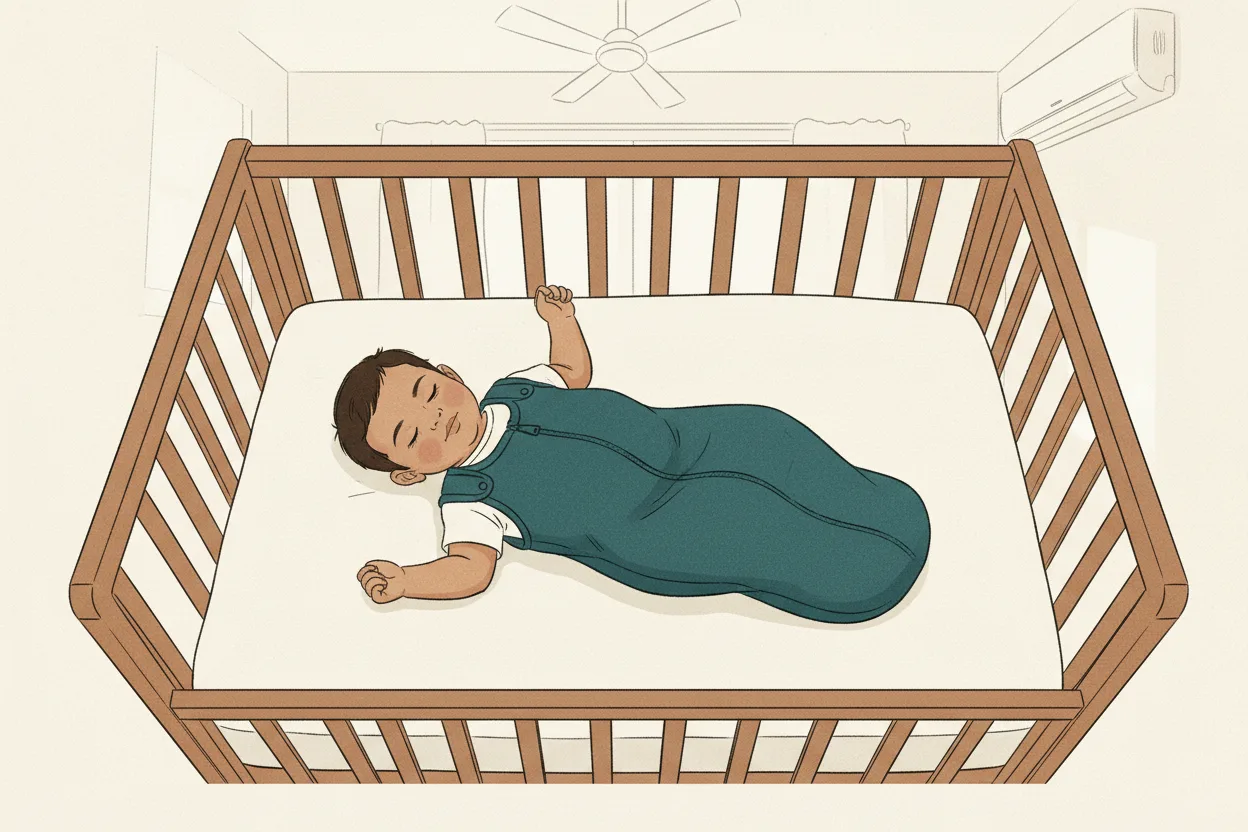
Whatever you use for lullabies or white noise, keep it out of the crib itself. The AAP's HealthyChildren.org advises using a fitted sheet only — nothing else should be in the crib with your baby, which rules out musical toys, plush speakers, or soft sound-machine toys tucked in beside them. Play music from a machine or speaker placed on a shelf, dresser, or the floor across the room instead, never inside the crib or attached to the rail within baby's reach.
Building a Simple Bedtime Music Routine
Here's a simple routine that works in most Indian homes:
- Pick one or two songs you're happy to repeat nightly — a lullaby you grew up with works as well as anything new.
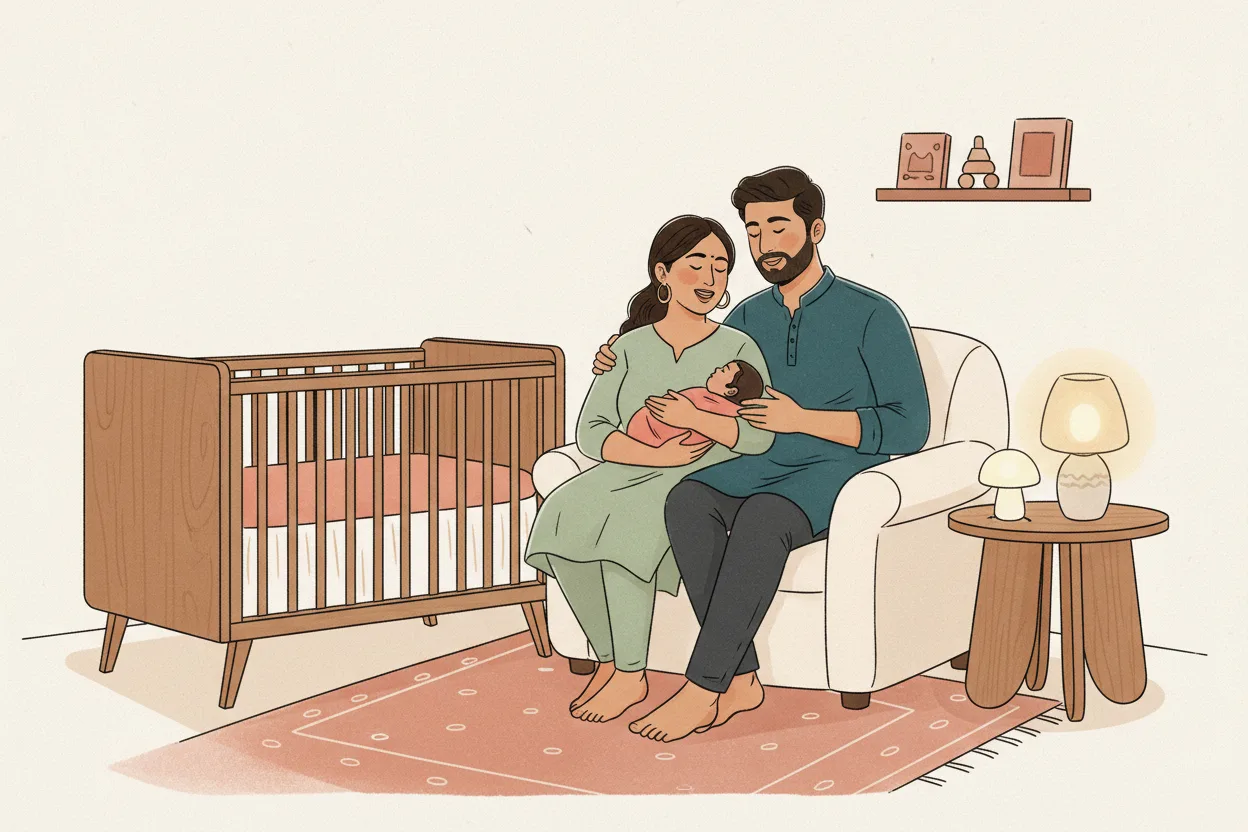
- Sing them yourself during the wind-down (feed, dim lights, swaddle or sleep sack) — this is the part with the strongest, most direct evidence behind it.
- If you use a machine or app for the rest of the night, keep it out of the crib itself and, as Children's Hospital of Philadelphia advises, place it more than 200 centimetres from the crib at a low volume.
- Stay consistent. The same song and routine, night after night, becomes a reliable cue for sleep — the specific tune matters far less than the repetition.
Frequently Asked Questions
Can I start singing to my baby before birth? Yes. Since a fetus's hearing system is functionally mature by late pregnancy, your baby can already hear and respond to your voice in the womb. Singing during pregnancy is a safe way to start the habit early.
Does it matter which language or song I sing? No — the evidence points to babies responding to singing itself, not to any specific language, style, or "approved" lullaby list. A Hindi, Tamil, Bengali, or any other lullaby you're comfortable with works the same way.
Is it safe to leave a white-noise machine playing all night? Use it with care rather than avoiding it altogether. Some sleep machines can exceed safe sound levels — well above the 50 dB recommended nursery limit — if placed close to the crib at high volume. Keep it more than 200 cm away and on a low setting, and you can leave it running through the night.
Is my newborn too young for a white-noise machine? No — a randomised trial found that newborns just 2 to 7 days old settled faster with white noise than without it, so there's no minimum age to wait for. Just follow the same volume and distance precautions from day one.
Will playing classical music make my baby smarter? No. Harvard researchers found no evidence that music offers a cognitive boost. Play it if it's calming for your baby — not as a developmental strategy.
Can I keep a musical toy or speaker inside the crib with my baby? No. Safe sleep guidance from the AAP is a fitted sheet only in the crib — nothing else, including musical toys or speakers. Keep any sound source outside the crib, on a shelf or dresser across the room.
Does singing help premature babies specifically? Yes, notably so. A 2023 Cochrane review found music and vocal interventions probably lower preterm infants' heart rate during sessions, and a 2021 study found that repeated parental singing during kangaroo care improved these babies' processing of speech sounds by term age.