
A TSH level that climbs between birth and the 44-hour mark is usually the normal newborn TSH surge, not a sign that your baby has thyroid disease — a physiological spike that elevates TSH in the first 1 or 2 days after birth happens in every newborn, thyroid medication in pregnancy or not. What matters now is the retest, and understanding why it's timed the way it is.
Not medical advice — this explains what the screening numbers generally mean; only your baby's pediatrician or endocrinologist can interpret your baby's specific result and decide on treatment.
Why TSH Climbs in the First Two Days
A peer-reviewed review on newborn congenital hypothyroidism screening explains that "the ideal time to obtain the blood spot is 3-5 days after birth to minimize the false positive high TSH values due to the physiological neonatal TSH surge that elevates TSH levels and causes dynamic T4 and T3 changes in the first 1 or 2 days after birth." In other words, a test drawn very early — including a cord blood sample taken at the moment of delivery — is more likely to catch a baby mid-surge than a test drawn a few days later, when levels have settled.
This is exactly why your baby's TSH being higher at 44 hours than it was at birth isn't automatically alarming — that window overlaps the physiological surge described above, so the sample can simply have landed inside it. The follow-up heel-prick test is what tells you whether the number settles back down or stays elevated.
This is also why Indian pediatric endocrinology guidance doesn't recommend testing right at birth: a pilot newborn-screening study from India, citing Indian Society for Pediatric and Adolescent Endocrinology guidance, notes that TSH screening is preferred "at 48–72 h of birth" rather than in the first day, for the same reason — to let the normal surge settle before the sample is drawn.
What TSH Number Actually Triggers a Retest
"High" isn't a single fixed number, but Indian guidelines do define specific thresholds. The ISPAE newborn screening guidelines state that neonates with a screening TSH above 20 mIU/L (or above 34 mIU/L for a sample taken between 24 and 48 hours of age) should be recalled for confirmation, with a markedly higher reading prompting an immediate confirmatory blood test rather than a routine repeat. If your baby's report includes the actual TSH value, that's the number worth asking your pediatrician to explain against this threshold, rather than relying on a bare "flagged" or "normal" label.
Cord Blood vs Heel-Prick: Why the Method Matters
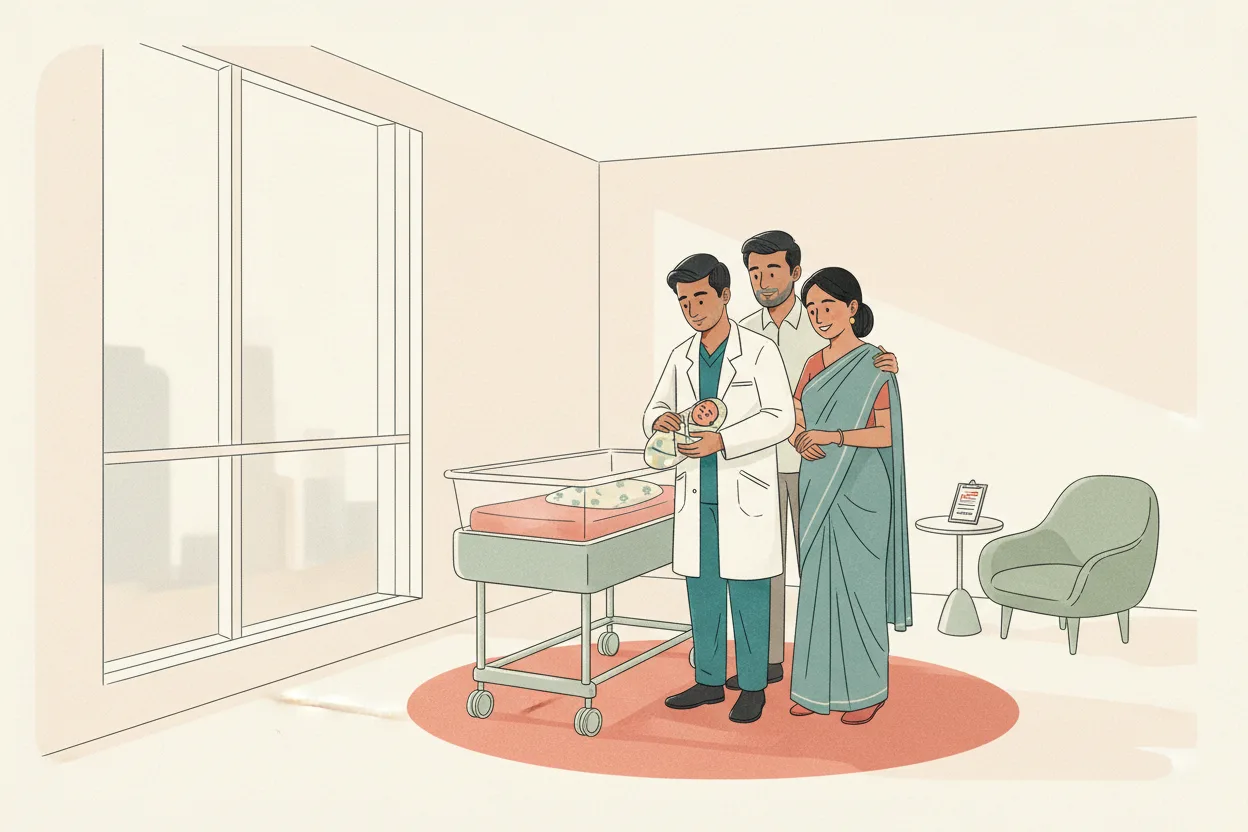
Hospitals in India commonly screen with a heel-prick (dried blood spot) sample taken before discharge, the same core method described by the American Academy of Pediatrics, which explains that hospitals "screen for this disease using blood collected from your baby's heel before discharge from the hospital" rather than relying on cord blood alone. Cord blood, drawn at the instant of birth, and a heel-prick, drawn a day or more later, are not interchangeable — they catch different things.
| Cord blood (at birth) | Heel-prick (before discharge) | |
|---|---|---|
| Sensitivity (catches true cases) | Lower | Higher |
| Specificity (avoids false alarms) | Higher | Lower |
| Best used for | An early first look | The confirmatory/primary screen |
A peer-reviewed diagnostic comparison study found that "heel‐prick samples have 100% sensitivity with higher recall rate and much lower positive predictive value, while cord‐blood samples which have higher specificity (99.9%) but lower sensitivity (75%)." That's why a cord-blood reading — even a high or a reassuring one — should never be treated as the final word; the heel-prick result taken closer to day 3–5 is the one that actually confirms or clears the diagnosis.
If You Were on Thyroid Medication During Pregnancy
Being on thyroid medication throughout pregnancy raises two separate questions: what happens to the baby's own thyroid, and what happens to your dose now that you've delivered.
Your baby's thyroid, if your condition involved antibodies. If your thyroid condition was Graves' disease or another antibody-driven form, the relevant antibodies can cross the placenta and act on your baby's thyroid gland directly. A systematic review on maternal Graves' disease and neonatal thyroid function found that "TRAbs, in particular, play a critical role, as they can either stimulate or inhibit thyroid function, resulting in neonatal hyperthyroidism or hypothyroidism, respectively." That means a newborn's thyroid numbers can be temporarily pushed up or down by the mother's antibodies, independent of whether the baby's own thyroid gland is working normally — another reason a single early reading isn't the full picture, and why your baby's team will want to know your specific thyroid diagnosis, not just that you were "on medication."
Your own dose, after delivery. Pregnancy typically requires a higher levothyroxine dose than usual, and that need drops once the baby is born. A peer-reviewed review on postpartum thyroid management recommends that "immediately postpartum, the levothyroxine dose be decreased to two-thirds of the final dose administered during gestation." Don't stop your medication on your own after delivery — this dose reduction is something your prescribing doctor should manage and confirm with a follow-up blood test, not something to guess at.
Why a Timely Diagnosis Matters
The reason this gets checked so carefully in the first place: thyroid hormone drives early brain development, and the newborn window is when treatment does the most good. MedlinePlus (U.S. National Library of Medicine, NIH) explains that "if untreated, congenital hypothyroidism can lead to intellectual disability and slow growth." Cleveland Clinic states that "your baby will need to start medication within the first month of life to prevent permanent developmental delays or intellectual disabilities" — which is exactly why doctors move quickly on a flagged result instead of waiting to see if it resolves on its own.
Congenital Hypothyroidism in India: The Numbers
This isn't a rare edge case in India — it's more common here than the global average, which is part of why screening protocols are strict. Citing Indian Council of Medical Research (ICMR) data, a PubMed Central systematic review states that "a large collaborative study from the Indian Council of Medical Research has recommended universal newborn screening for CH with an estimated overall prevalence of 1 in 1,130 newborns." That relatively high prevalence is exactly why your hospital is following up on a flagged number rather than dismissing it — and exactly why it's worth taking the retest seriously without panicking over one early data point.
At the same time, a flagged first result is not the same as a diagnosis. A peer-reviewed review on congenital hypothyroidism screening notes that in most screening programs, the ratio of false positives to confirmed cases is about 2 to 3 to 1 — meaning most babies who get called back for a repeat test turn out, on retest, not to have congenital hypothyroidism at all.
What Happens Next
If your baby's heel-prick TSH comes back flagged, your pediatrician or a pediatric endocrinologist will want a repeat blood test to confirm the level, alongside a thyroxine reading, before deciding on treatment. Bring your own thyroid diagnosis and medication history to that appointment — whether you have Graves' disease, Hashimoto's, or another form of hypothyroidism changes how your baby's result is interpreted, as above. Ask directly: was this sample cord blood or heel-prick, and when exactly was it drawn relative to birth? That detail changes how much weight the number carries.
Frequently Asked Questions
My baby's TSH was higher at 44 hours than at birth. Is that dangerous? Not necessarily. TSH is expected to rise in the first 1–2 days after birth as a normal physiological surge, and levels are more reliable once tested closer to day 3–5. Your baby's team will use the trend and a follow-up test, not one isolated number, to decide anything.
Should I trust a cord blood result over the heel-prick, or the other way around? Weight the heel-prick result more. Heel-prick samples have higher sensitivity for catching true cases, while cord blood has higher specificity but lower sensitivity, so a heel-prick drawn a day or more after birth is the one that actually confirms or clears a diagnosis.
I have Graves' disease and was on thyroid medication throughout pregnancy. Could that be affecting my baby's numbers? Yes, potentially. Antibodies linked to Graves' disease can cross the placenta and push a newborn's own thyroid function up or down, separate from how the baby's thyroid gland is actually functioning. Tell your baby's doctor your exact diagnosis, not just that you take thyroid medication.
Can I just stop my own thyroid medication now that I've delivered? Don't decide this yourself. Postpartum guidance typically calls for reducing the dose to about two-thirds of the final pregnancy dose, not stopping it outright, and the exact change should be confirmed with your doctor and a follow-up blood test.
How common is congenital hypothyroidism in India — is my baby's flagged test likely to be a false alarm? It's common enough that India runs organized newborn screening for it: ICMR-backed data puts the prevalence at about 1 in 1,130 newborns, well above many global estimates. Many flagged first tests do turn out to be the normal early surge — in most screening programs, false positives outnumber confirmed cases by roughly 2 to 3 to 1 — but that overall prevalence is exactly why hospitals retest rather than ignore a high reading.
What TSH number counts as "high enough" to need a retest? Indian guidelines (ISPAE) set the screening TSH recall threshold at above 20 mIU/L, or above 34 mIU/L if the sample was taken between 24 and 48 hours of age, with a much higher reading triggering an immediate confirmatory test instead of a routine repeat. Ask your pediatrician for your baby's actual number against that threshold rather than just a "flagged" label.
Why does it matter if treatment starts a few weeks later rather than right away? Because the newborn period is when it counts most. Untreated congenital hypothyroidism can affect intellectual development and growth, and starting treatment within the first month of life is what prevents those permanent effects — which is why doctors move on a confirmed result quickly rather than watching and waiting.