
He was confident, and she had only just met him. Massaging the baby with any oil — branded, mustard, coconut — would bring on arthritis by about the age of five and block all the pores in her skin. Drop the hair oil too. We went looking for that claim and could not find it. The precise wording matters: not "this is a myth," but no supporting evidence found in the sources we could reach. Next to it sits the more useful fact — the cause of juvenile idiopathic arthritis is not known at all, and MedlinePlus describes it as an illness in which "the body attacks and destroys healthy body tissue by mistake."
Not medical advice — consult your pediatrician about your baby's specific health needs.
What we searched, and what came back
We searched PubMed, the main index of the medical literature, three ways: oil massage with arthritis in infants, infant massage with arthritis, and juvenile idiopathic arthritis with topical oil. All three returned zero papers. The only studies that pair massage with juvenile arthritis put massage on the treatment side: a narrative review in the Journal of Paediatrics and Child Health lists "massaging" among the non-invasive therapies used to manage lower-limb problems in children already living with the condition. We also chased the places a kernel might hide — joint strain from vigorous handling, vitamin D and rickets confusion, mustard oil toxicity, oils causing acne-like eruptions — and none produced a paper describing massage oil leading to joint disease. One line of enquiry did return something.
Why this would be a surprising finding
The CDC's page on childhood arthritis says it "begins when the immune system becomes overactive, leading to joint and body swelling," and states plainly that "the causes of childhood arthritis are not known." An autoimmune process nobody has yet traced to a single trigger is a hard thing to pin on oil rubbed onto the outside of the skin. And if massage oil did it, India — where the practice is routine — would be the easiest place on earth to notice. Instead, an Indian randomised controlled trial in 2,294 preterm newborns reported that "no significant adverse effect was noted with coconut oil application."
Worth knowing before she next sees him: the Indian Academy of Pediatrics' guidelines for paediatric skin care state that "oil massage has multiple benefits and is recommended." That is India's own paediatric body, and it is a document she can name rather than a tradition she has to defend.
The one thread that genuinely connects oil and arthritis
There is a real literature tying oil to arthritis, and it may be what a doctor half-remembers. It is about oil getting inside the body. In laboratory arthritis models, mineral oil is injected into the skin deliberately to provoke joint inflammation: "In laboratory models of RA mineral oil is injected intradermally with an emulsifier." The same case report describes a child given oral mineral oil by syringe from infancy who went on to develop rheumatoid-factor-positive juvenile idiopathic arthritis. One case is not a cause, and an injection is not a massage — but that is the nearest thing to a kernel we found, and it concerns swallowed and injected oil rather than oil spread on a baby's arms.
"It blocks all the pores"
Here the research exists, and describes something different. A confocal Raman study of oils on adult and infant skin reported that the oils tested "demonstrated modest SC swelling (10-20%) compared to moderate swelling (40-60%) for petrolatum" — they sit in the uppermost layers of the stratum corneum, the skin's outer sheet, rather than sealing it shut. Occlusion is real and measurable, and a matter of degree.
Whether oil helps or harms that outer layer depends on the oil, and the evidence is honestly mixed. A 2022 systematic review of fourteen randomised trials in 5,683 newborns found that "eleven of the studies concluded that the oils used in the skincare of neonates effectively improve the skin condition and barrier functions of the skin. However, three studies found equivocal, negative, or mixed findings." Mixed is the accurate summary — neither "blocks all the pores" nor a clean all-clear. Which oil to pick is its own question, covered in traditional baby massage practices, and if her skin is already flaring, eczema changes the calculation.
The oil risk that is well documented
This is the one that deserves her attention, and he did not name it. Oil reaching the airway causes exogenous lipoid pneumonia. A systematic review in Paediatric Respiratory Reviews of 44 studies covering 489 children concluded that "paediatric ELP resulting from cultural and medical practices continues to be described globally," with treatment including "stopping oil." The practices behind it put oil into a baby's nose, mouth or throat — a different act from oil on the body and scalp.
How to ask about a claim you cannot verify
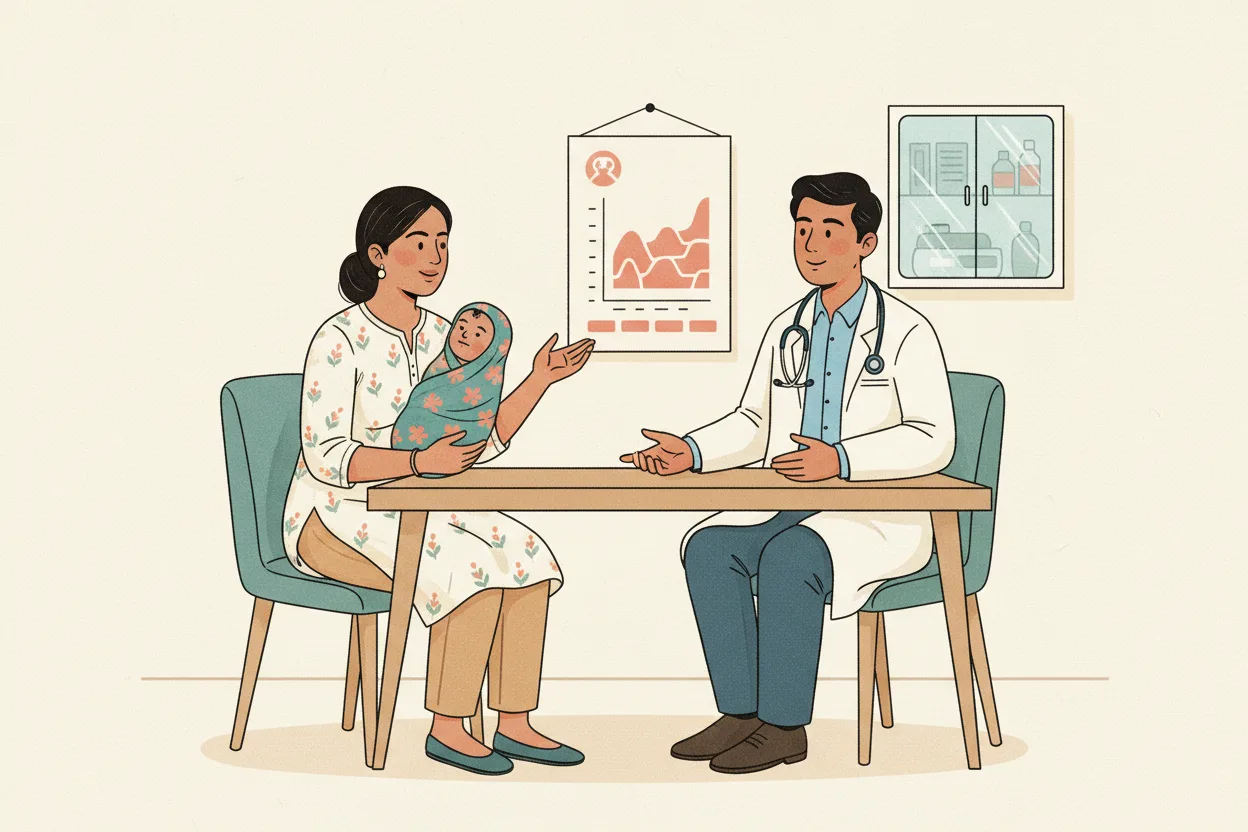
The method matters more than this one answer, because this will happen again. MedlinePlus advises that you "jot down your questions and concerns" before the visit and "ask questions to make sure you understand." Curious beats adversarial:
- Is that something you've seen in your own patients, or is it in a guideline I could read?
- What would I watch for, so I'd know if it were starting?
- Would you be comfortable if I kept the massage and stopped the oil near her face?
Each leaves him room to be specific, or to soften, with nobody having to be wrong out loud. Now the honest part: a doctor unable to produce a paper is not thereby mistaken — experienced clinicians carry pattern recognition that runs ahead of the published literature. Equally, an uncited claim does not oblige her to act. "I couldn't find support for this, so I'm continuing" is defensible. So is "I'll stop, because he examined her and I didn't."
NHS guidance on second opinions says that "before requesting a second opinion, it's worth asking your GP or consultant to go over and explain anything you don't understand," and that "a healthcare professional will rarely refuse to refer you for one." Ask him first. A second opinion earns its place when the advice touches something ongoing and important, or when his reasoning stays unexplained after you ask. That is a separate question from choosing a paediatrician, and different again from in-law advice: a clinician's claim gets weighed on its evidence, not its confidence.
The Dettol advice may be his soundest point
He also told her to stop washing the baby's clothes with Dettol and use ordinary detergent instead. That one has backing. Absent allergies or eczema, KidsHealth states, "washing your little one's clothes with the rest of the family's clothes isn't likely to irritate your baby's skin" — and the things to leave out are "anti-static products or fabric softeners." A household disinfectant is not a laundry detergent, and his advice points the same way.
Which is the lesson. One doctor, one visit, three claims — they need not stand or fall together. Weigh them one at a time.
Frequently Asked Questions
Does oil massage cause arthritis in children? We found no study, guideline or case report describing it. MedlinePlus states that "the cause of JIA is not known," so no origin story is settled — a reason to treat any confident single cause with caution.
So the claim is false? We cannot say that, and we found no body explicitly refuting it either. What we found is an absence: the mechanism is not described in the paediatric or dermatological literature we could reach. Absence of evidence is weaker than disproof, and we will not dress it up as more.
Should I stop the hair oil? Nothing we found connects oil on the scalp to joint disease. The documented concern is oil near the airway, where a systematic review of 489 children describes exogenous lipoid pneumonia arising from "cultural and medical practices" — so keep it on the scalp, away from the nose and mouth.
Was my paediatrician wrong? Unknown, and not the useful question. He examined your baby; we read papers. NHS guidance suggests the first move is asking him "to go over and explain anything you don't understand."