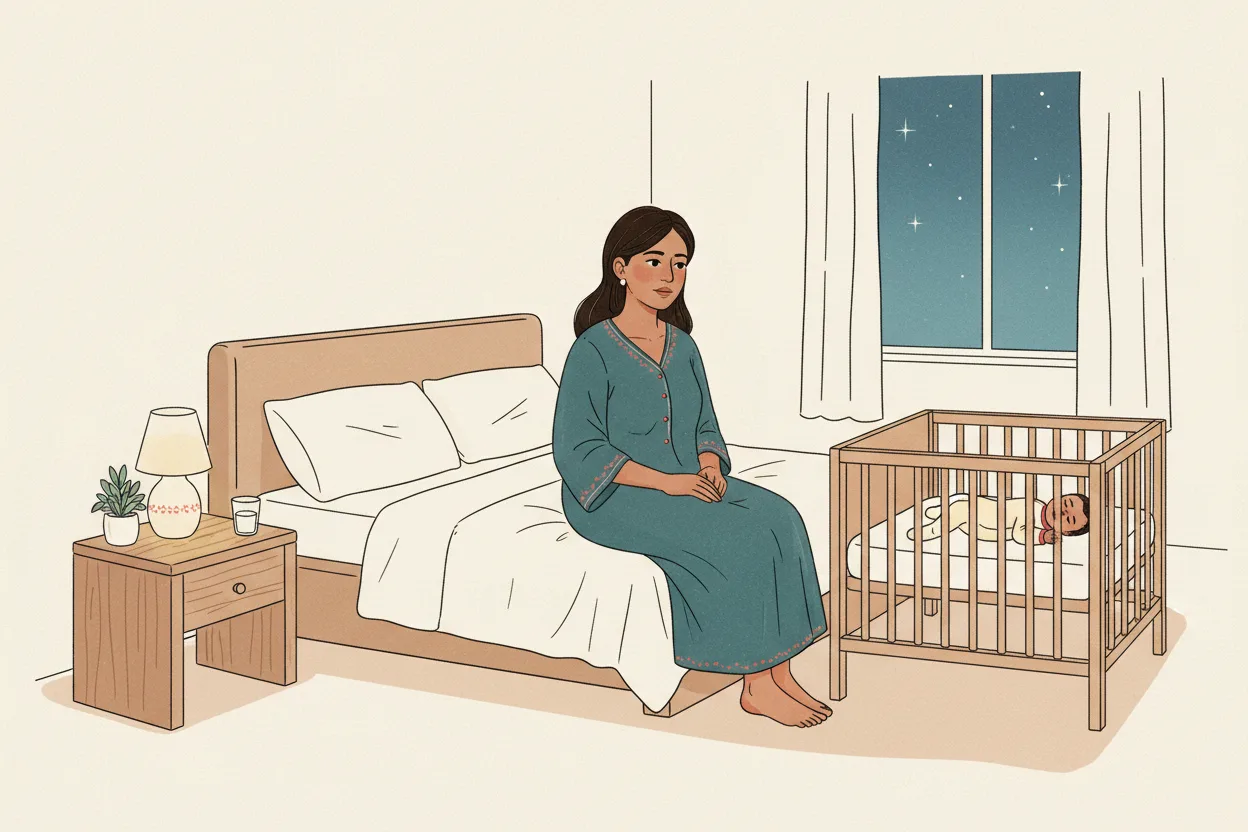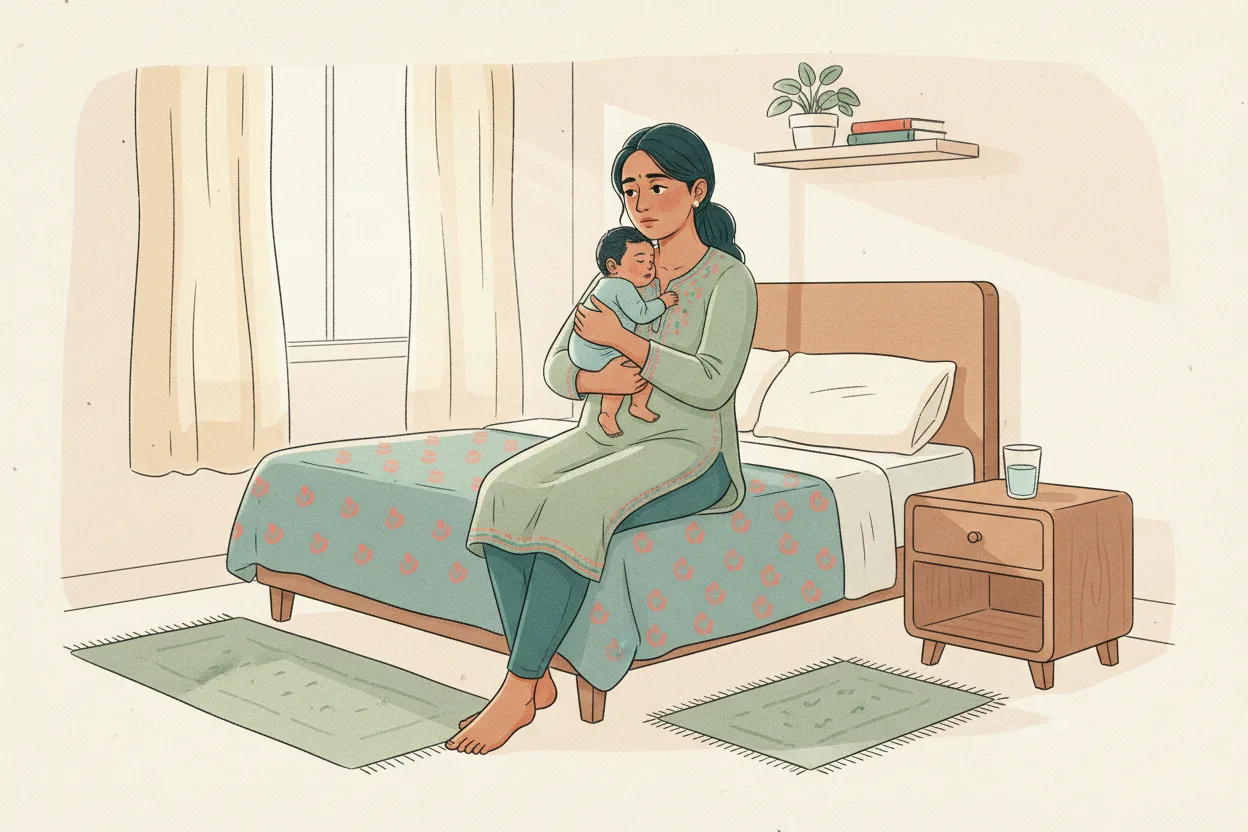
Loving your baby, laughing at a joke and having genuinely good hours does not rule out a postpartum mood or anxiety disorder. The Cleveland Clinic's postpartum depression page describes "alternating highs and lows, frequent crying, irritability and fatigue" — the highs are inside the picture, not evidence against it.
The timing you are using as reassurance points the other way. The US National Institute of Mental Health states that "most episodes of perinatal depression begin within 4−8 weeks after the baby is born." Week four is not when you are in the clear; it is the window in which an episode most commonly starts.
Not medical advice — talk to your gynaecologist, or a psychiatrist, about anything here that sounds like you.
Loving Your Baby Is Not an Exclusion Criterion
The two-week rule you have read about — blues before, depression after — is a rough edge, not a test you can self-administer; we cover where it comes from in baby blues in the first two weeks. What matters is the threshold: the NHS lists ten signs of postnatal depression and says plainly that "it's important to get help even if you only have some of the signs." Difficulty bonding with your baby is one of those ten. It is not the entry ticket.
Look at how the screening tool is actually built. The Edinburgh Postnatal Depression Scale, published by the American Academy of Pediatrics, opens by asking whether you have "been able to laugh and see the funny side of things" — and the four answers run from "as much as I always could" down to "not at all." It measures how much laughter is left, not whether any is. A mother who still laughs scores on that item; she does not score herself out of the questionnaire.
The useful question, then, is not "am I ever happy?" but "how much of most days, and for how long?" NIMH frames its first symptom as a sad, anxious or empty mood "most of the day, nearly every day, for at least 2 weeks" — persistence, not the absence of joy.
The Presentations Nobody Puts on a Poster
Public messaging asks about sadness, which is why three very common experiences get filed as personality problems instead. WHO's postnatal care schedule asks clinicians to "assess maternal mental health (screening for postpartum depression or anxiety)" at the six-week visit — depression or anxiety, two different things. NICE goes further, telling clinicians to ask about anxiety with its own separate two-question scale, and to keep looking when a woman scores under the cut-off but the concern has not gone away.
Anger and irritability. MedlinePlus lists "feeling unusually angry" among the symptoms of postpartum depression. There is also a name for the version where rage, not sadness, is loudest: the Cleveland Clinic explains that postpartum rage is not an official DSM-5-TR diagnosis, but "healthcare providers recognize that it exists and can help you," and that it often sits alongside postpartum depression or postpartum anxiety. Snapping at your mother-in-law over how the daal was made, then hating yourself for an hour, is a described pattern — not a defect in your character.
Dread about things that have not happened. The Cleveland Clinic describes postpartum anxiety as excessive worrying that "often causes you to have irrational fears or excessive concerns about events that are unlikely to happen," affecting roughly one in five women. Rehearsing your baby's first day of school, an illness nobody has diagnosed, an accident on a road you have not driven down — that is the shape of it. The EPDS carries two items on exactly this: whether you have "been anxious or worried for no good reason," and whether you have "felt scared or panicky for no very good reason."
Brain fog. The NHS symptom list includes "difficulty concentrating or making decisions," and the Cleveland Clinic lists "difficulty thinking or focusing." Re-reading the same message four times is a feature of the condition — and also what broken nights do on their own, which is why sleep debt with nobody to share the nights is worth fixing in parallel.
What "Normal" Actually Looks Like at Four to Eight Weeks
Here is the part usually left out: "absolutely normal" is the wrong yardstick, because the women around you at week four are not their old selves either. The Cleveland Clinic notes that "there isn't a one-size-fits-all timeline to postpartum," that "the symptoms and changes that occur during the postpartum period can last far beyond eight weeks," and that the delayed phase of recovery runs from roughly six weeks postpartum to six months.
| Common without a disorder | Worth raising at your check | |
|---|---|---|
| Crying | Some days, with a trigger you can name — a hard feed, a comment, a photo | Most of most days, often with no trigger |
| Mood | Good hours and bad hours inside the same day | Flat, empty or dread-filled nearly every day, two weeks running |
| Anger | A short fuse when you are running on no sleep, which eases after rest | Rage that frightens you, or that you turn on yourself |
| Worry | Checking a sleeping baby; settles with reassurance | Fears about unlikely events that will not switch off; panic |
| Thinking | Slower and foggier, still managing | Decisions and self-care visibly slipping |
The right-hand column is simply the NIMH framing of most of the day, nearly every day, for at least 2 weeks. A new baseline with bad days inside it is what week four looks like. Your pre-pregnancy self, restored on schedule, was never the benchmark, and nobody has the standing to hand it to you as one.
What to Do at Four Weeks
Treat this as a screening conversation, not a wait-and-see. The EPDS was built for this exact appointment — ten questions, usually under five minutes, developed for the 6–8 week postpartum examination. Many Indian obstetricians use it or an equivalent, so ask for it by name if your six-week visit is turning into a scar check and a contraception chat.
A screen is not a diagnosis — the EPDS says so itself: "it does not diagnose depression," it tells your doctor to look further. And WHO pairs the mental health assessment with the six-week visit, so if you were planning to skip that appointment because you feel physically fine, that is the one to keep. Bring your partner — he can describe the pattern across a whole week, and hold the baby while you answer ten questions honestly.
To talk to someone before then, India's National Health Mission points to Tele-MANAS, whose toll-free helpline 14416 offers multi-language support; a Ministry of Health and Family Welfare document describes it as a nationwide, round-the-clock, free service in twenty Indian languages.
One exception: thoughts of harming yourself or your baby, or losing touch with what is real, need same-day medical attention rather than a scheduled visit — MedlinePlus is explicit about that, and the red-flag list sits in our first-two-weeks piece. If a screen does point somewhere, treatment is its own conversation: what medication involves, and what is compatible with breastfeeding.
Frequently Asked Questions
I cry every day but I also feel really happy sometimes. Can this still be postpartum depression? Yes. The Cleveland Clinic's own description is "alternating highs and lows, frequent crying, irritability and fatigue," and the NHS says to get help even with only some of the signs.
I am angry, not sad. Does that count? It does. MedlinePlus lists "feeling unusually angry" as a symptom, and the Cleveland Clinic's postpartum rage page says clinicians recognise anger-led presentations and can help.
Is four weeks too early to raise it with my gynaecologist? No — it is the point of highest yield. NIMH places the usual onset at four to eight weeks after birth, and the questionnaire is designed for the six-to-eight-week visit.
How long until I feel like myself again? There is no fixed date. The Cleveland Clinic says there "isn't a one-size-fits-all timeline to postpartum"; the NHS puts recovery from postnatal depression itself at 3 to 6 months, sometimes longer. A new normal with bad days in it is the realistic target, not the old one.