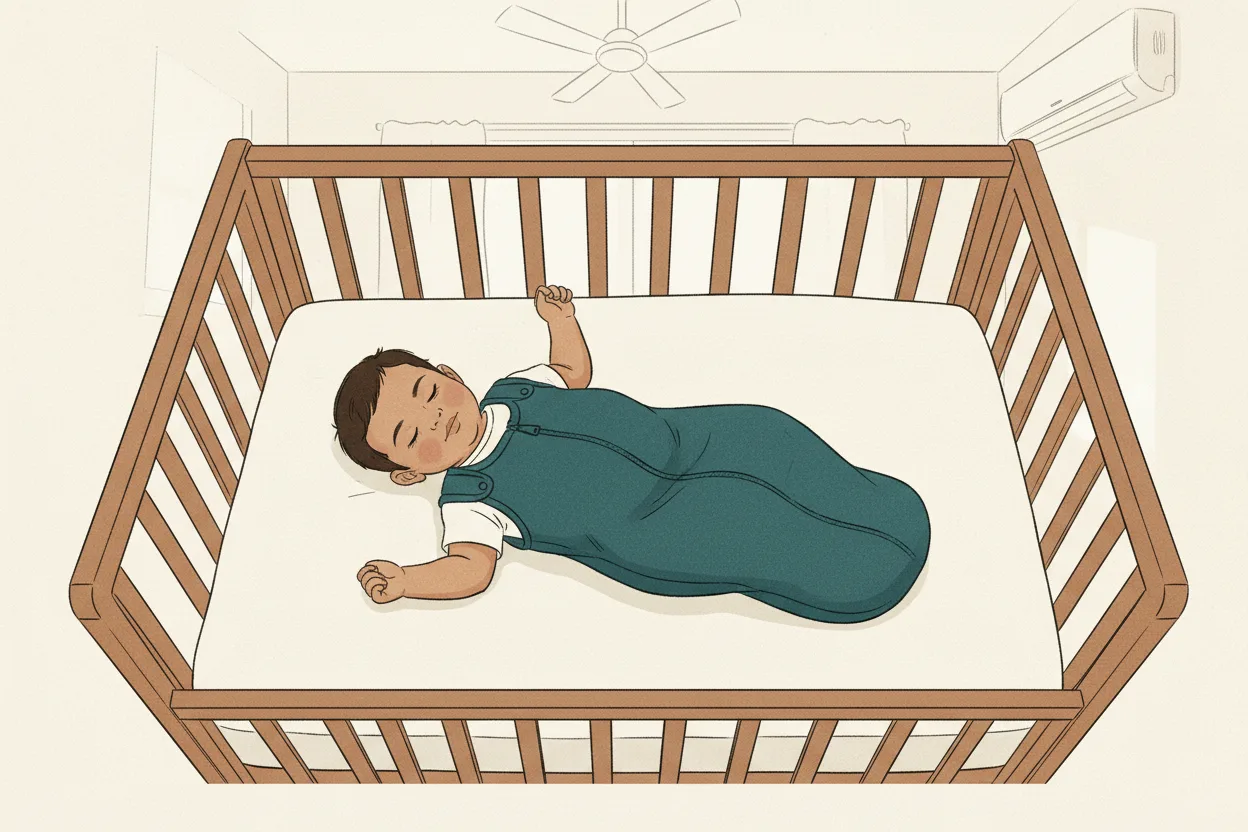
No co-bedding, no bed-sharing, own firm sleep surface, every time — that's what most NICU discharge sheets say, and it's worth following exactly, especially for twins or a baby born early. Here's what the guidance actually means and how to set it up in a home where grandparents, aunts, and visiting relatives are close by and have their own strong opinions.
Not medical advice — follow your NICU or pediatrician's specific discharge instructions for your baby.
Why the India-Specific Context Matters Here
A preterm or twin discharge comes with a stack of instructions, and one of them — "no co-sleeping" — often runs straight into how your parents or in-laws slept their own babies. That advice usually comes from love, not carelessness. But for a baby born early, the guidance from your discharge team isn't a generic caution — it's specific to your baby's situation.
A separate nursery isn't required to follow it. A cot or bassinet in your own room — whether that's a nuclear-family apartment or your space within a larger multi-generation home — is exactly what the guidance below asks for, and it's a setup either parent can manage at 2 a.m., not just mum.
Why Twins Can't Share One Crib
If you came home with twins, the instruction to give each baby their own cot is not extra caution — it's the specific rule for multiples. A peer-reviewed study citing AAP policy states that the AAP recommends separate sleep areas be provided for multiple-birth infants, and that cobedding — placing twins in the same crib — should be avoided both in the hospital and at home. It's tempting to keep twins together in one crib since that's how they shared space before birth, but each baby needs their own firm, separate sleep surface from day one.
The Setup Doctors Actually Mean by "No Co-Sleeping"
"No co-sleeping" doesn't mean baby sleeps far away — it means baby's own firm sleep surface, positioned close to you. The AAP states that the risks of sharing a sleep surface with someone else increase 5 to 10 times when the infant is under four months of age, is sharing the surface with someone other than a parent, or is preterm or low-birthweight — regardless of other factors. That's exactly a preemie or twin's situation in the first months home, which is why the "own surface" rule is stricter for your baby.
The upside is that closeness and safety aren't in conflict. The AAP recommends room-sharing — baby's own cot or bassinet in your room, not your bed — because it can decrease the risk of SIDS by as much as 50% and is much safer than bed-sharing. That's the version of "baby near me" your discharge team wants: a bassinet at arm's reach from your bed, in your room, for at least the first six months.
Two more pieces from the same guidance matter every night, not just the first one:
- NICHD's Safe to Sleep campaign states that baby should always be placed on their back to sleep, for naps and at night — this is true even after a growth check confirms your preemie has caught up in weight.
- NICHD also states that a baby's sleep area should be kept free of soft or squishy items — pillows, stuffed toys, and crib bumpers — since these pose entrapment and suffocation dangers. Skip the padded "welcome home" crib sets relatives love to gift; a bare cot with a fitted sheet is what the guidance calls for.
Skin-to-Skin Time Is Not the Same as Co-Sleeping
Family will often push for daytime cuddling and closeness, and that instinct is actually backed by strong evidence — it's just a different thing from where baby sleeps at night. WHO's guideline states that kangaroo mother care — continuous skin-to-skin contact — should be started as soon as possible after birth for preterm or low-birth-weight infants, as a strong recommendation backed by high-certainty evidence. That's a supervised, awake-parent activity done sitting up, chest to chest — grandparents can take a turn too. For actual sleep, baby always goes back to their own firm, flat surface, unsupervised.
Reducing Risk Further, Night and Day
A few more pieces of the same evidence base are worth building into the routine from the start:
The AAP recommends offering a pacifier at nap time and bedtime, since this helps reduce the risk of SIDS. The NHS advises that overheating increases the risk of SIDS, and that babies can overheat from too much bedding or clothing, or from a room that's too hot — worth watching if you're keeping the room warm for a preemie, since a fan or AC set to a comfortable temperature beats heavy layering. And the Lullaby Trust notes that breastfeeding lowers the risk of SIDS, and any amount helps.
Tracking Growth: Use Corrected Age, Not Birth Date
Relatives comparing your baby to a full-term cousin born the same month is one of the more stressful parts of this stage — and it's comparing the wrong number. HealthyChildren.org (AAP) explains that for about the first 2 years, using your baby's corrected — or adjusted — age gives a better idea of when they should reach common developmental milestones, rather than their age counted from actual birth date. It's a useful, evidence-backed line to have ready the next time someone asks why baby "isn't doing X yet."
What's Worth Buying
| Product | Price Range | Where to Buy |
|---|---|---|
| Bedside bassinet / co-sleeper cot | Rs. 4,000 – Rs. 12,000 | Amazon.in / FirstCry |
| Second cot/bassinet for twins | Rs. 4,000 – Rs. 12,000 each | FirstCry |
| Firm cot mattress + fitted sheets (no bumpers) | Rs. 1,200 – Rs. 3,500 | FirstCry |
| Room thermometer/hygrometer | Rs. 300 – Rs. 900 | Amazon.in |
| Orthodontic pacifier (preemie size) | Rs. 150 – Rs. 500 | Amazon.in |
Skip bumper sets, positioners, and padded nest inserts regardless of how they're marketed — they add nothing to safety, and the padding is exactly what the guidance above warns against.
Frequently Asked Questions
Can my twins share one crib to save space and keep them comforted? No. The AAP recommends against it — separate sleep areas should be provided for multiple-birth infants, and cobedding should be avoided both in the hospital and at home. Give each baby their own firm sleep surface, positioned as close together as you like.
My mother-in-law wants the baby to sleep in her room some nights so we can rest. Is that okay? Keep baby's own cot or bassinet with you rather than moving it to another room. The AAP recommends room-sharing with baby's own sleep surface in the parents' room for at least the first six months, because it lowers SIDS risk by as much as half. Family can absolutely help by taking daytime naps or skin-to-skin turns so both parents get rest at night.
Is holding my premature baby skin-to-skin the same as letting them sleep on my chest? No — one is supervised daytime contact, the other is unsupervised sleep. WHO recommends starting kangaroo mother care (continuous skin-to-skin contact) as soon as possible for preterm or low-birth-weight babies, done while you're awake and upright. For actual sleep, baby should always go back to their own firm, flat surface.
Is bed-sharing ever fine for a preemie once they're a bit bigger? The added risk is specifically tied to being preterm or low-birthweight. The AAP states that bed-sharing risk increases 5–10 times when a baby is preterm or low-birthweight, regardless of other factors — so it's worth checking with your pediatrician before assuming that risk has passed, rather than guessing based on weight alone.
Will my baby catch up to other babies their age? Most preemies do, on their own timeline. The AAP explains that for roughly the first two years, tracking your baby's corrected age — not their birth date — gives a more accurate picture of when they should hit developmental milestones.
Does breastfeeding actually make a difference to sleep safety? Yes, alongside everything else here. The Lullaby Trust states that breastfeeding lowers the risk of SIDS, and any amount of breastfeeding helps — it's one more reason to get feeding support early if your preemie is having a hard time latching.